Sony 4K camera coming under $5,000 ?

From what I've heard from people in the know, that's likely a fairly safe bet

I've been encouraged by your subtle (NDA inference) comments regarding the GH system.
I did what I never thought I would a few months ago and built a new kit around the GH3 - MFT lenses, small heads, tripods, jibs etc. and for so much of what I produce, I've really become enamored of the small form factor and the quality we pull from the GH3.

When I shoot with bigger cameras and have to utilize bigger everything, I really miss the new paradigm.
I'm really looking forward to what a next generation GH could bring.
At this point, I'm really impressed with about everything the our GH3s deliver.
 
Back to the leaked Sony. It will be Quad 4k, not cine 4k, since the leaked XAVC/S recording wrapper is a variation that supports only Quad 4k.

I have no idea why they called it CAVC/S in the leak.

XAVC/S supports both 8 and 10 bit, 4:20 and 4:2:2. So, no idea what the cam will deliver, but most likely the lower end of that range in order to protect the "pro" series.
 
Last edited:
Back to the leaked Sony. It will be Quad 4k, not cine 4k, since the leaked XAVC/S recording wrapper is a variation that supports only Quad 4k.

I have no idea why they called it CAVC/S in the leak.

XAVC/S supports both 8 and 10 bit, 4:20 and 4:2:2. So, no idea what the cam will deliver, but most likely the lower end of that range in order to protect the "pro" series.

Possibly it was called CAVC because the X and C are right next to each other on a keyboard? Simple mis-type?

Since this seems to be marketed as a prosumer cam, I don't expect much from the codec. Still, I'll take Quad 4. Just not sure what I can edit it on or where I can view it.
 
'Man of experience' www.hdwarrior.co.uk wrote on his blog (29th Aug).. "As for the 1/3″ sensor, no one has let that cat out of the bag yet but logic tells you that you won’t be able to produce a 4K image from a 1/3″ sensor so I am banking on a minimum APS-C or a Super 35mm sensor."
 
Not with the zoom range they're talking about. No way.

My bet would be that it'll be along the lines of the JVC 1/2" 4K camera. We know that JVC is already offering a 4K system based off a 1/2" chip, so we further know that a 1/2" chip already exists on the market. And this camera looking somewhat similar to an EX1, would imply that 1/2" was a reasonable chip size for it.

A 2/3" 20x zoom isn't feasible in the form factor they're showing.

So -- if I had to bet -- at the price point, with the zoom range they're claiming... it's likely a 1/2" chip.


The JVC has a 10X zoom. I don't know how Sony can get a 20X zoom on a 1/2" chip. And the body of the new cam is close to the Sony AX2000, even down to the 20x zoom lens, and it's a 1/3" cam.

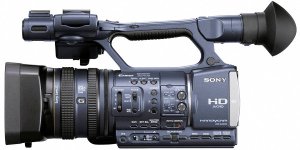
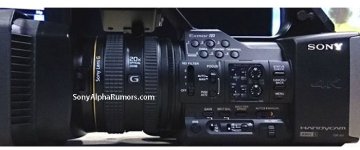
ax2000cs.jpgFDR-AX1_zps414caf17.jpg

I realize this is supposed to be the image of the FDR-AX1 (on the bottom), but it's also been identified as the PXW-Z100, perhaps erroneously. Or maybe they're the same camera??
 
Hmm. You make a compelling case. Certainly it's much easier to get a 20x zoom from a lens that covers 1/3" than from one that covers 1/2".

Not sure how practical a 4k 1/3" chip is going to be though. Maybe they're using 2k chips and spatial offset to deliver the 4K resolution; that would be more practical than trying to cram 4096 tiny 1.3-micron pixels on a 1/3" chip...

Either way, we don't have long to wait to find out what they're planning.
 
Not sure how practical a 4k 1/3" chip is going to be though. Maybe they're using 2k chips and spatial offset to deliver the 4K resolution; that would be more practical than trying to cram 4096 tiny 1.3-micron pixels on a 1/3" chip...
Apart from the size of the chip and how many pixels, then are we talking about 1 or 3 chips? Spatial offset must mean 3 chip, but how feasible is 3 chip 4k, certainly at this price point?

If it is 3 2k chips with spatial offset, then my own feeling would be the end result would be nowhere near good enough to really classify as putting a "4k" badge on the side.
Either way, we don't have long to wait to find out what they're planning.
Agreed!
 
Well, I don't think optically it's possible to deliver 4K on a 1/3" chip. You'd be looking at pixels that are about 1.3 microns square. The diffraction on such a product would be horrible, and probably start at about f/1.4. Just doesn't seem optically or physically possible.

On a half inch, you've got some more room, you'd get pixels that are about 2 microns. Those are absolutely tiny as compared to today's norm of 5 to 6 microns, and so low light would be assumed to be much worse, and I'm not sure that you'd get decent resolving power out of it. I don't know of anyone who's tested the JVC HMQ10; maybe it delivers fine performance, but it SEEMS like it's just asking too much. However, the JVC is the same price point as the Sony, and that would seem to imply a roughly comparable level of technology. I can't see Sony offering a 2/3" product with a longer lens for the same or less money as JVC charges for a 1/2" product with a shorter lens, that doesn't seem likely.

A 2/3" chip on 4k gives pixels that are big enough to consider as a more viable option. But then you start getting into lens issues -- a 20x 2/3" lens costs around $5,000 by itself, so I just can't see Sony offering a built-in fixed 20x zoom lens for a 2/3" camera, for a total package price of $5,000.

So that makes me think it's got to be either a 1/2" chip, or 1/3". And the picture above makes me lean all the more to 1/3". But, as said in the first paragraph -- is it even possible? The Red One put 4K on a 35mm-sized chip. The 1/3" chip is about 1/25 the size of a 35mm film chip, and that means (inescapably) pixels that are 25 times smaller than a Red One's. I don't know how that could be done effectively.

Which is why I thought of the pixel-shift idea. If they do that, they could get somewhere around a 3K image's worth of detail, out of existing-technology 1/3" 1080p chips, without the issues of diffraction that you'd get on a full 4K 1/3" chip.

Seems like a reasonable approach, if not ideal, but I don't know that the ideal is even physically possible now or ever -- there's only so small that a wave of light gets, and a 1-micron photosite might be too small to be able to even effectively capture it...
 
But then you start getting into lens issues -- a 20x 2/3" lens costs around $5,000 by itself, so I just can't see Sony offering a built-in fixed 20x zoom lens for a 2/3" camera, for a total package price of $5,000.
A 20x 2/3" lens may cost $5,000 if it's the normal f1.8, but not if it's a much smaller aperture. In terms of low light ability you're then back to square one - all else equal an f4 lens for 2/3" should give the same performance as f2 for 1/3". (And I'd expect them to be similar sizes.)
Which is why I thought of the pixel-shift idea. If they do that, they could get somewhere around a 3K image's worth of detail, out of existing-technology 1/3" 1080p chips, without the issues of diffraction that you'd get on a full 4K 1/3" chip.

Seems like a reasonable approach, if not ideal, but I don't know that the ideal is even physically possible now or ever -- there's only so small that a wave of light gets, and a 1-micron photosite might be too small to be able to even effectively capture it...
Since the wavelength of light is only about half a micron (depending on colour) then yes, 1 micron photosites may be starting to give the laws of physics trouble! :)

Don't get me wrong, I find the pixel shift idea interesting and agree with most of your other reasoning above, but you'd only get 3k if it was horizontal pixel shift only. If it was a combination of H & V I wouldn't expect anything like that good a result, probably more like 2.4K. If that's what Sony were trying to market as 4K, I'd be very unimpressed. They could do just H pixel shift with 1920x2160 chips I suppose? But even then it's only 3K horizontally which isn't that impressive.

(The theory I've heard for the resolution improvement predicts an overall improvement of about 1.5x for luminance resolution when pixel shift is used, but that's TOTAL. Apply it to both axes and it equates to about sq rt 1.5 on each axis - about 1.2x improvement per axis.)

I think a single 2/3" sensor of 3840x2160 with something like an f4 lens is more likely, but that's just a guess.
 
Last edited:
...and allow the FPGA to be hacked to permit CineForm RAW encoding (to be output over the HDMI port).

Why put up with that? Are we seriously not over the crippled-firmware thing yet? There is a $1k camera that can handle onboard raw (or will, I guess, if the next firmware update goes as planned). If they spent one red cent on R&D, Sony/Canon/etc could ABSOLUTELY, ABSOLUTELY do the same. There is no more excuse for not being able to get a decent codec without a frankenrig.
 
A

I think a single 2/3" sensor of 3840x2160 with something like an f4 lens is more likely, but that's just a guess.

If this is possible, then it might be the best option. It'd be rather slow, but for that 20x zoom, you'd have to make some kind of concession.

But if it were a 2/3" chip, wouldn't a 10X zoom make a lot more sense? It'd still have a usable zoom range, with a more practical chip size for 4K.
 
Why put up with that? Are we seriously not over the crippled-firmware thing yet? There is a $1k camera that can handle onboard raw (or will, I guess, if the next firmware update goes as planned). If they spent one red cent on R&D, Sony/Canon/etc could ABSOLUTELY, ABSOLUTELY do the same. There is no more excuse for not being able to get a decent codec without a frankenrig.
I agree with you. Considering my other requests, I was simply trying to cut them some slack. And, given that no Sony camera at any price yet records 4K without an external recorder, I think it unlikely at the $2,500 price point a VG-style 4K camera should be marketed -- that would be at the bottom end.
 
If it is 3 2k chips with spatial offset, then my own feeling would be the end result would be nowhere near good enough to really classify as putting a "4k" badge on the side.

Nothing would suprise me. How long did we play the "is it really HD?" game at the beginning of the HD era? What they bring out it will not be what you want a year or two from now anyway. Or with 4k maybe never. How well does 4k downsample to DVD :)
 
4:2:0, f1.6-3.4, FF equivalent 31.5-630mm, 1/2.3 sensor (but uses small portion of sensor), three ring control, PCM, minimum illumination 4LUX (no low light camp here),
 
If this thing is using the central 8.3 Mpix out of that 18.9 Mpix 1/2.3" sensor, that's not even a 1/3" sensor.
Which matches the focal length data: if 4.1-82mm becomes 31.5-630mm equivalent, that's a 7.68x crop factor, which means the used part of the sensor is smaller than that on the iphone 5.
3840 pixels in 4.7mm of used-sensor width means 1.25-micron pixels.

Also, my bet: this is the same sensor you'll find in the $250 QX10 smartphone companion.
 
Back
Top