
Navigation
Install the app
How to install the app on iOS
Follow along with the video below to see how to install our site as a web app on your home screen.
Note: This feature may not be available in some browsers.
More options
You are using an out of date browser. It may not display this or other websites correctly.
You should upgrade or use an alternative browser.
You should upgrade or use an alternative browser.
Small form Portable video computer: 4:4:4 video recorder and more
- Thread starter GOODYES
- Start date


Postmaster
Dark Side of the Camera
As a beta tester of Adobe OnLocatioon, I have to say yes and no.
It also supports DVCProHD, one of the most common HD formats in broadcasting.
On the other hand, we (me and some other beta testers) where discussing our as...s of with Adobe, to support third party capture cards like Black Magic, but they turned a pretty cool program into a SD card/metadata organizing application.
That was a disappointing move, because - together with Adobe Story and Premiere it could be the ultimate workflow and timesaver.
So until OL isn´t supporting any capture cards, there is no way of components/SDI/HDMI input - it´s a pretty useless, but still amazing sleeping beauty, with some great potential IMHO.
Frank
Postmaster
Dark Side of the Camera
So, here are some pics of the first prototype.
The official name is SFV (Small form portable video computer)
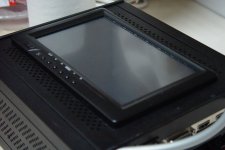

The entry model (HDMI only) is 4:2:2, with a very bright 7 inch monitor and up to 60fps. uncompressed, at a target of 3450 Euros.
The later pro version does 4:4:4.
It can record almost 2 hrs. of uncompressed 4:4:4 or 8.5 hrs in a 300 mbps codec.
Price target for the pro version is in the neighborhood of 5000 Euros - about half the price of a similar Cinedeck.
I´m doing a review when I get a working sample.
As soon as I got more information, I let you guys know.
Frank
The official name is SFV (Small form portable video computer)
The entry model (HDMI only) is 4:2:2, with a very bright 7 inch monitor and up to 60fps. uncompressed, at a target of 3450 Euros.
The later pro version does 4:4:4.
It can record almost 2 hrs. of uncompressed 4:4:4 or 8.5 hrs in a 300 mbps codec.
Price target for the pro version is in the neighborhood of 5000 Euros - about half the price of a similar Cinedeck.
I´m doing a review when I get a working sample.
As soon as I got more information, I let you guys know.
Frank
Last edited:
Postmaster
Dark Side of the Camera

PhantomVideo
Well-known member
Hey Frank, this looks great just to confirm there's a Intensity in there right now ?


nyvz
Veteran
"High bright 450cd 7 inch integrated touchscreen 1920x1080*3 monitor."
Interesting
Anyone know of a manufacturer that makes such a panel? And why does it have such a similar chassis to my 7" 800x480 lcd?
nyvz
Veteran
120w? That does not strike me as battery-power-able at least if camera-mounted. Then again the form factor or active cooling scheme does not seem all that camera-mountable either.
I'd be interested to know what makes this product more than just a custom computer built from off-the-shelf components. It looks a bit like a $500 mini-itx computer with a $150 LCD attached and maybe an extra $300 worth of graphics card and video i/o cards. I'm pretty sure I've seen that mITX chassis and that LCD chassis before. If it is just a $1.5k-2k custom computer then i could understand it just being a smallish computer, but at the listed 3-6euro, I'd hope it has some custom hardware or maybe some really amazing custom software. Custom design would certainly be needed to make something in that form-factor sufficiently ruggedized and silent for production.
Seems to me there is a sweetspot for video capture, something camera-mountable, small, stable, silent, low-power. This seems like it would be too large, big, with too high a power-consumption to hit that sweetspot. If you are not in that sweetspot, you are competing with much more affordable solutions such as a desktop computer with a video i/o card.
Hi,
Do you know what are inside the ninja or inside the cinedeck ?
They are computer based recorders, and the cinedeck is based on W7.
More over, SFV will include fast hard drive/s as per model, by default, and will be proved & tested (we will soon publish an article about "what you need to know prior to buying a hard drive for video purposes").
Regarding SFV, will employ last tech., high performance, including latest intel components.
This means internally are professional components, not consumer htpc or other ones.
The current case is a prototype, production will be a litle bit small and aluminium based.
-EDITED-
Currently proto is consuming 44W avg. Is more silent than cinedeck and currently we are also working on battery solution.
As for capture devices, from entry level HDMI (what we call an entry advanced model) and the more powerful Flagship (SFV) featuring dual hdsdi & 3g.
LCD have resolutions up to 1080P ranging from native res. (up to 1080p is indicated in the bottom of the website). Native is 800x480 as other ones, but at 450cm/2 hight brightness i can tell you that's not a cheap panel.
Did you know about uncoming -until summer or later- new LaCie thunderbolt 700MB/s drive ?
SFV will embedd the same harddrive/s that are on that LCIe 700MB/s model.
The SFV will bring more performace transfer rate than LCIE. Around 900MB/s.
Do you think a labtop or a sub 2k mini computer is able to manage uncompressed hd. video well.
Our experience indicate that not, for professional video you can't.
Do not expect first test until some time, cause actually we are also waiting last video drivers from manufacturers to work with last chipsets, while progressing in our own custom software development.
More news can come from Frank, he will also test the prototype.
We will make fully tests with some camcorders prior to production, including sony F3, panny AF and even GH2.
We want to do business as others, respecting other manufacturers, so we will not fight agains cinedeck or atomos, they are good, very good.
We are a team, and we intend to provide uncompressed right & working solution. (Does any know the difficult that cinedeck have with uncompressed, we know)
Affordable cine, that our goal.
Alejandro.
www.cinemartin.com
http://twitter.com/cinemartin_team
Last edited:
Postmaster
Dark Side of the Camera
I'd be interested to know what makes this product more than just a custom computer built from off-the-shelf components. It looks a bit like a $500 mini-itx computer with a $150 LCD attached and maybe an extra $300 worth of graphics card and video i/o cards.
Remember that we are talking UNCOMPRESSED HD here.
Have you ever recorded uncompressed HD on your computer? You need a pretty fast I/O system for that.
This is nothing like Nija, Aja or Firestore.
There are not much portable devices like this on the market.
The uncompressed Cinedeck had some problems and it´s like $10000.
The next available thing comes from ARRI and costs more than your car.
I was wrapping my head around this since years. A cheap portable, battery driven uncompressed recording device.
The great thing is, it´s actually a computer - so there is much more possibilities than a Nanoflash or Ninja has.
Editing, watching daylies, backups, maybe even sending them over the Internet - who knows what else.
It´s a swiss army knife field computer.
I can see this in the hands of documentary guys, broadcast teams in a war zone and of course also for narrative film making, since the quality of uncompressed material is striking.
Frank
nyvz
Veteran
Hi,
Do you know what are inside the ninja or inside the cinedeck ?
They are computer based recorders, and the cinedeck is based on W7.
The ninja is a computer-based recorder? what platform is it based on? at its size, I imagine it must use some custom boards. This is just a guess, though. Do you have other information on this?
From what I understand the cinedeck is similar to what you are proposing but it clearly uses a custom chassis and some custom components, and I think it uses CineDDR software which is $3k alone.
Regarding SFV, will employ last tech., high performance, including latest intel components.
This means internally are professional components, not consumer htpc or other ones.
The current case is a prototype, production will be a litle bit small and aluminium based.
So the case you show on your website is not at all what the final will look like? I'd just be concerned that you would be alienating an important set of consumers if you use too high-power components that make your device draw too much power or too large. I'm all for better, faster, more stable components and for additional functionality, but I'm interested in understanding how your product balances these factors.
LCD have resolutions up to 1080P ranging from native res. (up to 1080p is indicated in the bottom of the website). Native is 800x480 as other ones, but at 450cm/2 hight brightness i can tell you that's not a cheap panel.
Seems like there must be a better option out there than a 7" 800x480 panel. I used a similar panel on my first miniITX video capture computer in 2005, and have an HDMI one now as a cheap video monitor, but they certainly seem like the budget options since end user products are <$200 with these panels. With the high availability lately of 1024x600, 1280x720 and 1280x800 panels in the 5"-9" range, it seems like a silly thing to skimp on. By the way, you should definitely write the native resolution of the panel in your specs, or else you will mislead customers. Native resolution is really the only spec that matters since any 800x480 panel that can't scale input from standard resolutions up to 1080p is going to be pretty useless.
Did you know about uncoming -until summer or later- new LaCie thunderbolt 700MB/s drive ?
SFV will embedd the same harddrive/s that are on that LCIe 700MB/s model.
The SFV will bring more performace transfer rate than LCIE. Around 900MB/s.
From what I understand those lacie little big disk thunderbolt drives use two Intel 510 Sata3 SSDs raided together. Why would you need more than one? Are you referring to maximum throughput? Intel says they will have a maximum read speed of 500MBps and write speed of 315MBps, so you can do the math on maximum potential RAID0 speeds. Doesn't 10bit Uncompressed RGB 1080/30p run about 233MBps?
Do you think a labtop or a sub 2k mini computer is able to manage uncompressed hd. video well.
Our experience indicate that not, for professional video you can't.
I though uncompressed HD recording/playback was primarily limited by storage bandwidth, and with modern SSDs, it seems like even very low-powered computers ought to be able to manage uncompressed HD. Compressed video is tougher since it require more CPU speed which requires more power and more cooling. That is why most solutions find a balance, with high-bitrate lightly compressed HD video since a little CPU power can go a long way in saving storage space, but too much would require an oversized, loud, device that would be harder to power. I'd be a bit surprised if there was much demand for uncompressed HD recording, given the benefits of lightly compressed HD.
Tony Hernandez
Well-known member
Hi,
Im Antonio, member of GOODYES Team,
The proto show on the website -as of today- is a proto.
SFV will be like a cinedeck, but a litle bit more powerfull, yet with its own software, custom case and pieces.
Allow real uncompressed recording as opposite as the issues found at cinedeck (cause cinedeck uses sata2 and no raid), and also will have HQ. compression recording modes.
1080 60p is twice as 1080 30p data rate, and both uncompressed portable recordings are no possible on todays market models.
Cinemartin's target is to deliver professional solutions.
Proto is the first thing, even a billionaire needs to build, as for test and send to colleagues for more tests prior to production.
Hope the people like it, as for dont see my friend leaving the SFV on the trunk of the memories.
I like Alejandro, his capabilities, his experience as a developer, his talent, and so on. He start over from zero last year, and i think we need to be here to support him.
Postmaster
Dark Side of the Camera
From what I understand the cinedeck is similar to what you are proposing but it clearly uses a custom chassis and some custom components, and I think it uses CineDDR software which is $3k alone.
The Cinedeck uses Cineform
I though uncompressed HD recording/playback was primarily limited by storage bandwidth, and with modern SSDs, it seems like even very low-powered computers ought to be able to manage uncompressed HD. Compressed video is tougher since it require more CPU speed which requires more power and more cooling.
Almost true.
But the whole hardware must be up to transfer those bitrates.
I tried it on several Laptops - no way.
There are too many bottlenecks in Laptops to get a steady data bandwidth for uncompressed HD, let alone 2k.
Even Cinedeck still has some problems.
Frank
Postmaster
Dark Side of the Camera
Here is some news: http://frankglencairn.wordpress.com...very-affordable-mobile-uncompressed-recorder/
Frank
Frank

The cinedeck runs windows xp/7 pro fyi. (Can't remember which)
The owner of cinedeck showedme. You can exit the video interface program, and a standard windows start page is under it.
The owner of cinedeck showedme. You can exit the video interface program, and a standard windows start page is under it.
peterarcson
Carbonite Member
I think the your competition knocks on your door:
http://www.dvinfo.net/news/convergent-design-unveils-gemini-444.html
BTW, I used Nanoflash on a few occasions and I must say the technical support from CD is just amazing.
http://www.dvinfo.net/news/convergent-design-unveils-gemini-444.html
BTW, I used Nanoflash on a few occasions and I must say the technical support from CD is just amazing.
Postmaster
Dark Side of the Camera
I used Nanoflash on a few occasions and I must say the technical support from CD is just amazing.
If you would not need to call the technical support at all - now THAT would be amazing. :evil:
Frank
If you would not need to call the technical support at all - now THAT would be amazing. :evil:
Frank
While I agree with this statement that I'd rather have something that works well so I don't need assistance than something that doesn't, I've come to the opinion that customer support after purchase is an often overlooked feature of many products / brands. No product is going to work 100% of the time 100% of the time, and I've found that the companies I can get someone on the phone (if they're in the US), or a quick e-mail response (if they're overseas) is a HUGE selling point.
I was ready to sell my cheap Davis & Sanford tripod a couple years ago after I got some better sticks, but after dealing with their customer support I've kept the legs as my back up, back up sticks. To me that says a lot, to hold onto a product that I don't need, but I know that the customer support is good enough, that it is worth it to hold onto the legs because of their support.