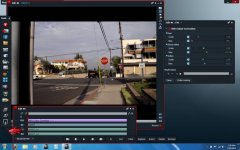
SLOG2 picture profile

Cuervo: sure, sometimes you'll blow out the highlights, as you would expect whatever you rate the camera at, but the muddy shadows will be dealt with when you bring the exposure back down in post. My suggestion is a compromise between making best use of the DR in every situation and giving a consistent exposure of the subject for the grader to speed up the grade in long form work.

You can, of course, rate it at ISO 2000, as suggested, but I find there's too many problems in the low mids and shadows at that rating. With Slog2 you have so much highlight head room, I find it's beneficial to sacrifice a bit of it to pull the mid tones up to the sweet spot of the curve.
 
I have a shoot coming up where we want to light most of the scene with a big bonfire, action happening in front of it and people being mostly in silhouette. Maybe we want to open the dark side up a bit with a 2K tungsten with heavy diffusion far away. Is this a situation where you think using s-log would be beneficial because you don't blow out the fire or will it fall apart because of the darkness around the fire?

This we shot using the AB_range profile:

http://www.colinelves.com/A complex state.html

With fill in the foreground from a couple of LED panel lights and an 800w pancake lantern.

TBH, I think Slog will certainly help keeping the fire from clipping, just use the zebras to pull expsure back so it just clips. But the subjects will most probably be proper sillouhettes without some form of fill. But, in my experience, Slog2 is fairly WYSIWYG in terms of shadow detail. If you can see it on the monitor, you can see it after the grade. If there is noise there, there'll be noise (plus macro blocking) after the grade.

Which is to say: if you want some details in the subjects (not just total sillouhettes against the fire) you'll need some fill, but you'll also get a lot of noise and blocking after you've graded them using Slog2.
 
So, no one has anything to say re: 800% ITU709? Isn't this kinda in between SLog2 and standard encoding? Won't the shadows be less compressed than Slog2, with less range in the hilites, but, less noise in the shadows, too?

edit: just ran a few clips with ITU709(800%). nowhere near the DR of Slog2
 
Last edited:
I haven't had much of a play with 800% 709. I guess the important question is: does it give you more range than one of the older, big DR profiles?
 
So, no one has anything to say re: 800% ITU709? Isn't this kinda in between SLog2 and standard encoding? Won't the shadows be less compressed than Slog2, with less range in the hilites, but, less noise in the shadows, too?

edit: just ran a few clips with ITU709(800%). nowhere near the DR of Slog2

Camera luts have nothing to do with ITU/REC709 or SRGB both of which define the white point, maximum DR and color gamut of a monitor. When you look at an HDTV you are looking at 709. That is what you actually see. The standard defines a maximum linear DR of 10 stops between black clip and white clip as shown on the range of a 0-100% waveform monitor in 10 IRE increments. It says nothing about what your camera footage looks like at all, whether its flat, contrasty, clipped, nicely toned, has smooth highlight rolloff, whatever. Any DR the camera can capture beyond 10 stops has to be compressed to fit within 10 stops somehow to be seen at all. The different camera luts plus how you grade in post (using an ITU/REC709/SRGB monitor as a reference) determine how the compression occurs and what is sacrificed in the process to achieve a finished look. What the camera maker or post software calls a lut is just a name, but I wish they would stop naming them 709 anything. It just confuses people. What you actually see on the monitor is what you get and 100% 709 is all there is when it comes to HD video.
The name 800%709 suggests that it is some form of compression curve for recovering 14 stops of camera DR, but who knows what the shape of that curve actually is?
 
Last edited:
Razzi...

Thanx for your input, but, what does Rec709(800%) have to do with LUTS, as an in camera recording option that came with the SLog2 in v3.00? After a little playing with this recoding mode, it's clear that it has less DR than Cinegamma 4, so, it's a rather useless Preset PP, as I see it. And grading in post requires a somewhat reverse gamma curve than Slog2. So, my comment, above, was just a wild stab in the dark that leads nowhere. Sorry for taking up your time with an explanation, esp. since I don't understand why you made the comments you made.

REC709(800%) is a meaningless term other than as a menu label. There is no such thing. Any video the camera outputs in a standard HD compliant codec is by definition REC709(100%) compliant. Every step of the in camera process that determines how that video is encoded is defined by a LUT of some kind. Those menu options are predefined LUTS. As a video engineer, it is just a pet peeve. Sorry for the rant.
 
Last edited:
Hey Razzi...
I have viewer LUT's to unfold cineon film scans to;
HD@709
P3
Vision@709
Vision@D54/16FL
Vision2@709
Vision2@D54/16FL

Use is dependant upon target deliverables (the LUT's for vision print stock are specfic to the filmout facility and lab)

The nameing is sensiable if you have more than one target, and related viewing options

d
 
Why would Sony include a PP labelled Rec709(800%) in their v3.00 upgrade? Of what use is it, except that it takes up one PP setting?
 
Its a sony naming. Its a hypergamma. 800% more DR ... 6 stops over 18% grey, very similiar to slog2 which is btw 1300%. It has nothing to do with rec709 100 or 109%. Its just the reference to 18% and the value of reflectance.
 
which was exactly my reasoning, Skylike. But, testing that profile out produced a very wide histogram. So wide, that, in fact, I was blowing out the high lights and the shadows, all at once. Briging the shadows up pushed the highs into never never land. And bringing the high lights down crushed all the darkest blacks. Hardly a scientific test, I know, but not suggestive of anything useful as profiles go, except, perhaps, a scene with low dynamic range.
 
Hey Razzi...
I have viewer LUT's to unfold cineon film scans to;
HD@709
P3
Vision@709
Vision@D54/16FL
Vision2@709
Vision2@D54/16FL

Use is dependant upon target deliverables (the LUT's for vision print stock are specfic to the filmout facility and lab)

The nameing is sensiable if you have more than one target, and related viewing options

d

That makes sense, and for DI systems that use DCI-P3 calibrated projectors or monitor emulations that let you see what the end result output will be in non HD formats like DCI. But for HD video there are only two relevant color space standards REC/ITU.B709 and sRGB. Both are referenced to the D65 white point, DR and color gamut performance characteristics of an analog C-phosphor CRT display and look the same on properly calibrated monitors.

We use three different monitors and two different systems for video and photo editing. My wife Suzy uses a 2011 model 27"iMAC loaded, I'm currently using a Toshiba Win 7 64bit laptop with 8-bit Radeon HD graphics chips to an external LG IPS sRGB monitor and we use an 10 bit LG XYcc deep color consumer LCD TV as a third reference. The iMac has been changed from the default Apple 1.8 gamma color space to 2.2 gamma sRGB in its monitor LUT tables and all three displays are calibrated to SMPTE standard grey scale and color test patterns and checked against an X-rite/Macbeth color chart. All three displays look pretty much identical. Our Epson printers use an sRGB ICC profile, so print colors and value scales come out very much the same too.

Most of us are not finishing for DCI or film out, but trying to emulate film like images in HD with digital video cameras. The camera luts give us different options for that, but we are delivering to the same HD color spaces.
 
which was exactly my reasoning, Skylike. But, testing that profile out produced a very wide histogram. So wide, that, in fact, I was blowing out the high lights and the shadows, all at once. Briging the shadows up pushed the highs into never never land. And bringing the high lights down crushed all the darkest blacks. Hardly a scientific test, I know, but not suggestive of anything useful as profiles go, except, perhaps, a scene with low dynamic range.

Isn't this what it's specifically good for? If you have a very narrow latitude image, say for example a grey sky, you can capture the most with this PP?
 
I could be wrong, but I thought the purpose of 800%709 was to provide a profile that would be broadcast compliant without grading but still cram a few extra stops of latitude into that 10 stop range.
 
Don't forget that the only reason the FS700 has these other SLog and 800% modes is for monitoring RAW recording. The fact that we're bending them to use in day to day shooting was not their intended purpose, just a side effect. I don't think sony would officially endorse using SLog in 8bit for day to day capture jobs.

The RAW output is Linear, no curves available or needed.

It might be the case that the O7 produces 10bit log encoded results but that flavour of log encoding is up to CD, it may not be SLog, it's just a way to squeeze 12 bit linear into a 10 bit container in a way that makes sense. It doesn't really matter so long as we know the flavour of log.

On other cameras these 800%709 dictate a 10 bit capture, then it all makes sense.

I'm hoping to grab some time in the next few days to put a 700 and 100 side by side and try these profiles with a transmission wedge so i can really quantify and understand where the data is stored. I'll write up the results and post them (time allowing!)

cheers
Paul

I disagree. Slog emulates the response curve of film negative. It provides a very extended linear value response from 100IRE down to about 25 IRE then compresses the low end of the DR range into a logarithmic progression curve between 20 and 0 IRE. This gives a very creamy gradual roll off character to the highlights and a steep roll off in shadow values at the low end sacrificing deep shadow detail similar to the way film negative responds to light. It doesn't grade easily in the native 8 bit AVC codec because the data doesn't exist to make maximum use of the fine tonal scale it can produce. But recording to an external deck in a less compressed 4:2:2 or 4:4:4 10bit codec does give the data depth needed.
This is a sample from the 8-bit AVC that I played with and you can actually get decent results if you don't push color saturation too far and adjust values for a smooth gray scale with moderate contrast. I pushed color sat right to the limit with this grade and you can see color bleed in the stop sign. These luts aren't just for monitoring, but provide different encoding value ranges for the sensor DR to achieve different looks.

9412510606_0f879a3f4b_o.jpg
 
Last edited:
I disagree. Slog emulates the response curve of film negative. It provides a very extended linear value response from 100IRE down to about 25 IRE then compresses the low end of the DR range into a logarithmic progression curve between 20 and 0 IRE. This gives a very creamy gradual roll off character to the highlights and a steep roll off in shadow values at the low end sacrificing deep shadow detail similar to the way film negative responds to light. It doesn't grade easily in the native 8 bit AVC codec because the data doesn't exist to make maximum use of the fine tonal scale it can produce. But recording to an external deck in a less compressed 4:2:2 or 4:4:4 10bit codec does give the data depth needed.
This is a sample from the 8-bit AVC that I played with and you can actually get decent results if you don't push color saturation too far and adjust values for a smooth gray scale with moderate contrast. I pushed color sat right to the limit with this grade and you can see color bleed in the stop sign. These luts aren't just for monitoring, but provide different encoding value ranges for the sensor DR to achieve different looks.

Well the bad news is that the FS700 only outputs 8 bit to external decks. I'm well versed what the benefits of log encoding are but on the stock FS700 you're not going to get more than 8 bit out of those ports, even if it's put into a 10 bit wrapper.

The only higher colour depth source is via RAW recording.

Within the 8 bit scale the top 100 values handle the 90% highlight and up. And as you say the bottom of the curve is super compressed. As i mentioned before there are some places where shooting and keeping the highlight values in detail can be useful, but as an everyday all over option it isn't going to work, unlike, say SLog on the F3.

Also AFAIK SLog isn't about film emulation at all, it's about mathematical compression of the linear light levels into a container that spreads them in steps that our vision system uses the best.

cheers
Paul
 
Well the bad news is that the FS700 only outputs 8 bit to external decks. I'm well versed what the benefits of log encoding are but on the stock FS700 you're not going to get more than 8 bit out of those ports, even if it's put into a 10 bit wrapper.

The only higher colour depth source is via RAW recording.l

Hmm.. Would it mean that CD's claim of Odyssey7Q recording 4k off the FS700 in 10 bit 422 is only partially true?
 
Hmm.. Would it mean that CD's claim of Odyssey7Q recording 4k off the FS700 in 10 bit 422 is only partially true?

Paul's mention of 8-bit in a 10-bit wrapper only applies to when the camera is set to output HD from the SDI port. If you set the camera to output 4K, then it's sending 12-bit linear RAW out of the port. It's the 12-bit signal that the 7Q is using to achieve the 10-bit 422.

But Paul is correct - if the FS700 is set to output HD, then it'll only ever be 8-bit.

Furthermore, the FS700 always records 8-bit to the internal SD card - no matter what you set the camera to output from the SDI port.
 
Back
Top