Shoulder Rig questions...

Rick Burnett

Section Moderator
I am relatively new to the world of shoulder rigs. I know there is a lot of personal opinion about what is good or not good. That said, I just wanted to get some thoughts as I evaluate different shoulder rig options.

1) I have seen a variety of weight systems for the back, including some with no weight system at all. Some systems seem to be heavy enough on the back that you could almost balance the camera on your shoulder. Some seem to be just enough to keep the camera from jumping up and down on your shoulder. Do people look for both of these things? Traditionally, how should the weight be distributed?

2) I see some systems with the hand grips up near the bottom of the camera. Then some with long extension arms to keep the arms at the side while filming. Is this for fatigue in the arms? I can see the higher grips being useful so you could tilt the rig lower if you wanted without having to move your arms behind you too far. What do people look for in this?

3) I see some systems where the sensor inside the camera would be right next to a persons head. In other systems, I see the camera further away. It would seem to me, the closer the lens is to your head, the slower the pan will be and the better the shot.

Just want to get some opinions as I customize my rig. Thanks!

Rick
 
I come from a traditional ENG camera orientation (as well as the similarly designed CP-16 and Arri SR 16mm cameras), and definitely prefer the center of gravity to be right over the shoulder. That makes it balance neutrally for the most common straight-ahead shooting, so you have to put the minimum amount of muscle into it to point the camera. Letting your body stay relaxed is the key to steadiness, so anything that you have to apply pressure to in order to aim or stabilize the camera will sooner or later show up as shakiness in the footage. Overall weight is very important to keeping relaxed too, so I wouldn't want to use added dead weight to achieve this, but if mounting the battery or mic preamps or something on the back of the rig helps balance it better, then that's definitely the way to go.

This is probably more a matter of taste and experience, but those low-mounted grips look wacky to me. I'm used to having my right hand strapped to the side of the lens to stabilize the front of the camera and operate the servo zoom rocker, which leaves my left hand free for the focus ring. So I'm stabilizing the camera with both hands and bearing almost all the weight on the shoulder. At times I don't have to work the focus ring, I often bring my left hand up to the front of the viewfinder, which I find a better place to rest it. So if I were adding handgrips to a rig, I'd probably put them at or only a little below lens height, and almost parallel to the ground.

But a lot of this may be a matter of individual taste, conditioning and ergonomics. I'm basically flabby and lazy by nature and am now getting old and stiff as well, and tend to prefer the lowest-energy ways of doing things!

For the most neutral-looking movements, you'd probably want the camera to always pivot around the nodal point of the lens, which is about where the iris is located in most designs. But that is way too far forward to be consistent with balancing the camera on your shoulder at all, so I think it's hardly ever done that way. But having the sensor back by your head gets you closer to that ideal.

- Greg
 
Last edited:
Thanks for that detailed response Greg, I really appreciate it. Most of the shoulder rig manufacturers really don't give you any details on the usage of their systems, or practices and such. Looking through the HUGE number of systems out there, I see a lot of difference. When I shot last weekend, my rig was too front heavy. My FS100 too far forward. Too much strength required to keep the camera in position and I just kept telling myself, this is NOT right.

The biggest problem for me is I am tall. For this reason, I wanted to undersling my camera below the rig on my shoulder. The problem with this method is that it places the camera too far forward. I think I am going to have to move it backwards and then just have it up on my shoulder more if I want the system to be comfortable. I also think the weights i am using are not heavy enough. Some more experimentation will be in order!

Again, thanks! Great information!
 
I agree with Greg on most of the points - especially when extra weight is added to get a better balance.Why make it heavier? Some people say, that it gives it smoothness...
Rubbish! If you relax your body - as Greg suggested - and even practice your shot a few times - you will get it bang-on. To my taste - the camera's rig will be so balanced that when you let go off your hands - it should just sit there.(Try this ONLY at home over the mattress) The problem with most rigs is - they have the camera front heavy - and I don't care how fit you may be - after 10 minutes you will tire and your shot will get ruined. I did try a FS 100 - and the center of gravity seems to be near the front.
And the viewfinder at shoulder position is useless - so I had to use an add-on one.
 
I definitely agree. This is something you learn the first time you take your camera out. :) I shot for a few hours and I work out twice a week, so I am in shape. Still, just the rotational pressure on my back alone was to much to me. I think having the camera balanced is really the best thing. Sure, weight WILL help if you are moving to keep it from bouncing on your shoulder, but having it balanced means so much less effort will be required to work with it. When your arms start shaking, that is just NOT a good thing.
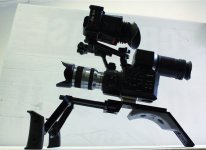
 
This is what I used - you can see, that the shoulder pad can be moved forward another inch or so - but there was a battery pack on the back plate - which ballanced things well.


FS1oo.jpg
 
Nice! I saw that in another post talking about the F3 a few days ago.

One thing that annoys me, on a side note, is I wish I could duplicate EVERYTHING from the onboard LCD to the HDMI port. I want to see 2x focus assist, zebras and focus in red on HDMI, put I cannot figure out how to get it there.
 
"I could duplicate EVERYTHING from the onboard LCD to the HDMI port. I want to see 2x focus assist, zebras and focus in red on HDMI, put I cannot figure out how to get it there. "

Rick, I am told - you can. This means - going to the store and handing your wallet to the man behind the counter.There are many electronic viewfinders that take the signal from the camera and display it on their screen. Depending on the thickness of your wallet - they can do a lot of things (short of serving food and beverage).
 
The camera is not outputting the information, so I'd have to use an LCD that recreated those functions. My smallHD LCD does have feature overlap, but I'd like to use what is in the camera that it is not displaying out the HDMI.
 
I'm still waiting for my camera (heading this way from B&H), but I was reading the manual online. Have you looked at the "Display Output" option on P78? That doesn't do the trick?
 
I'm used to having my right hand strapped to the side of the lens to stabilize the front of the camera and operate the servo zoom rocker, which leaves my left hand free for the focus ring. So I'm stabilizing the camera with both hands and bearing almost all the weight on the shoulder.

- Greg

This has been bugging me for a while. I think the design of nearly all these 'shoulder rigs' is wrong. 2 handgrips and no way to control the camera without letting go of one of them.

I want to buy some bits and try something - with a double shoulder mount and weight on the opposing shoulder to balance the rig and bring the centre of gravity back to the centre of your chest, you should end up with a a rig that you can 'let go' - you have both hands to control the camera.

product.php
product.php
product.php
http://www.handyfilmtools.com/new/product.php?id_product=11

this is a bit expensive just to test but I think the idea really has merit (apart from the 2 handgrips) Have you ever seen a pic of a shoulder mount where the operator is actually controlling the camera as opposed to supporting it?
 
Last edited:
I think the double shoulder support has a lot of merit. My main objection to that specific rig would be their use of extra dead weight (the steel weights) to bring it into balance; as I said before, I'm convinced that extra weight of any kind brings on fatigue and shakiness sooner. Now you do have to consider that comes from my own experience where I've often had to walk around with the camera on shoulder and ready to shoot for 8+ hours at a time. In a more formal situation you would seldom have to do that for so long without a break.

Although it's in some ways a much lower end camera, I'm liking my Panny HMC80 for those all day shoots because it is much lighter than the Ikegamis and Betacams I grew up with. The balance on the shoulder pad out of the box is lousy, way too front-heavy, but I added the Anton Bauer battery plate on the back and with a big brick back there, it's just about tolerable (and runs all day without changing batteries). About 10 pounds total mass on the shoulder that way.

- Greg
 
"This has been bugging me for a while. I think the design of nearly all these 'shoulder rigs' is wrong..."

tired, there is no ideal rig that will do everything for every camera AND be cheap - it's not a condom - "one size fits all" sort of thing.
90% of the time you have to lug it trough airports - in the bag or a case, and extra weight of any kind is 'dead' wight and extra room for it.
You can try and make one - and than I will ask you to sell it to me for $100...
The trick is to find one nearest to your liking - maybe even modify it a bit - and get used to it - in a few years - you will have to change anyway.
 
One thing to consider is that a lot of these cameras are just really light. The lens ends up being so heavy that we need to add weight unless we want to push the camera too far back. Look at the Alexa which is 16lbs without a lens! I will agree that adding weight that is useful is the BEST path I feel as well. Sometimes for me that is not practical.

I hadn't considered the dual shoulder system, I am going to think about that more, but I agree that one of the problems is, the more unwieldy the rig gets to move around not on your shoulder, I've found it a pain to transport and/or have to take it all apart to move it.

I think the dual handles is a lot to do with too much forward weight. Now that I am experimenting with really getting the weight backwards on the system, I am going to try and do 1 handle. That may require multiple shoulder support to make it work the best.
 
As far as the dual handles, you should look into something that (1) balances a weight behind your shoulder, on your back, to center the weight more and also (2) having a leg that braces from the rig to rest on your waist belt - that will free your hands to a degree.
 
Back
Top