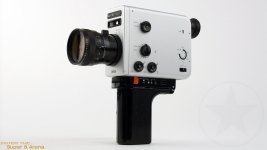
Short shot on film 'The Lady Killer' 03:27

Egg Born Son

Veteran
Finally something I can share! I was DP on this film (and technically editor). And I can say film because this is my first outing shooting on film (super 8) and after years of technical comparisons and pixel peeping re: digital vs film, it all goes out the window. There is something magical about film. Whether it offsets the inconvenience is another argument but I'm on the side of the stalwarts now.

Made for the Revel8 film festival, the rules were: 1 reel, edit in camera, submit undeveloped film and see it for the first time at the festival. The wait was excruciating! The filmmakers and composers also did not meet until the festival screening. The composer did a wonderful job, I was ecstatic with the soundtrack.


Braun Nizo 561macro
Kodak 7266 Tri-X reversal
lit with Kino flos & Arri redheads
 
Last edited:
Considering editing in camera, pretty damn good! Did it win anything?

Also what frame rate was it shot at, I didn't see the odd motion artifacts that come from the 18fps from super8 days of old?
 
Thanks. We won best soundtrack, which I certainly agreed with. I was absolutely thrilled with it. I didn't get to have any contact with the composer until after the screening but will certainly be hitting her up again in the future. I think our story could have done with an extra moment of escalation in the middle but the music created such atmosphere I think we got away with it. We've been getting some great feedback and some 250 views in 24 hours which is about equal to the entire rest of the competition (and more than attended the screening) so we must have done something right.

It was shot at 18fps. Not sure what youtube is playing back at, I assume 24fps. I didn't upload this video, I'm still waiting to get the original film and 2K telecine transfer before I can do my own upload to vimeo.
 
YouTube or the transfer they did was pretty good, the motion was even good so I assumed you must have been running at 24fps. The camera looked nice and tight on the start and stop, looked like it worked pretty well. Too bad film production has just about slipped into the tar pits, all that nice 8mm equipment out there begging to be used.

Did you record any dialog thinking to sync it later or was everything done silently?

And, I didn't think 8mm held up well enough for 2k scans, if it does it should still be a viable source, especially if some of the old cameras can be modded for faster frame rates. I wouldn't mind fooling with an old camera once in a while at a more standard frame rate. I'd probably build myself one of the open sourced DSLR based digitizers and get some really good close focus lens or filter diopters.
 
If you realy think what you said[Finally something I can share! I was DP on this film (and technically editor). And I can say film because this is my first outing shooting on film (super 8) and after years of technical comparisons and pixel peeping re: digital vs film, it all goes out the window. There is something magical about film. Whether it offsets the inconvenience is another argument but I'm on the side of the stalwarts now] so be it but i cant think how anyone can think that quality nice good or pleasing,clearly some do,i once used super 8 so i am allowed a fair comment.
 
YouTube or the transfer they did was pretty good, the motion was even good so I assumed you must have been running at 24fps. The camera looked nice and tight on the start and stop, looked like it worked pretty well. Too bad film production has just about slipped into the tar pits, all that nice 8mm equipment out there begging to be used.

Did you record any dialog thinking to sync it later or was everything done silently?

And, I didn't think 8mm held up well enough for 2k scans, if it does it should still be a viable source, especially if some of the old cameras can be modded for faster frame rates. I wouldn't mind fooling with an old camera once in a while at a more standard frame rate. I'd probably build myself one of the open sourced DSLR based digitizers and get some really good close focus lens or filter diopters.

Yeah, pretty happy with the transfer. I don't know what pull down was used. I'll have to get in contact with the telecine guy.

Using a dead man's trigger to operate the camera was a very different experience. During the shoot I worried that I was coming off each shot too early, had a real itchy trigger finger and I got spooked real easy. My instinct would have been for longer shots so lucky my twitchy finger knew what it was doing better than my brain!

There is plenty of Super 8 gear still out there and it is having something of a revival. I don't know if it's true but during my research I read somewhere on the internets that there is more super 8 being used now than ever before. If that's true it's probably got something to do with hipsters. I paid a bit extra on mine to get one that had been checked and serviced. There are a number of places around the world that specialise in super 8 processing.

It was a silent film so no dialogue recorded but I have every intention of doing sync sound in the future.

Super 8 doesn't really make 2K resolution in the sense that we are used to with high end cameras and good lenses but I guess scanning to a higher resolution preserves more detail from the analogue format. Many cameras including mine have variable frame rates. Mine has 18fps, 24fps and 54fps. It even has a button that when you hold it ramps 18 or 24fps on the fly to 54fps as long as you hold. The main reason for 18fps being standard is you get an extra 50 seconds per cartridge. At 24fps you get about 2m40s. As far a telecining using a DSLR, many projectors have screen attachments that facilitate this.
 
Something everyone using film should look at http://kinograph.cc and for 8mm this page http://kinograph.cc/survey.html the process behind this project is really interesting, certainly different from the typical scanning process.

I haveñt seen a lot of 8mm cameras on eBay that came do 24fps, would be nice to get 24fps and maybe 30fps as normal speeds, and maybe up to 60 for slowmo.
 
Look for a Beaulieu 4008ZM or 4008ZM2 -- I see a half dozen or so of them on eBay right now with prices from $250 - $400 or so. They have click stops at 18 and 24 fps, but are continuously variable from 2 - 70 fps. Interchangeable C-mount lenses, too, although the stock lens is a gorgeous Schneider 6-66mm f/1.8 zoom.

- Greg
 
I looked a little more closely and found a few. Processing the film would be another challenge to overcome, but not impossible.
 
Unless you're comfortable with doing your own repairs/maintenance do some research into cameras if you're thinking of getting one. They're mostly 40-50 years old with a myriad of potential issues. I was looking at the Canons and the Beaulieu initially but shied away and after research settled on the Braun Nizo. The Canons are common and have a wide range of conditions. I discovered the rubber components can turn to jelly over time and some other issues I didn't want to deal with. Also the full featured ones can be pricey. I was then going to pair a Beaulieu with my c-mount Angenieux 15-150mm until I realised 15mm is a tele on super 8. Also parts and batteries can be an issue for many cameras and everything on the Beaulieu is propriety and non-standard. I didn't want the hassle. And the desirable rewind feature for double exposure is a very rare separate add on component.

In the end I went for the Braun Nizo because all the models are well laid out and full featured (the only desirable feature missing is rewind for double exposure but it does have an auto-dissolve feature); it is german and reliable with no major common issues; I went the 501macro over the touted 801macro because I read that the exposure circuit board can occasionally snap off, bricking the camera; the only issue to note is that like many super 8 cameras it uses discontinued mercury batteries for it's auto-exposure and the voltage is used to regulate exposure, not just power the circuit. So you need to have the right stable voltage. I found an adapter solution to use silver oxide batteries for that so it works without issue. Batteries can be a major issue for most cameras so do your research.
 
With the old selenium cells for light sensors, they are all going to be off a little, best to use a modern handheld meter. But yes there are adapters for the popular sizes of some old cells.

I keep thinking about getting a film camera, but until I make something for digitizing, it's a no go. Apparently you can still buy developing reels for 50 foot sizes and use an inversion tank, getting reversal can be a real hassle though. The reversion normally takes hitting it with a certain density of light a doing a second developing. Not really much in the way of chemical reversal components available that I ever found when searching for stills. Positives scan better, but at least you can scan the negatives and have something.

Back to cameras, something with a reflex viewfinder would be nice. And as long as it doesn't need too many difficult to make parts, I can fix it. In that camera you mentioned, what's on the circuit board? Can't be more than two layers of copper so it shouldn't be hard to replace. And it probably wouldn't be hard to work on surface mount stuff either.
 
On the processing I will be using nano lab based here in Australia. The cost for film, processing and 2K telecine and all shipping comes in about 100AUD per reel for colour and 90AUD for B+W depending on filmstock chosen. With a shooting ratio of roughly 3:1 and a well planned shoot, keeping the slating times lean i guesstimate the final cost to be roughly about $100/min. So a 20-25 minute short factoring in cutting room floor will probably be about $3000. That's doable.

I couldn't see myself doing anything longer with super 8. I wouldn't want to do a feature with it. I found shooting had very poor ergonomics compared to modern equipment and methodology. My back, neck and joints hurt more than usual and my eye was bruised by the viewfinder by about the 3 hour mark. I think music videos, insert footage/dream sequence/flashbacks for other movies and 10 minute shorts is the most likely outlets for me shooting more film. My director is keen to do 16mm now if we can find the money. I'm keen but also scared. There are a lot more skills required to prepare and operate. With super 8 you don't need to worry about loading cassettes, sprockets or messing with gates or any of that other stuff I don't know about. Still, if we can find the money I'm prepared to do the research. And it would mean I can break out my Angenieux which is always an event for me. :)
 
Back to cameras, something with a reflex viewfinder would be nice. And as long as it doesn't need too many difficult to make parts, I can fix it. In that camera you mentioned, what's on the circuit board? Can't be more than two layers of copper so it shouldn't be hard to replace. And it probably wouldn't be hard to work on surface mount stuff either.

According to a Hollywood based repair shop I found online that part of the board of the Nizo can't be repaired. I haven't opened it up and seen the board myself and don't intend to work on it. While I am technically minded it's a rabbit hole I didn't want to go down. I've got too much on my plate as it is. That's why I spent a bit more and bought one serviced from a shop in germany rather than ebay. I just wanted it to work since it's ultimately a curiosity to me. There's not much serious work I can realistically do with it. Maybe when I'm not scratching around trying so hard to make a living I can take the time but having just become a mortgage slave, that might be a while.
 
The only thing that would make it difficult to manufacture would be if it had a resistive band that something wiped across. And that wouldn't take much to fix anymore, there are about three companies making inexpensive circuit boards that can apply a resistive material to specs. that is designed to have a super move across the material.

But anyway.

I've seen 16mm cameras with video out going pretty cheap in the past, haven't tracked any of that in a long time though, I think prices have been rising.
 
They certainly have. When I first jumped on ebay you couldn't give these things away. By the time I decided to give it a go I ended up spending $450 although I secured a package with the complete set of accessories. No doubt by the time I'm ready to part with mine it will be worthless again. :)
 
I used the german Braun Nizo 561macro. I almost bought a Canon but was having trouble finding one with all the features I wanted in good condition. Also concerned about reports of aged rubber parts turning to jelly. After some research I found the Nizo line. Compared to other manufacturers the entire range is pretty much full featured with only the lens the real difference between models. The top end one is the 801macro but I read online that it was more prone to damage to the auto exposure circuit so went for the 561 which was the second top. I was also able to find a full set of accessories for this model so that informed my decision as well.

It runs off AA batteries (an absolute delight after a number of digital cameras, all with different proprietary batteries) and the only issue I had in terms of finding old parts was the discontinued 1.35V mercury batteries for the exposure meter that were common in old photography gear. Some super 8 cameras exposure circuits use these button batteries just for power but in the Nizo the stable voltage is used to regulate the exposure so it is critical. There are short lived button batteries that use zinc-air but these didn't seem ideal. It is possible to use cheap, stable and long lived 1.55V silver-oxide batteries and adjust exposure accordingly. My solution was that I found a guy in Thailand who makes adapters that convert 1.55V to 1.35V so I got the best of all worlds. Expensive but problem solved.

230559.jpg
 
Back
Top