Navigation
Install the app
How to install the app on iOS
Follow along with the video below to see how to install our site as a web app on your home screen.
Note: This feature may not be available in some browsers.
More options
You are using an out of date browser. It may not display this or other websites correctly.
You should upgrade or use an alternative browser.
You should upgrade or use an alternative browser.
F3: Shooting with tungsten whenever I can
- Thread starter pchristoph
- Start date

Bern Caughey
Veteran
I don't have the luxury of carrying around 4 x floppies...
I've got flight case for golf clubs that holds a pair each of Chimera's 6x6', 4x4', & 2x2', collapsible frames, plus a couple different sized California Sunbounce's silver/white reflectors, & RoadRags. Been meaning to add to a pair of Advantage Gripware's collapsible 4x4' frames, & floppy slip-ons, to the mix. Used them once on a gig & they felt robust enough. Seems slip-on rags from Matthews, or Canvas Grip, would work just as well as Advantage's.
http://www.advantagegrip.com/e-z travel.htm
Love the skin tones tungsten render, but for practical purposes I rarely use them anymore. Recently I've mostly relied on SkyPanels, combined with Arri's bi-color LED fresnels, usually the L7-C. When these are not available locally, & impractical to ship, then my go to is M18s, & JoLekos, though for lesser needs I often use just Kino Flos.
The SkyPanels are great, but their cases are bulky. The L7-C, & L10-C, are somewhat less great, & bulky for what the offer. Both leave a footprint that I'm not always comfortable with, & somewhat pricey as rentals, so I'm building a kit for simple needs, especially documentary. My hope is to have bi-color LED kit that can be powered by AC, or batteries, & fits into a small rolling suitcasee (not a Pelican case in order to remain stealthy).
Picked up an Aladdin Bi Fex 2 (1x2') last week, & after testing ordered another, the intention being to stack them side-by-side to form a 2x2' keylight, or possibly pushed thru a larger frame. The Aladdin has nearly 800 emitters which make it remarkable bright & scores very high on TLCI ratings at all color temperatures. It's so light that it can be supported by those little stands with reversing legs, or rigged almost anywhere with a bit of twine, or tape. Hate to use the term, but for many of my gigs these will be a true game changer, especially as they can be powered by AC, or onboard brick batteries.
But I still need to supplement these with hard lights. I'm very interested in the bi-color DLED7 Turbo, but haven't seen them in person, & switching between AC & battery, requires a different, & somewhat pricey, ballast. They also produce a lot of heat, which makes me a bit concerned for the longevity of the emitters, & overall energy efficiency. Hope to check them out soon, & imagine I may still be lured over.
I'm leaving the country later in the week, & need something right away (B&H is closed) so headed to Kinotecknik's distributor to checkout the bi-color Practilite 602, & a battery solution. While not as powerful as a DLED7 it seems it might be still be useful, & more travel friendly.
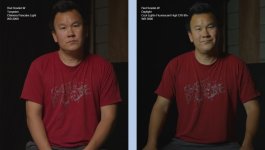
Side by side I did a while back when I got my Red Scarlet-W.
Tungsten light was Chimera Pancake Lamp / AKA Chimera China Ball. Daylight source was Cool Lights Fluorescent High CRI 90+.
Obviously, daylight is great for offices or anytime you need to convey daylight. But on a sound stage or a controlled set, I just love Tungsten skin tones. Also, as I mentioned before Tungsten is very consistent in look so you generally know what skin tones you're getting. With Daylight sources - Fluorescent, HMI, LED, etc... there's always a color variance even with the highest quality daylight sources, so skin tones appear different depending on what type of daylight source you're using.
Link to see full size
http://www.builtbyugene.com/images_misc/LightTest2.jpg
Tungsten light was Chimera Pancake Lamp / AKA Chimera China Ball. Daylight source was Cool Lights Fluorescent High CRI 90+.
Obviously, daylight is great for offices or anytime you need to convey daylight. But on a sound stage or a controlled set, I just love Tungsten skin tones. Also, as I mentioned before Tungsten is very consistent in look so you generally know what skin tones you're getting. With Daylight sources - Fluorescent, HMI, LED, etc... there's always a color variance even with the highest quality daylight sources, so skin tones appear different depending on what type of daylight source you're using.
Link to see full size
http://www.builtbyugene.com/images_misc/LightTest2.jpg
Last edited:

basspig
Veteran
I shot this under LED lighting and I really love the way the FS7 rendered the colors. The intent was to make the food look appetizing, like a TV commercial, rather than render it as it looks to the naked eye. I used one of Sony's LUTs, the S Gamut to LC709, which tends to make greens look "nuclear" which is why I don't use it for nature shots, but in this instance, the reds and yellows are appealing.