Shooting sun - dangerous for your gear?

Polarbeer

Member
Hi,

After owning Panasonic GH2 for a couple of weeks, I started wondering, how dangerous sun is when shooting stills or movies? At least using full time live view camera like these m43 Panasonics won't burn hole in your eye, although you would zoom directly on mid day sun.

Searching internet on this topic, gives you different kind of recommendations. Any good thoughts on this subject - especially from Panasonic m43 shooter perspective?

-pb
 
Hi,

After owning Panasonic GH2 for a couple of weeks, I started wondering, how dangerous sun is when shooting stills or movies? At least using full time live view camera like these m43 Panasonics won't burn hole in your eye, although you would zoom directly on mid day sun.

Searching internet on this topic, gives you different kind of recommendations. Any good thoughts on this subject - especially from Panasonic m43 shooter perspective?

-pb

In 1999 I videoed the total UK solar eclipse in Devon, using a JVC full-size VHS camcorder. I was wearing smoked glasses, and I didn't start recording until the eclipse was partially complete (and it was a fairly cloudy day, to boot)

Suffice it to say that it destroyed something in the camera - afterwards, metering was non-existent and would suddenly flare to a complete 'white out' when trying to film normally.

Shame, because it was nice camera - not hi-def, obviously, but still decent quality footage for the time because the tapes were first generation. It was shoulder mounted and easy to get completely stable shots, and was very comfortable to use for long periods.

I've never tried filming anything like that since, and never will.
 
Thanks for your reply.

Well here in Finland sun is located near horizon even during midday in wintertime. So you easily catch sun into your photos and films although you weren't trying that at all.

Best rule of thumb I have found so far is that "If you can't watch sun with your bare eyes, it is too bright for your camera also."
 
I'm not really sure it is a problem nowadays, all cameras have IR cut filters in front of the sensors. Sensor size also makes a difference, think of a magnifying glass, only when the light is focused down to a fine point does it get hot. A lot of lens and filters also have IR blocking coatings. Also if the sun is lower in the sky you have even less to worry about due to more atmospheric diffraction and distance for the sun's light to pass through. I've never taken precautions while shooting into the sun, I utilize it for effect all the time at least in photography.

I've heard of more problems with using optical viewfinders

Yes, if sun would cause problems easily, it would probably be much more common topic on camera related forums.

However it would be nice to read some well written article on this subject. An article telling which from numerous thesis are only urban legends.

According to wikipedia about half of sun's
irradiance at sea level is IR light. So a 100 % IR filter would
halve solar irradiance reaching the sensor.

-pb
 
I have just been waiting for this topic to appear.

The answer is if you shoot the bright sun, you will destroy your camera.*

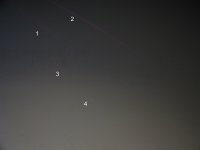
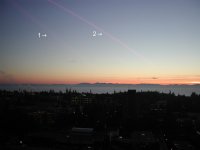
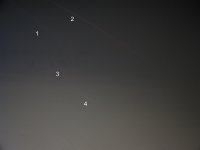
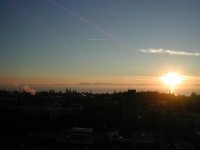
* That asterisk signifies that this purely based upon my own experience. I purchased some kind of timelapse Epson camera years ago and was stunned to see very light burned-in tracks arcing across the sky where the time lapse shot had the sun into the picture. This was maybe 3 or more hours before sunset with the tracks disappearing as it got half an hour or an hour before actual sunset.

This stunned me because it was my understanding that this couldn't happen to a CCD camera. I thought the video detector simply registered 100% and that was the end of it. CCD news video cameramen shoot into the sun all the time, afaik.

But there it was. After sending pictures to the manufacturer, I was given a camera refund and I purchased a Nikon Coolpix 5400 and, of course after the warranty, shot timelapse with the sun again. This time with a "real" camera. Well, same thing. I've posted some of the Epson photos.

Burn-in-11.jpg


Burn-in-12.jpg


Burn-in-12a.jpg
Both cameras have user manuals re how to shoot the sun at sunset, without any warnings about direct shots. I now have all my ENG and field video camera friends fearful about shooting the sun with their expensive cameras.

Are these tracks burned-in specifically because of timelapse? Or maybe I could have prevented this if I had the correct filter on? (I do have UV / polarizer filters though can't now tell you 100% if I was actually using such, I'm sure I was.) Does the same happen with CMOS?

In any case two cameras ruined. The light arcs can now be seen on every subsequent photo though mainly if you know to look for them, especially over solid backgrounds.

But this has put me on full paranoia alert for subsequent shooting... even sunsets though I'd have to say that obviously must be ok. Except note how close the tracks reach the sunset. Something isn't right.

RBG
 

Attachments

  • Burn-in-1.jpg
    Burn-in-1.jpg
    34.3 KB · Views: 0
  • Burn-in-2a.jpg
    Burn-in-2a.jpg
    18.2 KB · Views: 0
  • Burn-in-2.jpg
    Burn-in-2.jpg
    48.4 KB · Views: 0
EPSN0358.jpg

I'm probably going to screw this up, but here is my attempt to provide a better, bigger photo.
 
I shot few sunrise timelapses with GH1 with no issues. Here's an example I uploaded. But I don't think that in this particular genre the sun is high enough over the horizon to cause any damage to the sensor. Its light is too diffused by the thickness of the atmosphere. Yet I wouldn't mess with southern sun being at its zenith just because it's better to be safe than sorry.
 
Take the lens off your camera. Aim the lens at the sun. Put you hand where the sensor should be and focus the lens. If your skin melts, then it might be a bad idea.
 
Take the lens off your camera. Aim the lens at the sun. Put you hand where the sensor should be and focus the lens. If your skin melts, then it might be a bad idea.

Well some writers of internet say using wide angle lens is more risky than using zoom, because when taking wide angle shots the sun will show as a small dot in the final picture. Thus the whole intensity of the sun is focused on this small dot on the camera sensor. I don't know if this really is true...

Please post links to good articles if you find any. It's often tricky to guess the right words when searching for information.
 
I shot a video of the setting sun in 2009 with my Pentax K-7 and low cost 500mm F6.3 mirror lens without any problems.
 
Hehe. I can sense your frustration at not being able to frame that sunset quite right with that 500mm.

Ideally the horizon would be 1/3 of the way up, but then the fringing on those clouds was the nicest thing in the shot. Doh! But it doesn't work to have a tiny line at the bottom and the cloud edge right up at the top. Doh! Then there's the massive round flare. Doh! What to do? These things are sent to test us :)
 
I shot few sunrise timelapses with GH1 with no issues. Here's an example I uploaded. But I don't think that in this particular genre the sun is high enough over the horizon to cause any damage to the sensor. Its light is too diffused by the thickness of the atmosphere. Yet I wouldn't mess with southern sun being at its zenith just because it's better to be safe than sorry.

Thanks for sharing this nice timelapse. At least it suggests that GH1 is not overly sensitive for sunlight. So you had your GH1 aimed at rising sun for a quite long time without any lens caps or additional filters on it? I think your recommmendation of not shooting sun at its zenith is also wise precaution.

-pb
 
Back
Top