Selecting microphone(s) for film

Justin Teague

New member
I’m looking to buy one or two boom microphone to be used in the production of narrative and documentary films. I’ll be shooting mainly interiors with the occasional exterior. What I’ve gathered from reading a lot of forums is that it is best to use a hypercardioid for interiors and a shotgun for exteriors, but I’ve seen some who disagree saying that some shotguns (particularly ones that aren’t tube-interference, like the Sanken CS-1) work fine indoors and other saying that a hypercardioid can do fine outdoors in low-noise conditions. I’m looking for more opinions on this issue.

I’m also looking for mic suggestions. My budget is around $1000 (for the one mic or the two together). I've heard great reviews (and in some cases great samples) of the AT4053, AKG CK93, Sennheiser ME 66, and Oktava MK-012. Didn't like the samples I heard of the various Rode mics and the AT4073. I'm curious to know if anyone has used the AKG CK98. On the higher end (i.e. if I only got one mic), it's the Sanken CS-1 and the MKH416. Don't know of a good hyper at that price. (MKH50 is a little high.)

I should also mention that my intended showcase for the finished products is the web / DVD, so if an expensive and less expensive mic can't be distinguished on normal speakers / headphones, then the cheaper is all I need. I'm also new to booming, so a microphone with low-handing noise and a forgiving range is best.

Thanks!
 
No decent audio kit has only one mic. Most audio pros have a mic cabinet, or wide selection of mics for various circumstances (long shotguns, short shotguns, hypers, cardioids, plate mics, etc.). So you're on the right track looking at a couple different mics to begin.

I'd look at the Rode NTG-3. It rivals the 416 and costs less. That'll cover all your shotgun needs for now.

For hypercardioid, the CK93 or the Audio Technica 4053b if you can afford either. The plus side here, too, is that once you have the basic set you can add other capsules on down the road (cardioid, supercardioid, omni) for other applications if you need. A hyper will cover your interiors, and certain exteriors.

The argument over shotguns indoors really boils down to the characterisitcs of the room. Just because you aren't literally outside doesn't mean that you're working an interior where a shotgun won't function. In a treated space with no reflection, it's not a huge deal. On a very large sound stage, a shotgun will also be fine. But in the typical interior... a livingroom, kitchen, bathroom, bedroom... with little or no treatment, smaller room dimensions, and lots of reflection, a shotgun is going to be very challenging.

And for hypers outdoors, they can be great for shooting on reflective surfaces, or really just about anywhere else, assuming that the framing allows you to work close. A shotgun will give you a little more wiggle room to keep the mic out of frame and still be within the correct working distance.

Please also don't forget good headphones. Sony MDR-7506.
 
Last edited:
Thanks for the advice. I looked up some more samples of the NTG-3 and liked it a lot. Not sure why the sample I heard had so much noise.

As for picking between the AT and the Blueline, any suggestions? Any strengths or weaknesses of one compared to the other.
 
Thanks for the advice. I looked up some more samples of the NTG-3 and liked it a lot. Not sure why the sample I heard had so much noise.

You never know who created the "test." Cheap cable? Crappy pre-amp? Air conditioner right outside the window?

As for picking between the AT and the Blueline, any suggestions? Any strengths or weaknesses of one compared to the other.

The best way to decide is to get your hands on them and test them, side-by-side. It really boils down to which one you think sounds better.
 
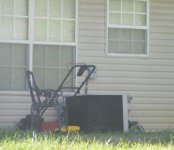
Strange place for an air conditioner...outside the window...

Um... really?

From my neighbor's house... please notice the large central air unit that sits outside the window (surrounded by his other crap).
 

Attachments

  • ac_window.jpg
    ac_window.jpg
    92.4 KB · Views: 0
You're on the right track in recognizing you'll need one of each type mic. I've tried to "cheat" with a shotgun indoors and although it's better than a built in camera mic, it's not as pleasing as a hyper.

Keep in mind you'll need accessories such as a boom pole, shock mount etc and these will easily add a few hundred bucks onto the price of the mic.

If you won't be using a helper to boom and the shot is static, you can use a manfrotto boom stand to hold the hyper when shooting indoors.

And finally, since no one mentioned it: if you don't need to own this stuff, you might consider putting the money toward hiring a sound person for your project.
 
What I’ve gathered from reading a lot of forums is that it is best to use a hypercardioid for interiors and a shotgun for exteriors, but I’ve seen some who disagree saying that some shotguns (particularly ones that aren’t tube-interference, like the Sanken CS-1) work fine indoors and other saying that a hypercardioid can do fine outdoors in low-noise conditions.
A shotgun can indeed be used indoors very successfully; however, it requires a great deal of skill and a reasonably dead location. Hypers are far more forgiving when used indoors. The reverse is also true; a hyper can be used outdoors, but is less forgiving of the ambient noise that always seem to be present when shooting outdoors. That is why one of each - a shotgun for outdoors and a hyper for indoors - is the usual recommendation for those who have minimal experience with sound. Another aspect is the skill with which the mics are used, something that can only be gained with experience.

A plumber has a wide selection of wrenched and pliers for specific jobs. The same applies to mics; use the right tool for the job. That's why the professional production sound folks usually have a fairly large selection of (expensive) mics.

Always keep in mind that a mic "hears" things much differently than your ears do, and your brain has an automatic "editing" function that allows you to filter out what you do not want to hear. Since a mic doesn't have that "editing" function - and is mono as opposed to your ears which are "surround" - you should always wear headphones; it gives you a much better read on what is actually being recorded.
 
BTW, there's a promotion this month (November) on the Rode NTG-3 where you'll get a free Rode zeppelin with it.

This is no small freebie. You should jump all over that.
 
Back
Top