Scorpio Anamorphic Lenses - NAB 2016

Stephen Mick

Totally Usable
Now, these aren't going to be lenses many of us are going to buy, but if you want to rent a great-looking set of anamorphic lenses, check out the Scorpio line.

They've got a complete line of 2x anamorphic primes ranging from 20mm to 300mm. All of them have 95mm fronts, and the close-focus on them is surprisingly short considering they're anamorphics. (The 35mm CF is 18 in., about half of normal 35mm anamorphics, I believe.)

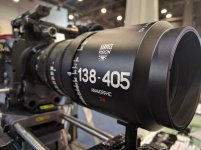
They also showed a kick-ass 138-405mm 2x anamorphic zoom. Wow.

http://www.servicevision.es/en/product-selling/scorpiolens-anamorphic-2x
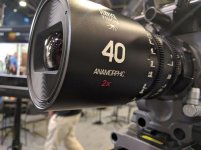

IMG_20160420_110208.jpgIMG_20160420_110321.jpgIMG_20160420_110752.jpgIMG_20160420_110758.jpg
 
Interesting that these give you the expanded horizontal field of view of a shorter focal length with the defocus properties of a longer one that you expect from anamorphic lenses, but they retain a circular bokeh like a spherical lens.

 
I was just going to point that out about the bokeh. Good looking glass either way though. I'd love to see more
 
Exactly.Had them on order initially, but the aesthetics is like normal spherical lens just in 2.35 format, though the bokeh is nice, the lenses are light, fast
 
Awesome lenses. When I start taking a real stab at anamorphic shopping these will be high on the list
 
Strange they told such a personal story of two people with anamorphic format.
 
Strange they told such a personal story of two people with anamorphic format.
Anamorphic doesn't just have to be used for sweeping landscapes and epic moviemaking. A couple of old favorites in the format are The Apartment and Spirit of St. Louis, which were both rather purposefully claustrophobic films.
 
Interesting that these give you the expanded horizontal field of view of a shorter focal length with the defocus properties of a longer one that you expect from anamorphic lenses, but they retain a circular bokeh like a spherical lens.


Doesn't this basically mean that the look is similar if not identical to using spherical lenses on a larger format - or faster spherical lenses on a small format? I just don't understand how the extra expense of rear anamorphics is justified since classic anamorphic artifacts such as elliptical bokeh are absent.
 
Anamorphic doesn't just have to be used for sweeping landscapes and epic moviemaking. A couple of old favorites in the format are The Apartment and Spirit of St. Louis, which were both rather purposefully claustrophobic films.
I was being facetious. ;) Considering the comments about 'circular bokeh', I felt like stirring the pot.
 
Doesn't this basically mean that the look is similar if not identical to using spherical lenses on a larger format - or faster spherical lenses on a small format? I just don't understand how the extra expense of rear anamorphics is justified since classic anamorphic artifacts such as elliptical bokeh are absent.

Anamorphic lenses produce a different image to spherical lenses that is not negated by the absence of oval bokeh. The final IQ from an anamorphic lens is different from merely cropping a spherical capture. If you haven't already, you should check out the YouTube clip that follows the one above, where a Zeiss lens is thrown in for comparison.
 
The Scorpio don't seem to flare very much when a highlight is present. Hard to be definitive about quality from the Youtube, but they certainly look good.
 
I agree that this comparison video shows what I find most interesting about anamorphic photography. Those that don't get it only look for the "flaws" of the image such as oval booked, heavy field curvature and horizontal flaring to give a look of anamorphic. But to me anamorphic is about the spatial dynamics and sense of depth. There is a far greater compression of the frame that comes with shooting with what is effectively a longer focal length lens. I like the shot at night with the guy holding the flashlight for this. He feels much closer to the girl when he appears thanks to the compression of depth in the image. It looks like it was shot in 65mm. To me that's what anamorphic is about. I tend to avoid the obvious artifacting in the image anyway.

Stuff like flare & oval booked is like a post program that creates a "film look" by adding phony dirt and emulsion scratches to the image. They just don't get what we actually like about the image.
 
Anamorphic lenses produce a different image to spherical lenses that is not negated by the absence of oval bokeh. The final IQ from an anamorphic lens is different from merely cropping a spherical capture. If you haven't already, you should check out the YouTube clip that follows the one above, where a Zeiss lens is thrown in for comparison.

I had watched the clip, and with respect to those who feel differently I still think it supports what I stated - namely that rear anamorphics look no different than spherical lenses shot on a larger format, or spherical lenses shot on a similar small format with a faster aperture. I agree that the Zeiss images look different, but the main difference I was able to see was a deeper DOF for the Zeiss, presumably due to a smaller entrance pupil diameter. Other differences were due to variations in camera position and subject since it wasn't a controlled test. The Hawk images look obviously different because of the distortion and front anamorphic artifacts.

Of course, its completely possible that I missed something, and just need to have it pointed out to me. I'm certainly open to being convinced that rear anamorphics really do produce an image that can't be reproduced with spherical lenses, but it would help to see a carefully done comparison with still images of an identical subject shot at an identical pupil diameter etc..
 
Wait what? People "don't get it" just because they see, not flaws, but different characteristics of the format than you? Easy Mitch, sounding just a tad bit elitist on that one...
 
I would have been much more interested in the comparison video had they used Master Primes instead of Ultra's, at least attempting to match the depth-of-field characteristic.

It's a little hard to know what aspect of anamorphic is creating the current interest. There is the aspect of vintage lenses and the flaring/oval highlights/distortion that is part of the anti-digital look. And as Mitch mentions, the telephoto compression. But as we move towards larger sensors, the latter will happen anyway (one gets that now with a full-frame camera), so I'm not quite sure what the true advantage of modern anamorphic lenses will be down the road. We don't need them in the same way that they were originally intended, since we have plenty of resolution for projection.
 
I had watched the clip, and with respect to those who feel differently I still think it supports what I stated - namely that rear anamorphics look no different than spherical lenses shot on a larger format, or spherical lenses shot on a similar small format with a faster aperture. I agree that the Zeiss images look different, but the main difference I was able to see was a deeper DOF for the Zeiss, presumably due to a smaller entrance pupil diameter. Other differences were due to variations in camera position and subject since it wasn't a controlled test. The Hawk images look obviously different because of the distortion and front anamorphic artifacts.

Of course, its completely possible that I missed something, and just need to have it pointed out to me. I'm certainly open to being convinced that rear anamorphics really do produce an image that can't be reproduced with spherical lenses, but it would help to see a carefully done comparison with still images of an identical subject shot at an identical pupil diameter etc..
To step it back a bit: YES, these images look like a spherical lens on a larger format. That doesn't just mean shallower depth of field characteristics. It also has to do with depth cues and spatial dynamics. It is a different look and not something that can simply be recreated with an aperture adjustment. Now whether you like this or not or if it is particularly of value to you in your photography is a different matter.
 
Back
Top