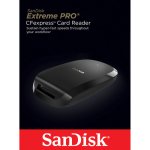
SanDisk Launches Line of Ultra-Fast CFexpress Cards

Does this make the Cfast and P2 cards obsolete?
Definitely. I'm going to sell all of my CFast cards and start using these CFexpress cards in my Amiras and C300 Mark IIs. If they don't work with those cameras, I don't care. I just want the higher read and write speeds.
 
Definitely. I'm going to sell all of my CFast cards and start using these CFexpress cards in my Amiras and C300 Mark IIs. If they don't work with those cameras, I don't care. I just want the higher read and write speeds.

The beauty of CFexpress is that you don't even need a camera. The card gets connected directly to your retina. But, if you blink, you can miss an occasional shot too.
 
giphy.gif
 
CFexpress is the official successor to both CFast and XQD.

If you're buying a camera, I would make sure it records to either SD cards or CFexpress. I think both will around for a while. This message will self-destruct in two years.
 
My philosphy is just buy whatever camera you think is best suited for you and ignore what media it uses as you'll likely just sell the media with the camera when you sell it (or throw it in the trash if you keep it until it's worthless). New and better specced media that does not work with your current camera does not out-date the media that does work with your current camera. Yeah, you may be able to save a bit of money but not having to sell your old media and buy new media when you upgrade to your next camera, but good luck playing that game in the world of changing tech.

I personally have found CFast to be unreliable, so more than faster speeds I hope CFexpress is also more reliable.
 
Are these just a PCIe interface or are they SATA interface? I can't say that I've looked into them. I hope we get some nice USB 3.1 (or higher) readers for these.
 
Are these just a PCIe interface or are they SATA interface? I can't say that I've looked into them. I hope we get some nice USB 3.1 (or higher) readers for these.

The latest CFexpress standard is PCI 3.0 x8 at about 10 GB/s.
 
So they are essentially small form factor NVMe drives with a durable connector.
Yes, the CFexpress 2.0 standard which was released in February 2019 actually introduced 3 different CFexpress card sizes and interface speeds, all of which are based around NVMe:
https://www.compactflash.org/cfexpress

CFexpress Type B cards (which is the type of these new SanDisk CFexpress cards) have the same physical dimensions as XQD and CFexpress 1.0 cards. These Type B cards have a PCIe 3.0 x2 interface that is capable of 2 GB/s of bandwidth. Since the card dimensions and connector type is the same as XQD, in some cases it may be possible for manufacturers to update devices with XQD card slots to accept CFexpress 2.0 cards as well.

CFexpress Type A cards are smaller with a lower interface bandwidth (PCIe 3.0 x1 @ up to 1 GB/s), while Type C cards are larger with a higher interface bandwidth (PCIe 3.0 x4 @ up to 4 GB/s).

Note that these bandwidth numbers are the theoretical maximum of the interface. PCIe does have some protocol overhead that reduces the maximum possible speed, and the actual read and write speeds of the flash memory on the card will likely be lower than the interface limit in most cases anyway.
 
Back
Top