GH5 S1H's total cost is adding up to Varicam family of cams

Cool setup Icarus! Looks very similar to what I am running (including the added battery grip)... and I think the way the S1H was designed to be handled.

I like you M to L zeiss setup, love the milvus but those smaller zeiss sure would be nice for the smaller/lighter footprint.
 
The closer the central gravity point of the whole unit is to the sensor the less the ibis has to struggle which results in smoother results.

Cool setup Icarus! Looks very similar to what I am running (including the added battery grip)... and I think the way the S1H was designed to be handled.

I like you M to L zeiss setup, love the milvus but those smaller zeiss sure would be nice for the smaller/lighter footprint.
 
No point in dogging the OP for not finding the S1H appropriate to his needs. If workflow/file naming is important - and I can absolutely see where that would be true owning a VariCam HS and a VariCam 35 - then the VariCam LT makes a huge amount of sense. In addition to Express P2 media, it can also be the same lens mount and batteries as the VariCam 35, so that's a lot less gear to purchase & carry. I would note that it depends how you intend to use the VariCam LT, but you may be able to forgo some of the accessories if you plan to use it in a gimbal or other rig rather than handheld. The basic camera body includes a locking EF lens mount, the battery mount, the I/O connectivity ports, the control panel, and a top handle. I note this because these items are extra from other manufacturers. That camera body is under 6 pounds and fairly compact, certainly smaller than an Alexa Mini once you add equivalents of the included items. You might want a PL mount instead, but otherwise you already have the glass, the cards & the bricks. If you're rigging small, perhaps you don't need the shoulderpad/baseplate, the articulating handgrip with controls, and maybe if you're doing gimbal work anyway then you could forgo the viewfinder and just use a high bright onboard monitor instead. I just tested one today in harsh direct sunlight and was amazed how well the 3000 NIT panel peformed, and that was a $900 monitor. So you could keep your investment and your footprint quite low, and still get the highest performance and the best workflow for your use.

The S1H is a fantastic camera, but it is not the tool for all jobs. For this one it sounds like the VariCam LT may be the smartest purchase for you.
 
Canon 50-1000mm cine servo for Super 35mm. After having to take 4 trips to carry that 15 lbs lens and all sorts of tripod supports, I revert back to 2/3" Fujinon HA25x16.5. No tripod support needed. And the reach is actually about 2000mm equivalent on a super 35mm. Has optical stabilizer that is really a life saver for small-medium situation. All within 6.5 lbs and can do a 1-man crew with it. Doesn't have that super DOF. But I need more in focus, continuous tracking shots than out of focus shallow dof. Plus I do lots of night shooting with the Canon ME20F-SH. The Canon ME20F-SH maximum resolution is 1080p. So shooting anything higher than 1080p is not absolutely needed for me now. Distribution is still 1080p.

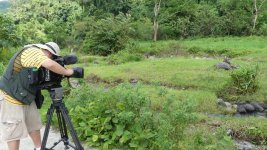
My medium size setup allows flexibility in getting spontaneous wildlife shots that would otherwise take 10-15 min to setup on the Canon 50-1000mm and having to pay a lot more for crew and manpower. At times I didn't have time to put on the pan handle and zoom controller. Still can get the shot quickly before the wildlife moves away. Plus transportation is not always possible by a car. I had to take a bike ride majority of the times.
 

Attachments

  • DVXUser_P1920172.jpg
    DVXUser_P1920172.jpg
    162.8 KB · Views: 0
While I think a quality VND not pushed to the limit would be just fine, if you are that worried, you could also use fixed ND filters and buy a set of them from B+W, attach Xume adapters to them. Then you aren't using VariND, rather fixed for optimal quality, with a very quick switch system in the Xume. A little more $$ but not THAT much more. And you could still use lens hood.

I can see why you want to go smaller and lighter!! S1H with adapters for your FF glass would be premium quality and if you shoot in 6K...

Also just thinking out loud here... the GH6 is almost certainly coming next year. I suspect it will be a noteworth IQ improvement over the 5. 4K or 6K M43 recording with the native m43 crop factor could also provide a super small and light package comparatively and you can adopt most any glass to it. You could also consider one of the native zooms (ie Leica 100-400, which is 200-800 FF equiv without using any ex tele feature). Olympus also has a slate of upcoming super tele zooms for m43 that have yet to be detailed (but is on their roadmap) IIRC.

Lots of options!
 
if i was shooting wildlife and wanted to go lighter i would get this:

https://www.digitalcameraworld.com/...-f45-pro-mc-20-converter-deliver-2000mm-range

balance it on a tripod and stick a bmpcc at the end with A high bright monitor and shoot raw


QUOTE=lonewolf2koc@hotmail.com;1986807894]Canon 50-1000mm cine servo for Super 35mm. After having to take 4 trips to carry that 15 lbs lens and all sorts of tripod supports, I revert back to 2/3" Fujinon HA25x16.5. No tripod support needed. And the reach is actually about 2000mm equivalent on a super 35mm. Has optical stabilizer that is really a life saver for small-medium situation. All within 6.5 lbs and can do a 1-man crew with it. Doesn't have that super DOF. But I need more in focus, continuous tracking shots than out of focus shallow dof. Plus I do lots of night shooting with the Canon ME20F-SH. The Canon ME20F-SH maximum resolution is 1080p. So shooting anything higher than 1080p is not absolutely needed for me now. Distribution is still 1080p.

My medium size setup allows flexibility in getting spontaneous wildlife shots that would otherwise take 10-15 min to setup on the Canon 50-1000mm and having to pay a lot more for crew and manpower. At times I didn't have time to put on the pan handle and zoom controller. Still can get the shot quickly before the wildlife moves away. Plus transportation is not always possible by a car. I had to take a bike ride majority of the times.[/QUOTE]
 
2000mm lens will me roughly the same as 512mm on the 2/3" HD. It'll satisfy the needs for shooting non-tracking small-medium sized birds. Pretty much limited to static photo coverage only. Can't continuously track and zoom the wildlife in motion with the heavier lenses. This looks like a good 2nd option if I don't want to be carrying heavy gear on top of the mountain. But 2x conversion on this lens to get 2000mm is a big concern for chromatic aberrations and loss of sharpness. I rarely use any extender on the Canon 50-1000mm PL or Fujinon HA16x16.5. It just doesn't look clean, especially anything beyond 4K sensor.
 
Lots of real-world tests are needed before finding the right light weight combo to supplement the main cams. Keeping up with new camera models and lenses are getting expensive for me, especially these GH and S1 series cam updating every 1-3 years. I'm having a very hard time deciding because these smaller cameras are only good for several years before a better one come out. In the meantime, will continue using the big & heavy setup. Extremely satisfied with the quality of the final footage minus the heavy weight, extra expenses and time needed to transport them.

While I think a quality VND not pushed to the limit would be just fine, if you are that worried, you could also use fixed ND filters and buy a set of them from B+W, attach Xume adapters to them. Then you aren't using VariND, rather fixed for optimal quality, with a very quick switch system in the Xume. A little more $$ but not THAT much more. And you could still use lens hood.

I can see why you want to go smaller and lighter!! S1H with adapters for your FF glass would be premium quality and if you shoot in 6K...

Also just thinking out loud here... the GH6 is almost certainly coming next year. I suspect it will be a noteworth IQ improvement over the 5. 4K or 6K M43 recording with the native m43 crop factor could also provide a super small and light package comparatively and you can adopt most any glass to it. You could also consider one of the native zooms (ie Leica 100-400, which is 200-800 FF equiv without using any ex tele feature). Olympus also has a slate of upcoming super tele zooms for m43 that have yet to be detailed (but is on their roadmap) IIRC.

Lots of options!
 
Last edited:
I'm having a very hard time deciding because these smaller cameras are only good for several years before a better one come out.

As an encouragement, I believe this is false logic. Yes, they get updated more frequently than the large studio cameras but IMO that's irrelevant. The camera is as good as it was the day it came out no matter what comes after it. The Varicam LT has aged at exactly the same rate as anything else, the lack of a replacement model doesn't make the Varicam LT any more advanced or look any better today than it would be if a Varicam LT mk II existed.

If you like the feature set and look of the GH5 or S1H, it doesn't matter what they release next. It will last as long as it is giving you the results you want. There are threads of people here still producing AF100 work that looks better than what a lot of people are doing on a Sony A7S III and so forth.
 
... taking a close critical look at the actual cost of a working S1H vs a Varicam LT. Although the body is about $4K, the needed core accessories such as a shoulder rig, outdoor VF, outdoor Small HD montior, ND filters, XLR, several L lenses are approaching to about $14K. I'm not too comfortable with Vari ND filters. There has to be a optical performance cost for convenience. On top of the numerous add-on accessories, the setup time to assemble accessories is time consuming. I rather get a ready to shoot Varicam LT or 35 and be done with it fast L lens selection is limited to normal use. With this in mind, I only see the S1H has a big advantage on gimbal, underwater housing, roaming monopod shooting, shooting at super tight spaces, and hi-res stills...

This is a good question, and in my documentary team we discuss variations of this frequently. We have a DVX-200, formerly used the DVX-100, also now use various cameras including Sony Alpha, Panasonic S1, BM Ursa Pro, etc. We frequently experience the pros and cons of each approach.

Obviously some mfgs think putting high end video features in a mirrorless camera will lead some % of their customers to shoot higher-end material on it and not purchase their "professional" cameras. Panasonic does not believe that, and openly said so. They said in general nobody will use an S1H as an "A" camera on a big-budget feature film. They feel the conventional "camcorder" form factor and ecosystem are well established and will usually be used prominently in major productions. In their view putting all that high-end stuff in the S1H cultivates a new class of customers who will later move up to Varicam.

So that has given us the S1H, essentially a compact EVA-1. What do we do with it?

As already stated, it is not cheap, esp. when considering the full package required. However it is very flexible. The Ursas we use are great for scripted work, studio interviews, etc. It is a bear to grab one and quickly reconfigure it for ad-hoc field work. They don't do well in low light, and have no built-in stabilization.

There are a bunch of 8-bit mirrorless cameras that cover the run-and-gun, low-profile, low-light situation. If properly handled they can shoot a professional multicam interview but you have limited leeway - you must watch the waveform monitor like a hawk. Even using an Atomos ProRes recorder, many cameras (inc'l all the current Sony Alphas) produce only 8-bit output. By contrast the Ursa sensor is so good it can handle almost anything and does internal ProRes.

Our mirrorless cameras are equiped with cages and NATO rails where we can (with practice) unpack and deploy them within 2 min, inc'l Tentacle Sync, Atmos recorder, etc. Even on a big camera you don't usually pack it with Teradek installed on a magic arm, matte box attached, V-Mount in place, etc. Yes on our DVX-200 it can be pulled out of the box and start shooting in seconds, but it's fixed lens.

I think the S1H has a useful niche. If you want something better than an 8-bit camera, but which has excellent stabilization, superb low light, good codec choice (inc'l upcoming ProRes RAW via Atomos), and a camera which can switch from shooting a professional interview to run-and-gun field use in seconds -- that is your camera.

Re XLR, we rarely need that, we have a field audio technician and normally use Tentacle Sync. Re variable ND, that is a drawback of all mirrorless cameras. Due to a variety of factors it seems unlikely they will ever have built-in variable ND. There are VND adapters but due to the flange-back distance they can only work on an older adapted lens. You could theoretically design a Metabones-like VND adapter containing optics for new-style native lenses having short flange-back distances, but it would be very expensive. Even if a native VND adapter existed, it can't go to zero attenuation so you'd have to remove it when going indoors. That would be a bigger hassle than removing a screw-on VND.
 
Useful niche for something that you have to spit 6-8K $ to make is usefull, sounds worse then the worse car salesman pitch!
Who does acctualy believes that any sane person will skinny dip into the unknown ecosystem with such a bloody track record (ask first adopters who bought S1 how do they feel about their investment once they realized S1H is coming to the market?).

I am still trying to employ FS7 and EVA 1 that are sittng on a shelves!
Not beucause thet are so bad cameras, but because clients simply do not privide budgets so that I can bring in another assistant to the project, which is a necessary move if I want to work comfortably and dtay healthy (I am sorry for seem like a princess bride to some of you l, but 2 rolling pelicans in my hands, tripod bad and monitor bag and lenses backpack on my shoulders, plus filters kit hanging from my mouth is realy my weightlifting and shlepping limit; plus it realy make me looks unprofessional...).


S1 and co. should’ve make things easier, and not add weight to the luggage...

For what? Better image?

My neighboor is still happily employed as a corp&event videographer with his 5Dmark2 and A7smark1 combo...and nobody cares for his “inferior” image quialty!

Maybe because times have changed ans his wife makes more money then him by being istgrm food star shooting exclusively with samsung phone...
 
Mirrorless cameras are best leaving as is. Rigging is just a bad idea when there's better options if it's a video camera you are looking for. Why buy an arm chair and try to make a sofa out of it?
 
If you want to rig your camera with everything that will make it look more professional maybe you should take a look at Z Cam. Some really nice wildlife footage from the Z Cam E2. https://youtu.be/XcdRWZesg-Q

“As promissed here the short video photographing and filming wildlife in Kenya. Filmed with E2, 120fps & 59,94fps, H265 Rec709. Lenses used: SIGMA 16mm F1,4 DC DN | Contemporary, SIGMA 120-300 S, SIGMA 18-35, SIGMA 500 f4 with Metabones XL. One or two shots are D850 or GoPro.”
 
Last edited:
Back
Top