S-Log 2 side by side

Yeah raw is the way, or at least 10-12 bit log, Cineform raw is pretty spectacular at making those canon raw files 10% the size, play easily in Premiere and still keep their raw goodness. I figure I've got 5D3 raw for controlled situations, great colour, reasonable lattitude, anything else or slow motion I'd probably use FS700 slog2, if I can't control the lighting I've got to make a compromise somewhere. One thing I'm sure of playing with those files at their extremes - those 5Dmark3 H264 files are garbage.

Cineform is really very good, but it appears to have fallen to the wayside a little with the GoPro acquisition. I wish it was pushed harder as an open standard and as a mezzanine codec. DNxHD seems to have taken over, but cineform is better. I have issues with it working in the higher end comping apps too. Shame because 12 bit 4444 is a very good intermediate for 99% of uses (up to 4K too). Better than ProRes IMHO.


Hey Toby,

With S-Log 2, can you tweak settings such as Black Levels, black gamma, Saturation, etc... like you can with the normal Cinegammas? Or is it just locked to it own settings? The reason why I ask is because maybe you can tweak a variation of S-Log to make it a little less flat and more suited for filming talent and what not? Seems like default S-Log 2 will be nice for certain situations with the added bonus of a great base to built other profiles from.

Anyways, I'm excited about S-Log. I know everyone complains about the 8-bit and God knows I would kill for 10 bit, but this is all we are given (unfortunately) and according to people who have actually tried it: Den, Toby and Freiheit; it seems to be another good profile.

I still don't see how a 10-bit 4:2:2 FS700 would have much sales effect the internal 10-bit 4:4:4 F5 and the much better 4K implantation. Sucks that Sony cripples us so badly, but at least the S-Log 2 seems pretty cool.

Gene, good point about modifying slog but i suspect the answer is no.

The 4K out of the 700 is actually very good all things considered. I would love to see it side by side with an F5. Okay, it's ergonomically dodgy but that aside it's a well priced solution (with the O7). The benefit of the 700 is that it's adapts to more lenses than the F5 and accessories tend to be a bit more cost effective. You can also move the recorder away from the camera and make the whole thing quite compact. Useful too.

A self contained 10 bit 422 700 would eat into sales i'd guess, afterall there has to be a reason why it's not there...

cheers
Paul
 
Hey Toby,

With S-Log 2, can you tweak settings such as Black Levels, black gamma, Saturation, etc... like you can with the normal Cinegammas? Or is it just locked to it own settings? The reason why I ask is because maybe you can tweak a variation of S-Log to make it a little less flat and more suited for filming talent and what not? Seems like default S-Log 2 will be nice for certain situations with the added bonus of a great base to built other profiles from.

Anyways, I'm excited about S-Log. I know everyone complains about the 8-bit and God knows I would kill for 10 bit, but this is all we are given (unfortunately) and according to people who have actually tried it: Den, Toby and Freiheit; it seems to be another good profile.

I still don't see how a 10-bit 4:2:2 FS700 would have much sales effect the internal 10-bit 4:4:4 F5 and the much better 4K implantation. Sucks that Sony cripples us so badly, but at least the S-Log 2 seems pretty cool.


Hi Gene,
I did try that but as Paul guessed it didn't have an effect on the image, I guess it's locked down. I was actually one of those people on here complaining about 8 bit and SLOG2, how I thought it would be pointless but I'm really coming round to it. I still wish it was 10 bit as I keep banging on about but I filmed on the beach for a couple of hours yesterday at dusk and grading the shots just now made me appreciate how good it is as I was unsure if it would all fall apart or not. I'll post up the video when it finishes uploading so you can see if it looks bad to your eye (hopefully not!). Many of the shots I took were low DR so the image had to be really stretched, that's a real torture test for log. These weren't however mid shots and closeups of people's faces so I can't show you where I think it would be less useful. Also, as was the case in my test video (though an extreme version) if SLOG is giving you skin tones you wouldn't normally have then you will actually have better skin tones with it, even if it's compared to a 12bit raw file, that extra chunk of DR is really useful, if you're controlling the light though you shouldn't be underexposing that much though.

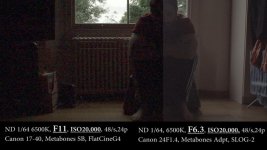
Also, I said the ISO and grain is a lot better which might be a bigger upgrade than the SLOG and I've fished out a photo to show that, here I was shooting my FS700 alongside the SLOG2 version, both exposed to not clip the highlights:
SLOG2_test2.jpg
 
Toby,

Look forward to the beach video.

Are you recording internally or externally? The noise reduction in the AVCHD is quite good, external recorders show the true noise from the sensor. On your sample i'd imagine web compression is affecting the final image more than the noise. There are some very good denoisers out there (Antimatter being my favourite at the moment).

thanks
Paul
 
At 00:21 of your test video I started to search for a phone number to my local Sony service center. Thank You for this comparison TobyLoc.
 
Hi Paul,
I shot both cameras to internal AVCHD and that's a relatively high bitrate jpeg export from the original files, so it's a pretty accurate rendition of at least what AVCHD looks like and should be a reasonable apples to apples comparison. I'm defintely not saying ISO20,000 doesn't have noise but it's definitely better than the normal FS700 at ISO20,000. Will have to take a look at Antimatter, I like Neatimage but even when used subtly it makes everything so plasticky looking I have to throw on lots of grain to bring the texture back (though I tend to throw grain on anyway! :) ). My broadband has been up and down all day so not sure if I will ever get the video up, fingers crossed!
Cheers,
Toby
 
All I can say about the 20,000 ISO is DAMN! It's so much cleaner. It seems worth it to do the paid upgrade just for the S-Log 2. 4K will probably be a rental only thing as I have a sinking feeling a really decent mid-range ($8K to $12K) 4K camera will come out within a year or so (a grown-up BMC or maybe Panasonic), but the S-Log 2 is something I would use all the time. Excited about this and thanks again Toby.
 
At 00:21 of your test video I started to search for a phone number to my local Sony service center. Thank You for this comparison TobyLoc.
haha! no problem, please don't just take my shots into account, Freiheit has some good comparisons too and hopefully there will be more around soon. It's difficult not to recommend the update though, LOG, higher ISO and raw availability for $400 seems a good bump in features for my uses, for others it might not be right. Whether raw/4k is something I will head towards I don't know, I really want more than 8 bit but it's a long way to go to get there and my 5D3 now shoots 12bit raw for when I need that colour depth.
 
20000 ISO? Are you sure, i understood the iso for RAW to be a fixed 2000. Perhaps a typo? :)

Does the camera you have there have the hardware upgrade too or just firmware?

Antimatter was better than neat image in my tests and Dark Energy ran a promo. It's after effects only which is a bit of a pain but can be very subtle if not over cranked, like all of these denoisers though. I think the tech was originally the arri scanner relativity. not 100% sure there.

cheers
paul
 
20000 ISO? Are you sure, i understood the iso for RAW to be a fixed 2000. Perhaps a typo? :)

Does the camera you have there have the hardware upgrade too or just firmware?

Antimatter was better than neat image in my tests and Dark Energy ran a promo. It's after effects only which is a bit of a pain but can be very subtle if not over cranked, like all of these denoisers though. I think the tech was originally the arri scanner relativity. not 100% sure there.

cheers
paul

Isn't RAW and S-Log 2 different things though Paul? From what I understand, the ISO for RAW does not matter since you can tweak it afterwards. But a Log is not RAW and not ISO tweakable afterwards, so therefore the ISO is still necessary to expose properly.
 
20000 ISO? Are you sure, i understood the iso for RAW to be a fixed 2000. Perhaps a typo? :)

Does the camera you have there have the hardware upgrade too or just firmware?

Antimatter was better than neat image in my tests and Dark Energy ran a promo. It's after effects only which is a bit of a pain but can be very subtle if not over cranked, like all of these denoisers though. I think the tech was originally the arri scanner relativity. not 100% sure there.

cheers
paul

I don't think I've made a typo but I'm not sure which ISO you're referring to, I've mentioned different ISOs a lot! If it's the picture it's correct, I'm comparing ISO 20,000 on the normal FS700 (on the left) with ISO 20,000 on the upgraded FS700 (on the right). I haven't shot any raw on the FS700, I didn't get the card reader in time and now someone else has it. The camera I had was the final hardware and firmware version I believe.
Cheers,
Toby
 
Here's the video I shot yesterday afternoon when I still had the camera, you should be able to download the original:
 
Isn't RAW and S-Log 2 different things though Paul? From what I understand, the ISO for RAW does not matter since you can tweak it afterwards. But a Log is not RAW and not ISO tweakable afterwards, so therefore the ISO is still necessary to expose properly.

SLog was added so that we could monitor RAW AFAIK. So it would make sense that the two are related but i don't know for sure, nor have anything to test with

I've never tried running the camera at 20000 ISO base or otherwise, i'd never have even thought of it! So it does make those tests very interesting Toby, i wonder if that hardware part of the upgrade is contributing to the ISO performance increase?

I suspect cameras work differently, for a CCD (which i have some experience of cobbling together a camera) the ISO is analogue gain to the sensor that changes the characteristics of it. Whereas i'm not so sure for a CMOS, whether that's true or not. I'm sure i read that RAW sets the ISO to 2000 but i don't know if that can be altered. I'd hope so, because i use ISO as an exposure tool these days, rather than aperture in some cases.

Perhaps someone who knows better can chime in and stop me spreading disinformation :)

cheers
Paul
 
Back
Top