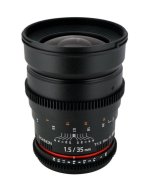
Rokinon 35mm F1.5 compared to Nikon 35mm T1.4 AI-S

Duke M.

Veteran
I've done a few tests before and people always complain about something. I'm not a lab technician so if you don't like the test set up ignore the whole comparison or do your own tests rather than gripe about it.

The labels are at the bottom of the pictures. I'm uploading small 1:1 sections of the high rez photos. I'm not sure what the forum software will do to them but they started as PNG lossless images.

ENVIRONMENT:

a) The test was indoors with controlled lighting.

b) Distance was 18" to the sensor plane. (The Rokinon is twice as long which puts the front element closer.)

c) Neither the tripod nor the box were moved, except the tripod jiggled a little when the lenses were changed.

d) The 'white' area of the box is actually a cream color.

e) Because I was shooting at an angle to avoid glare, and the focus was so shallow (fraction of an inch) you can see in some shots where part of the box is in focus and part is not. Its not a lens defect. Actually the Rokinon has really good corner to corner sharpness.

LENS NOTE:
The Rokinon markings start at T1.5, then 2, then 2.8. If they are truly at T2.8 the exposure should not exactly match the Nikon F2.8. They would have to be ~T3.1.

LIGHTING:
1) Rather than changing any camera setting when I went to T1.5 or F1.4 I lowered the lighting to avoid be over exposed.

2) Both lenses had considerable more CA when over exposed.

CAMERA:
i) The pictures were taken with a Nikon D5100 set to manual on a tripod at full resolution 4828x3264 or 16.1 megapixels. This gives you a better idea how it would look on an Epic.

ii) For reference 1080p video is about 2 megapixels. Any defect you notice from a 1:1 pixel Nikon capture should be reduced by 2.5 pixesl, or another way to think of it is any CA less than 2 pixels will nearly disappear on HD video.

IMAGE NOTES:
The Nikon lens has less contrast, particularly wide open at F1.4.
The Rokion has a warmer tone.
The Rokinon seems to have more consistent contrast throughout the range.
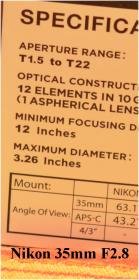
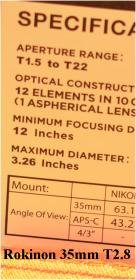
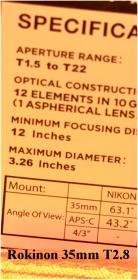
Nikon35mm28CU.jpgRokinon35mm28CU.jpg Rokinon35mm28CU2.jpg[in the second image only the bottom is in focus so compare the words "Mount". The third image is another effort.]
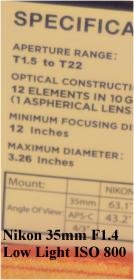
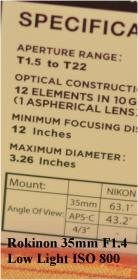
Nikon35mm14LowCU.jpgRokinon35mm14LowCU.jpg


This video capture was shot at 1080p on the Nikon camera with lower light. Then a capture was made from the video. Yes, I realize its under exposed but it still tells you some things. Look at the lack of CA, the sharpness and the bokeh on the left.
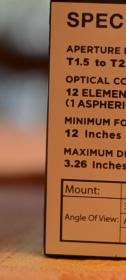
Rokinon35mmCapture.jpg [I see no CA in this capture and the focus is sharp.]

Here is the Nikon over exposed just as an FYI:
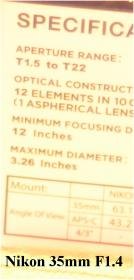
Nikon35mm14CU.jpg
 
Last edited:
Duke,
i appreciate both your efforts, desire to share here, and your disclaimers but I think you will get a lot more valuable information with a better subject for your tests.
My suggestion:

Download a pdf I posted just for this purpose:

http://www.leonardlevy.net/ISO_12233-reschart.pdf

Bring it to Kinkos or some print shop and make a blow up that is as wide as you can. I suggest 4'

mount it on a posterboard

Now you will have a very useful chart with much more resolution and contrast that will be invaluable for years to come.

My experience is the real CA problems with these lenses are longitudinal and show up as green and magenta fringing right in front of and behind the focus point. So the in focus frame may look great and the stuff on either side can be horrendous.
Red and blue CA at the focal plane is not nearly as big a problem.
It will also show up much more on high contrast edges ( hence you saw more when overexposed) especially things like lamp shades lights or window panes and sills. and much more wide open. Try a piece of bubble wrap at high exposure and you may run screaming from the room. Also the sharper the lens the more likely longitudinal CA unfortunately. It really separates expensive cine lenses from still lenses. I found it very bad on the Zeiss ZF f1.4. You will see it very clearly on the chart.

This is exactly the kind of CA you may see on a low DF shot at f1.4 with pretty hits in the background. It can get ugly.
 
Thanks Lenny,

I actually have that chart, but Staples couldn't blow it up much for me. I think I have it a little bigger than legal paper size. I'll see if Kinkos can do better.

I wasn't totally satisfied with the testing for several reasons. The first being that the D5100, even on manual, does not allow easy manual access to the controls and the LCD doesn't show what you're actually going to get in the shot. (It rocks with a Nikon 28-70mm AF-S lens when the lens talks to the camera.)

I don't expect the Rokinon to be perfect. When really pushed the Rokinon has CA as does the Nikon, but the Nikon arrives earlier.

My plan is pull out my F3 and run more tests with it this weekend. I don't run an Epic so the first test was merely to test sharpness and the worst settings to make CA appear. However, at 1080p resolution I think the CA will almost entirely disappear except the most extreme circumstances because these photos were at 8 times the data density.

You have to admit, the one video capture that I did at 1080p is sharp, clear and displays little to no CA. :)
 
The Rokinon 35mm cine is very similar in size and weight to the Tokina 11-16mm. Both are very tank like. The Rokinon is a half inch longer and .3 lbs lighter.

The ring where the index marker is located and where it also says "1.5 / 35" feels like metal. The exterior focus ring and gear are plastic. However, immediately under that is another ring with the focus markings on it and that feels like metal.

35mmCineUpright.jpg

Both the focus ring and iris ring are very smooth and dampened. (On the 8mm the iris isn't as dampened.) Focus and it feels like metal on metal and after looking at it closely it probably is. The markings are nice and clear.

The rear cap is standard while the front cap is a little flimsier but still sufficient.

The bokeh is very nice from T1.5 to about 4. (about half way) From T5.6 onward you start getting stop sign shapes.

If the focus range on the non-cine lenses is 140 degrees (I don't have one but read somewhere they were), then the cine version has a longer throw. Not quite 180 degrees, but really close. Say 170 degrees of focus turn. There are hard stops at each end of the focus, but you can't use the stop for infinity focus. It turns past infinity.

The metal mount is well made and fits nice and tight without excess tightness or slop.

The front element is recessed from the front lip so you can get close to a flat filter in a mattebox. Focusing is internal so nothing protrudes.

If the other lenses (particularly the 24mm, 50mm and 85mm) are as good as this one I'll be happy to have a set. I know its really stupid to consider it at all but I think the red ring is actually pretty stylish.
 
Last edited:
Tired, tired, tired of EF lenses with no iris. Rokinon cines look like a great upgrade/crossgrade that will cost little or nothing at all for me to implement. The images look good so far - thanks for posting results, and I also really like the red accents!
 
Duke, I did a lot of testing for longitudinal (axial) CA because I bought a Zeiss 35mm f1.4 and was shocked to see some of my out of focus background (especially a lit lampshade and window edges) had ugly magenta rings around them. It disappeared when in focus. Then I noticed that much of the chart would show green fringing just before and magenta just after the plane of focus. My f1.4 $1800 Zf2 35mm lens was much worse than any other lens I tried including my ZF 35mm F2 lens. A piece of bubble wrap the lens came in was pure green and magenta CA for about 3 inches in front & behind the focus plane. I sent it back even though those lenses get fabulous reviews. After all its the bokeh of the out of focus background that I was interested in and I don't want my clients asking why the speculars have little magenta rings around them. This effect won't go away with better monitors or more resolution imagers - it will be more noticeable.

I checked out a Rokinon also and returned that as well deciding to stick with my Zeiss f2. i have a Nikon f1.4 but its so soft wide open I didn't even check l it for CA. Interestingly my Nikon 17 -35 had blue and amber axial CA which i find much looks more natural, but every other lens was green and magenta.

I found every single still lens I owned had some axial CA and none of a group of older Zeiss cine standard primes did. You get what you pay for I guess. If you don't see CA at all on a Rokinon you're just looking in the wrong place.

At NAB I asked both Nikon and Zeiss reps about it and they both confirmed that axial CA at wide open apertures is very hard to get rid of and gets worse with a sharper lens. Must drive engineers crazy.

I'm not saying the Rokinon's aren't good. They are great for the price, just trying to point your tests in the right direction so you don't get surprised later.
 
I'm not saying the Rokinon's aren't good. They are great for the price, just trying to point your tests in the right direction so you don't get surprised later.

I've said that I know the Rokinon have some CA and so do the Nikons. These are both decent, great for the price, lenses and not really meant to compete with a $1,200 and up lens.

That being said, CA disappears at F2 on the Rokinon. Its a matter of taste but I'd rather be able to go to T1.5 and control the lighting if I want to shoot wide open.

The Rokinon is all about getting the most bang for the buck. In that I think its succeeding.
 
I think more careful tests will show the CA doesn't disappear by f2 but it certainly minimizes by 2.8. Also lots of shots, probably even most of them won't show the axial CA at all. I took that Zeiss f1.4 outside at night with all kinds of streetlights and it looked great. In my living room framing a head shot though it was problematic. Nothings perfect.

As for:
The Rokinon is all about getting the most bang for the buck. In that I think its succeeding.

I have no argument with you on that. Lots of bang for the buck and I've thought of getting one just to have a fairly decent lens at 1.5 even if I switched to the Zeiss later.
 
Thanks Duke for sharing this. Pretty compelling case for these lenses. There are some cases where I do not want to bring expensive and bulky PL lenses. This certainly fills that gap. Having a gear band on the iris ring is a plus as well.

I am fully kitted with the good Nikon zoom lenses but I still see a role for these.
 
Actually i look at the chart comparaison for the 14mm, 35, and 85mm Samyang and i was quite surprised to see how much they could compete compared to the Zeiss Distagon ZE or Canon L lens. The 14mm is a little bit distant but the 35mm and 85mm impressed me...
http://www.the-digital-picture.com

I will really love a side by side comparaison to judge sharperness, color constrast , distortion and CA with the Rokinon and Zeiss CP.2... Really curious. Please email me if you find any
thanks


__________________________________________________________
Vincent Thomas
VFX Supervisor / Lead Artist / Director & Cinematographer
http://fr.linkedin.com/in/vincentthomas
http://www.stranger-than-paradise.book.fr/
 
Actually i look at the chart comparaison for the 14mm, 35, and 85mm Samyang and i was quite surprised to see how much they could compete compared to the Zeiss Distagon ZE or Canon L lens. The 14mm is a little bit distant but the 35mm and 85mm impressed me...

I'd like to see the comparison of the 14mm, but from what little I've seen it has more barrel distortion than other choices in that length. The 24mm is suppose to be a good/great lens along the lines of the 35mm and 85mm.
 
Do you have any footage shot with these lenses? I do not like looking at charts or still frames as it really doesn't do any justice to what most people will shoot in real life.
 
Do you have any footage shot with these lenses? I do not like looking at charts or still frames as it really doesn't do any justice to what most people will shoot in real life.

There are tons of test clips of the Rokinon/Samyang lenses on youtube and vimeo. How pretty they look has more to do with the operator and the environment than anything else. Tests are meant to check extremes and see the edges of the usability envelope.
 
Back
Top