Replacing Flourscent bulbs in room with balanced ones

Jon Furtado

Well-known member
I'm looking to replace the florescent bulbs in a class room I'm shooting a film in with proper balanced bulbs. I've never done this. What are the things that I should be aware off? I haven't done this in a large room before. Any thoughts?

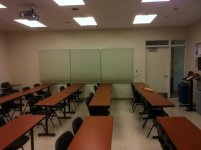
Here's a pic of the room. The bellow pic has the florescent lights I need to replace.
Flo lights.jpg
 
It is as simple as replacement light bulbs. But yet, still have a few things to be aware of.
Typically, those light fixture has four t-12 in there, make sure you get enough, kino bulbs. Schedule a little bit more rig time for yourself since you never done it before.
Kino bulb is tiny bit bigger than the t-12 because of the plastic protection around the bulb so take your time to put them on.
Be careful with Fluorescent and the plastic cover at the fixture, they both break really really easy. Put the fluorescencets in a safe place once you take them down.

As you see from the picture, there are alot of spill to the walls. Get duvetyne to block out the spills.
 
Are the lights going to be in your shots? We often turn them off and relight the set with our lights and then frame around the off lights. Another thought, it's going to cost a small bundle to re-tube every light with kino tubes. If they have to be on you could poison the overheads with a few tubes per unit.
 
The color balance in that shot looks pretty good. Have you tested some video there to see if you really have a big problem? Be nice if you don't have to replace them. Then, if you need to augment just use some of the tubes they're using in the ceiling lights in your Kinos.
 
So I took my AF100 down to the set and checked it out. It tinges a bit green. Not a ton, but I think I'll just put a 1/2 minus green around all the tubes and balance my camera to 3200K. It looks like the budget won't allow for buying kino tubes for all the lights.
 
Yeah, if you dont have the budget, I would just take some florescencents off the next door classroom and put them in your kino.
Renting kino tubes would be alot cheaper than buying.
 
Yeah, if you dont have the budget, I would just take some florescencents off the next door classroom and put them in your kino.
Renting kino tubes would be alot cheaper than buying.
Exactly. And I usually find the bldg maintenance guy and ask him for some tubes. You'll have to swear to return them and buy him lunch but he'll take care of you :)
 
So I took my AF100 down to the set and checked it out. It tinges a bit green. Not a ton, but I think I'll just put a 1/2 minus green around all the tubes and balance my camera to 3200K. It looks like the budget won't allow for buying kino tubes for all the lights.

Sound like a good plan. Also someone mentioned duvetyne, I agree too much wall spill for my tastes.
 
I have a question along similar lines:I am building a recording studio which will be used for video shoots.There will be a large picture window overlooking an arbor.What is the best method for balancing the natural ambient light with artificial light?1) gel the window with daylight to tungsten, use tungsten fixtures & shoot tungsten WB2) gel tungsten fixtures to daylight & shoot daylight WB3) use daylight CFL's and shoot daylight WB4) use 3200k CFL's, gel the window for tungsten and shoot tungsten WBThe studio will predominantly be used with the window blocked by an acoustic barrier & shooting entirely under artificial light, with occasional shoots with the window open & supplemented by artificial light.
 
Last edited:
I have a question along similar lines:I am building a recording studio which will be used for video shoots.There will be a large picture window overlooking an arbor.What is the best method for balancing the natural ambient light with artificial light?1) gel the window with daylight to tungsten, use tungsten fixtures & shoot tungsten WB2) gel tungsten fixtures to daylight & shoot daylight WB3) use daylight CFL's and shoot daylight WB4) use 3200k CFL's, gel the window for tungsten and shoot tungsten WBThe studio will predominantly be used with the window blocked by an acoustic barrier & shooting entirely under artificial light, with occasional shoots with the window open & supplemented by artificial light.

Whatever you decide, I'd suggest you go flo over tungsten. Power, heat, and the extra power (and heat) needed to overcome your CTB... ack.
 
For temporary location use you can also rent plastic tubes (or plastic sleeving) that slip over the fluorescent bulbs which will knock down the typical big green spike. They make the lights look a lurid purple-pinkish to the eye. Or buy the same minus-green filter material in sheets and lay it on top of the plastic diffuser in the ceiling fixtures.

For fixed use (like the recording studio) I would use electronic ballasts in any case (to avoid buzz/hum in the audio, even if you weren't doing video.) And, of course install bulbs with the desired color temp.

Beware that you can't typically put a dimmer on any old fluorescent ballast, even modern electronic ones. If you want to dim them either get dimmable electronic ballasts, or (even better, IMHO) get the ballasts that are self-dimming with a 0-10V DC control signal.
 
Back
Top