Remote Phosphor Lighting, which one?

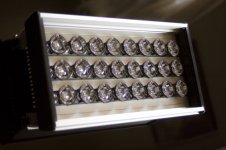
The actual unit prototyped, but photoshoped just the front panel in place to have an idea of how the unit would look when finished. The aluminum casing will be available in black or deep blue anodizing. You can say it is just an artist's conception at this stage.

That looks very nice. Simple and efficient, I like it. I would definitely be interested in something like that as well.
 
Remote phosphor will surely be a hot topic of discussion until the LEP ( light emitting plasma ) becomes a viable reality in the not too distant future. I like the fact that remote phosphor can be done on currently available components and works with the same power DC driver principle as the regular leds, just their wavelenghts are different, ultra blue vs white. The RP panels are available by several mfrs.
The panel must be very evenly lit by the blue leds within the enclosure with minimal internal light loss. This will be my main area of concern but I came up with 2 possible methods to achieve this.
1- using highly reflective internal baffling ( I already have 4 different material choices) between the leds and the walls of the enclosure.
2- using more leds and closely spaced together, great idea but will add to the cost of materials.

Using the baffling will require more labor/time to install properly = $$.
Using more leds will add to the material cost which is greater than the baffling idea.
Using more leds will allow EACH led to operate at a much lower current and thereby raising their efficiency with a possible 20% overall light ( lumen) output, greatly extending their life span.
As soon as I get my 1st unit done , hopefully by mid Oct., I will do the photometrics and sample photos & videos with it.
 
At this stage, the leds and the RP panel are installed in the chassis. The constant current drivers, each have a capacity output of 8 Amps for a total of 16 Amps will be capable of accepting DC input voltage from 12-24 volts. Even at the lower end of the input DCV range, the drivers will still be able to output their full rated current to the leds. I recommend using one of those 120 amp/hr brick batteries used for ENG work (14.4V DC).
The brick battery will clip on right behind the unit, no wires showing. It will also have a 4 pin DC XLR input as an alternate AC to DC operation with appropriate adapter box. Cooling fans will not be used in order to provide complete silent operation as well as avoiding additional battery draw. I have done a quick powering on test with the drivers throttled down to provide 5 Amps each to the leds. At the battery terminals from a fully charged brick, the voltage across was measured at 15.6 volts DC ( those bricks are rated at 14.4 but can be in the area of 18 volts when fully charged), and the current was measured to be 6.3 Amps. This means that the light was drawing just under 100 watts of power. After a full hour of operation, the light held it's brightness without and dimming noticed. The panel used for this test is the 4000K neutral. A lux reading ( incident) was taken at exactly 1 meter ( 3.3 ft.) from the panel and measured 7602 lux. which is roughly equivalent to 11,000 lumens considering the super wide angle it provides. A 1000 watt bulb filament when used in conjunction with a softbox/diffusion panel or umbrella will certainly not appear as bright as the bare bulb itself and can have a light loss factor as much as 2 full stops depending on the fabric/material used. That 1 K light may really be a paltry 350 watter or less when all is considered. When someone says a light has a 1 K softbox equivalent, just what are they talking about ? How about putting some actual measured numbers including distance and beam angle ? I have a small flashlight that runs off 2 batteries and is brighter than a 1K HMI. The trick is that it has an extremely narrow beam and can light up a barn door at 100 feet. At THAT distance, it is brighter than a 1 K softboxed.
 
Last edited:
What do you see as the practical limits for this?

- Phosphor panels - right now, the standard panels being offered are small. Do you think it is practical to make a panel/light in a larger size, say 12 x 24 to simulate a softbox?
- Gainging lights - could the units you are making be ganged without heat issues?
 
The light fixture can be made in larger sizes, just a question if the RP material will be made in larger sheets. So far the largest I have been able to get are in the 12 inch X 8 inch sizes but I cannot predict if there will be anything larger in the near future. I guess that demand for larger sheets will entice the makers to comply. I do see however, that the fluorescent ceiling fixtures in offices that are presently out there in the 2 feet X 4 feet panels will have the same size replacement with RP instead. If the cost goes down enough, then it will be a very viable alternative. At that point I just have to purchase a 2X4 feet sheet and cut away. In the meantime, I have to use what is available. Yes, you can gang them together( haven't thought of a scheme yet, perhaps using brackets of sort) , no heat issues as each unit is designed to have passive cooling and operate independently. I have already calculated the thermal properties of the T6061 aluminum chassis in conjunction with the leds and gave a 25% under maximum capability for heat dissipitation. The unit does get hot to the touch but that is normal as it dissipitates over 80% of the input power to heat. Leds being as efficient as they are only use a small fraction of the input power to convert it to light. A led may take in say 100 watts but only convert 20 watts of it to light. On the other hand, a 100 watt kitchen light bulb will convert only 4 watts to light and the other 96 watts goes as waste heat. You can say that a filament bulb is a heat radiator that gives off a little light. I do not think it will be practical to make them larger than what they are as the price would really go over the roof, being quite expensive as they are at the moment. A panel like 12X24 inches as mentioned would mean at least 200 ultra blue leds in them as well as a specially built custom driver with or without DMX, would go in the area of $5K at retail. Whew!!
 
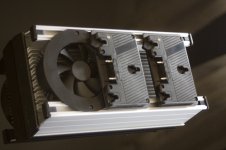
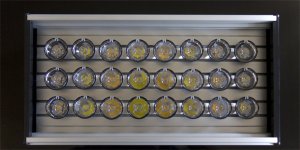
Perhaps a bit off topic on remote phosphors, but I just have to post a few shots of this battery operated beast I made. Based on 24 lighting class leds in the 5500K color and TIR optics in 20 degree beam.It necessitated a fan to tame it down. Well, here you have it, 24,000 lumens, get your RayBans, battery operated ( 2 bricks). Not for sale.2K5500FVlr.jpg2K5500Flr.jpg
 
A few minor modifications are in place, namely the 5 inch diameter fan will be replaced by 2 Sunon ultrasilent MagLev fans that are only 2 inches each in diameter and will be hidden by a top plate just under the 2 battery holders. That top plate will cover the entire 12 inch length of the unit and the heatsink fins will not be visible. The on/off and dimming control will be on the rear panel right of the 2nd battery plate.
The aluminum grey finish has been sent to the anodizer and will be in powdercoat black. Using 2 AB bricks at 120w/hr each rating gets this unit shining for a little over an hour. The leds are putting out a steady 100 lumens/watt efficacity at their 2.8 Amp feed. They are really being underdriven to prolong their longevity to 25K hours life cycle. I imagined a unit like this would be handy when no generators are allowed. The beam angle of the optics can be made in narrower or wider fields, and the color temperature in custom Kelvins. A similar unit like this one, however only in half the lumens using one battery is in the works that would have 12 leds in warm and 12 leds in cool and switching between them also would have the 4000K neutral color choice. 3200K-4000K-52000K. See photo.1K18MC.jpg
 
I've gotten my hands on the Area 48 from BBS lighting. They just redesigned their softbox.

how would you rate the light output through softbox with grid - did you test it, can you tell anything about it?
I had visited their booth once but it was an exhibition for event-technique and there were flashy and colorful lights all over the place so I really couldn't find out enough.
 
I've gotten my hands on the Area 48 from BBS lighting. They just redesigned their softbox.

Thoughts? I was supposed to have a look at the first one down here in Melbourne this morning, but they messed up the shipment, so it's going to be tomorrow instead. Hope to compare it to a Kino Flo Diva 400 for an idea of how well it'd function as a general purpose softlight.
 
Thoughts? I was supposed to have a look at the first one down here in Melbourne this morning, but they messed up the shipment, so it's going to be tomorrow instead. Hope to compare it to a Kino Flo Diva 400 for an idea of how well it'd function as a general purpose softlight.
Will you have the opportunity to test the soft box and snap grid too?
 
Will you have the opportunity to test the soft box and snap grid too?

Hopefully, depends on what accessories they're having shipped down with the unit (I get the impression this is the first, or one of the first units being sent to my state - so no one knows anything about them; or remote phosphor in general really).
 
Back
Top