
Navigation
Install the app
How to install the app on iOS
Follow along with the video below to see how to install our site as a web app on your home screen.
Note: This feature may not be available in some browsers.
More options
You are using an out of date browser. It may not display this or other websites correctly.
You should upgrade or use an alternative browser.
You should upgrade or use an alternative browser.
RED Komodo to start limited shipping soon for $6k
- Thread starter ahalpert
- Start date

NorBro
Major Contributor
Well, there is the theory that the cartel intentionally slows its own progress.
In which case maybe RED can catch up to them in a year with 2 computer science graduate students and enough pizza and coffee.
Seeing how you (and thousands of others) personally own 6-8-10+ cameras from 4-5 different companies...some would say they've accomplished their purpose, ha.
Another example can be made in IBIS...there is really no reason on God's green earth why Panasonic is the only company that has usable video IBIS (besides Olympus who doesn't really make video-focused mirrorless cameras).
Besides the fact that it is a delicate MEMS nightmare in terms of shock resistance and long term reliability, the move to global shutters goes a long way towards making it unnecessary.
NorBro
Major Contributor
Besides the fact that it is a delicate MEMS nightmare in terms of shock resistance and long term reliability, the move to global shutters goes a long way towards making it unnecessary.
Pretty silly thing to say, IMO...great IBIS is extremely necessary and has many purposes that no GS will ever help with.

ahalpert
Major Contributor
I side with NorBro - IBIS and GS serve separate functions.
"Your footage is shaky as hell."
"Hey - at least there's no jello effect."
That being said, IBIS may never find a home in high-end production where it's largely unnecessary and even detrimental. Sometimes, you want that handheld shakiness and then it's really great to have GS.
"Your footage is shaky as hell."
"Hey - at least there's no jello effect."
That being said, IBIS may never find a home in high-end production where it's largely unnecessary and even detrimental. Sometimes, you want that handheld shakiness and then it's really great to have GS.
I side with NorBro - IBIS and GS serve separate functions.
"Your footage is shaky as hell."
"Hey - at least there's no jello effect."
That being said, IBIS may never find a home in high-end production where it's largely unnecessary and even detrimental.
High resolution oversampling for 4K and post stabilization from gyroscope metadata seems to be the preferred high end approach. At least for RED.
NorBro
Major Contributor
People don't have time for software solutions hours/days later...need a stabilized sensor for so much run-and-gun shooting for immediate turnaround.
After AF, Panasonic's S1/H IBIS is the greatest camera technology ever. Makes certain b-roll so much fun to shoot when you can walk around without a tripod/etc. (And I don't mean walk around and film at the same time for gimbal-like results, but walk around and stop to get a shot at various focal lengths and have it be steady in your hands.)
After AF, Panasonic's S1/H IBIS is the greatest camera technology ever. Makes certain b-roll so much fun to shoot when you can walk around without a tripod/etc. (And I don't mean walk around and film at the same time for gimbal-like results, but walk around and stop to get a shot at various focal lengths and have it be steady in your hands.)
FWIW, the new Canon and Sony AF goes beyond DPAF. It incorporates AI. This is why you can get your cat in focus instantly. AI will pick up the eyes, if not the whiskers. And, because it is not proprietary, all the companies should have it by this day and age. It needs computational power and some savvy programming.
As to the cartel, it still makes 20 MPX MFT and 24 MPX APS-C and FF sensor cameras while the smartphones have gone onto 40-108 MPX on sensors much smaller in size. Samsung could have stuck with the fixed mounts a la RX 10 and RX 100 series and still made a killing.
As to the cartel, it still makes 20 MPX MFT and 24 MPX APS-C and FF sensor cameras while the smartphones have gone onto 40-108 MPX on sensors much smaller in size. Samsung could have stuck with the fixed mounts a la RX 10 and RX 100 series and still made a killing.
FWIW, the new Canon and Sony AF goes beyond DPAF. It incorporates AI. This is why you can get your cat in focus instantly. AI will pick up the eyes, if not the whiskers. And, because it is not proprietary, all the companies should have it by this day and age. It needs computational power and some savvy programming.
As to the cartel, it still makes 20 MPX MFT and 24 MPX APS-C and FF sensor cameras while the smartphones have gone onto 40-108 MPX on sensors much smaller in size. Samsung could have stuck with the fixed mounts a la RX 10 and RX 100 series and still made a killing.
Most of the truly advanced sensor developments show up in cell phone size sensors first. Huge market and tiny sensors are cheaper to make.
ahalpert
Major Contributor
And let's not forget that high megapixel is more useful on a fixed lens where you need to crop to get the framing you want.
The 1DX series could have higher resolution for the money you're paying. But those shooters generally frame in-camera and are more interested in high fps, unlimited buffer, and having manageable file sizes for fast delivery.
The 1DX series could have higher resolution for the money you're paying. But those shooters generally frame in-camera and are more interested in high fps, unlimited buffer, and having manageable file sizes for fast delivery.
As to the cartel, it still makes 20 MPX MFT and 24 MPX APS-C and FF sensor cameras while the smartphones have gone onto 40-108 MPX on sensors much smaller in size. Samsung could have stuck with the fixed mounts a la RX 10 and RX 100 series and still made a killing.
97% of folk don't need more than 20 megapixels.
(heck, even the Nikon D6 is a 20MP camera!!)
But cellphone makers are still on the megapixels bangwagon for the race to sell more units with marketing buzzwords
Phase One XF IQ4 has 150 MPX medium format sensor. For $52,000. It's $50,000 overpriced.97% of folk don't need more than 20 megapixels...
99.999% of people don't need a Phase One XF IQ4!
No. It's 99.9999999%.
Nonetheless. It'd move more units at lower prices.
ahalpert
Major Contributor
People don't have time for software solutions hours/days later...need a stabilized sensor for so much run-and-gun shooting for immediate turnaround.
I think when your AC is running footage back to the editors for same-day edit, you need in-camera stabilisation.
David Fincher will want gyroscope metadata for post-stabilisation.
And let's not forget that high megapixel is more useful on a fixed lens where you need to crop to get the framing you want.
Think about how tiny those little phone sensor pixels are, and the implications for sensitivity and DR. A big phone sensor is 1/4".
ahalpert
Major Contributor
Think about how tiny those little phone sensor pixels are, and the implications for sensitivity and DR. A big phone sensor is 1/4".
Supposedly pixel size has no relation to dynamic range.
Sensitivity - yes. But then people say that smaller pixels = finer noise = higher usable ISO. Plus there are some creative quad Bayer implementations trying to have the best of both worlds - high-resolution and sensitivity (not at the same time)
ahalpert
Major Contributor
This may not be the right thread, but we were having a Leica conversation earlier...
An interesting rangefinder just launched called Pixii. M mount, no screen, just a rangefinder viewfinder, and transfers photos automatically (and instantly?) to your phone.
Interesting for making you focus on what you're shooting rather than how! But APS-C (bad match for the lenses) and 2900 euros.
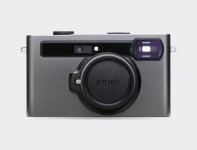
https://store.pixii.fr/products/pixii-camera
An interesting rangefinder just launched called Pixii. M mount, no screen, just a rangefinder viewfinder, and transfers photos automatically (and instantly?) to your phone.
Interesting for making you focus on what you're shooting rather than how! But APS-C (bad match for the lenses) and 2900 euros.
https://store.pixii.fr/products/pixii-camera