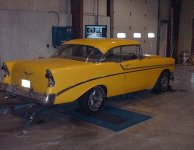
Recording Sound of Moving Car

Hello,

So over this weekend I was testing on recording sound of a moving car...kind of like Fast and Furious, where the car goes from 0-80+mph, as we are following it in a car. We where using a sennhesiner mkh-416, with the Blimp system and dead-cat. I knew our problem would obviously be wind, and was trying to figure out a way to cancel that noise out. We had it angled out the trunk of a car, but since no aerodynamics with an open trunk, it didnt help much.

Does anyone have any methods or solutions to recording a moving car/subject at these speeds? These are for the followCam shots, drive by shots was no problem...I will be doing this for future projects and need something that works. My only solution is to have the car on the dyno so it can run through all 5/6 gears but that is a last resort.

Thanks
 
Isn't what you're mostly after engine noise? If so, maybe try rigging up a microphone under the hood?
 
Usually the sound of moving vehicles is recorded with multiple mics: in the cabin, engine compartment and by the exhaust. (on separate tracks of couse) I would recommend dynamic mics for high SPL areas. Dynamic omnis are less susceptible to wind noise but something will be needed other than in the cabin.
IMO the 416 would not be for good for this.
 
Im mostly after exhaust noise, as these cars are modified and want that sound that you would hear if driving next to it. We did do some testing with under hood to get the Blow off valve purging, which came out good once we found a decent location.

I was thinking of creating a box, that is angled like a diamond, ( < ) with the microphone inside it. To reflect the wind to the sides, but dont know how much this might actually help...
 
Usually the sound of moving vehicles is recorded with multiple mics: in the cabin, engine compartment and by the exhaust. (on separate tracks of couse) I would recommend dynamic mics for high SPL areas. Dynamic omnis are less susceptible to wind noise but something will be needed other than in the cabin.
IMO the 416 would not be for good for this.

Yes we did record multiple locations of noise, inside the car, engine bay, trunk, and drive bye's, but the problem is with the followCam shots that we need audio matched up to...

Thank you for the input on using Dynamic Mics, I will do my research!
 
You don't want to record with a car on a dyno which is very noisy environment.

As Rick has pointed out, multiple dynamic mics are the norm. I have done similar recordings of various cars and then use a mix of the sounds to create the finished product. In one of my porta rigs I use anywhere from 5 to 8 mics into a MOTU interface and record with Boomrecorder on a Macbook pro. We always record on a closed track to avoid other sounds and address safety concerns. Always follow the tracks safety regulations. For example many tracks will not allow cars running antifreeze on the track.

Good Luck!

Dave
 
... but the problem is with the followCam shots that we need audio matched up to...

Car sounds in motion picture are created as much as they are recorded. Start with the different sound recorded in and around the car. There may be other sounds that you layer in through FX or Foley to create the "external" sound of the car for the follow shots, but it can certainly utilize the sounds recorded earlier. Perhaps you need to have a mic array (stereo, at least) mounted to the top of the car, well protected from wind, to get the passing wind sounds. But the point is that you can use the sounds you have already to create what you need: it's in the adjusted mix levels of each individual mic source, with a few extras added in to get the feel of being outside the car.
 
You will spend more time (ultimately wasted) trying to get BOTH good sound AND good video if you think you must shoot this IN SYNC. It is virtually NEVER the case where you can find a setup that will get what you want for both picture and sound. THAT is why the sounds are created and synthesized in the post-production mix. On casual inspection, it may SEEM like this is the more difficult method, but it is easier when all is said and done.
 
Hello,

So over this weekend I was testing on recording sound of a moving car...kind of like Fast and Furious, where the car goes from 0-80+mph, as we are following it in a car. We where using a sennhesiner mkh-416, with the Blimp system and dead-cat. I knew our problem would obviously be wind, and was trying to figure out a way to cancel that noise out. We had it angled out the trunk of a car, but since no aerodynamics with an open trunk, it didnt help much.

Does anyone have any methods or solutions to recording a moving car/subject at these speeds? These are for the followCam shots, drive by shots was no problem...I will be doing this for future projects and need something that works. My only solution is to have the car on the dyno so it can run through all 5/6 gears but that is a last resort.

Thanks

Quite a while ago Noiz posted about a small 'cheap' condenser mic that I recall him putting into a wheel well of a car (or something like that...).

In any case:

http://www.musiciansfriend.com/pro-audio/cad-cm217-condenser-mic--buy-one-get-one-free

The 2 for 1 price of $49.99 still seems to be available...

While this won't solve your wind protection problems... it may be 'cheap enough' to buy a bunch... and place around with varying protection.
 
You will spend more time (ultimately wasted) trying to get BOTH good sound AND good video if you think you must shoot this IN SYNC. It is virtually NEVER the case where you can find a setup that will get what you want for both picture and sound. THAT is why the sounds are created and synthesized in the post-production mix. On casual inspection, it may SEEM like this is the more difficult method, but it is easier when all is said and done.

No, I know I wont be able to and never said I want to record this in SYNC. I have ALREADY recorded ALL the VIDEO, and have moved on to the audio/sound fx portion of this short. I understand I need multiple takes from different positions around the car and inside the car which I have done. My question was how to record a moving car at high speeds without wind noise. Which input was given saying use dynamic mics.
 
My question was how to record a moving car at high speeds without wind noise. Which input was given saying use dynamic mics.

Dynamic mics are not impervious to wind noise, especially when hanging one out of a moving vehicle. Any mic that you use will need wind protection. But... the sounds you have already recorded from different areas around the car can be used to create what you want, just focusing more on the sources on the outside of the vehicle. You may need to add some textures through FX and Foley (such as splatters of water, or tiny bits of gravel and dirt and debris crunching through the tire treads) to enhance the "exterior" soundscape.
 
I kind of skimmed so I apologize if I'm repeating others.

I have done a lot of cars. First speed is not necessary, at least not high speed. The speed doesn't get you anything. A car going fast is mostly about engine RPM so you can go at a nice safe speed and get better sound. At high speed you get too much wind and other things people don't "hear" in real life.

We would generally stick a mic under the hood (be careful though because the wires going to the spark-plugs are EXTREMELY high voltage and they will fry anything electronic that is close so stay away from them. A second mic usually dynamic with lots of foam gets taped so it will get a good shot at the exhaust. With another recorder or another channel if you have it a mic inside the cab is good and a mic close to the wheel well with a LOT of foam) is good to get an interior and tire sounds.

As to driving you need to find a hill. You need the engine under strain and you can't get that on the flat.

Shifting is good but really hard to get in an automatic. We also would have a mic recording the "by" in stereo. You want to follow the car so you can stretch out the by as much as possible because the camera tends to do the same so a "real" by is generally way too fast. In all the cars we probably never got over 45 or so.

If you have a very safe street you can do break screeches also. You need to be going down hill (not very steep) and use the emergency break (on any recent car they have ABS which will defeat any slammed on breaks, the emergency breaks only activate the rear breaks so it is safer and a lot easier to lock up the wheels). I may delete the above since you REALLY NEED to practice where you are NOT going to hit something. Once your wheels lock up even just the rears, you are not totally in control of the car and VERY bad things can happen. But it's a lot safer than slamming on the breaks on a car with out ABS. This is also not a speed thing, it's weight and the inability of just two wheels to stop a moving car. We never drove fast. Again probably never much over 35 and never over 45 or so.

Do not try this on a road where thee is any chance of cross traffic, bicycles, joggers, and you don't have a good 1/4 mile+ visibility. And let me say again DO NOT go really fast. It is NOT better sounding and the danger goes up drastically.

A good bit of training for this kind of thing is a big graven parking lot on a day with no cars there. Try skids and such so you know what it feels like to not have the wheels doing the steering. Actually I think this would be good for all drivers. It probably saved my life once (not recording sound) when I hydroplaned on the freeway in a rainstorm.

OK long post. But I have recorded everything from planes (taking off maybe 10 ft over my head (now that is a shorts checker)) and sports cars to semis and trains. I have yet to get any serious injuries doing it but I am VERY paranoid. On the plane shoot series, three pilots died. Not while we were shooting but fast things can kill you. And things go bad faster than you can think. I have had things go bad and there is just the before when everything is fine and the afterward where there is a lot of pain. I have avoided hospitals in the painful afterward, but there has been plenty of pain.

The message is spend 90% of your time thinking of ways it can go wrong and how to avoid getting killed. That will make the other 10% much more fun.

This really goes for all car recording. You don't need speed and speed is VERY hard to control. Plus it doesn't sound good.
 
For a low budget/amateur film without any pro drivers or a dyno; could analog synthesis in the studio help?
Maybe some existing auto sound effects (engines, drive-bys) mixed with some motorcycle engine sfx or other engine recordings, sped-up/slowed-down as necessary, with maybe some low frequency oscillator through a tube amp or distortion plug-in, and some panning and volume effects for movement?

Just thinking out loud. Maybe the "let's try driving fast" approach isn't in everyone's best interest?

GJ


I kind of skimmed so I apologize if I'm repeating others.

I have done a lot of cars. First speed is not necessary, at least not high speed. The speed doesn't get you anything. A car going fast is mostly about engine RPM so you can go at a nice safe speed and get better sound. At high speed you get too much wind and other things people don't "hear" in real life.

We would generally stick a mic under the hood (be careful though because the wires going to the spark-plugs are EXTREMELY high voltage and they will fry anything electronic that is close so stay away from them. A second mic usually dynamic with lots of foam gets taped so it will get a good shot at the exhaust. With another recorder or another channel if you have it a mic inside the cab is good and a mic close to the wheel well with a LOT of foam) is good to get an interior and tire sounds.

As to driving you need to find a hill. You need the engine under strain and you can't get that on the flat.

Shifting is good but really hard to get in an automatic. We also would have a mic recording the "by" in stereo. You want to follow the car so you can stretch out the by as much as possible because the camera tends to do the same so a "real" by is generally way too fast. In all the cars we probably never got over 45 or so.

If you have a very safe street you can do break screeches also. You need to be going down hill (not very steep) and use the emergency break (on any recent car they have ABS which will defeat any slammed on breaks, the emergency breaks only activate the rear breaks so it is safer and a lot easier to lock up the wheels). I may delete the above since you REALLY NEED to practice where you are NOT going to hit something. Once your wheels lock up even just the rears, you are not totally in control of the car and VERY bad things can happen. But it's a lot safer than slamming on the breaks on a car with out ABS. This is also not a speed thing, it's weight and the inability of just two wheels to stop a moving car. We never drove fast. Again probably never much over 35 and never over 45 or so.

Do not try this on a road where thee is any chance of cross traffic, bicycles, joggers, and you don't have a good 1/4 mile+ visibility. And let me say again DO NOT go really fast. It is NOT better sounding and the danger goes up drastically.

A good bit of training for this kind of thing is a big graven parking lot on a day with no cars there. Try skids and such so you know what it feels like to not have the wheels doing the steering. Actually I think this would be good for all drivers. It probably saved my life once (not recording sound) when I hydroplaned on the freeway in a rainstorm.

OK long post. But I have recorded everything from planes (taking off maybe 10 ft over my head (now that is a shorts checker)) and sports cars to semis and trains. I have yet to get any serious injuries doing it but I am VERY paranoid. On the plane shoot series, three pilots died. Not while we were shooting but fast things can kill you. And things go bad faster than you can think. I have had things go bad and there is just the before when everything is fine and the afterward where there is a lot of pain. I have avoided hospitals in the painful afterward, but there has been plenty of pain.

The message is spend 90% of your time thinking of ways it can go wrong and how to avoid getting killed. That will make the other 10% much more fun.

This really goes for all car recording. You don't need speed and speed is VERY hard to control. Plus it doesn't sound good.
 
I'm sure if you watch many of the Fast and Furious films you'll realize how much of the sound is fake/greatly exaggerated (like with much of sound work). Plus, why do cars make screeching sounds every time they stop/drive off in movies? Exactly...
 
“The sound element of the picture is critical to me,” Cohen continues, “and so much depends on how you mix it. It can be mixed in a way that is thrilling and specific and multi-layered and dimensional, or you can get a hodgepodge of noise that will actually be painful.

Interesting.
 
Thanks all for your reply....most of your input has helped. I should have described this short in full detail to help get a better understanding.
 
For a low budget/amateur film without any pro drivers or a dyno; could analog synthesis in the studio help?
Maybe some existing auto sound effects (engines, drive-bys) mixed with some motorcycle engine sfx or other engine recordings, sped-up/slowed-down as necessary, with maybe some low frequency oscillator through a tube amp or distortion plug-in, and some panning and volume effects for movement?

Just thinking out loud. Maybe the "let's try driving fast" approach isn't in everyone's best interest?

GJ

WEll Dynos are pretty useless because they make so much noise on their own and well they are generally in some place not out in the open.

But if you read my post I strongly don't recommend "driving fast". It's dangerous and doesn't sound good.

Of all the cars I have recorded the only professional drivers we ever used were for the tractor trailers, for obvious reasons. Some had experienced drivers and we just rigged them but mostly it was just us SFX guys doing the recording and driving.

You are of course going to layer it up and build it. But synths are generally a waste of time. Samplers are useful but studio synthesis sounds like what it is. If there is no great reason to use the "real" car sounds you can go record anything that sounds the way you want the "character" car to sound like.


kylevant,

Because it sounds cool. That's why it's what car thief's do after they jack your ride and why Formula D racing exists.

It can be over done, but it does sound cool.
 
Back
Top