Recording small orchestra / ensemble?

firehawk

Veteran
Looking for advice on recording a small ensemble video. Similar to this. Not sure total size just yet
https://youtu.be/oWJynlA88RI

I'll have more information soon but I am curious about these mics I see in the video. I have quite a few different mics. Not sure where to start.

Seems a high XY placed mics and then a mic near each musician?
I also have some audio recorders such as Sony PCM 10 that record stereo and have always served me well. Maybe put a couple of those up on a stand?

From 1st comments it sounds like a small budget so running a bunch of mics to a nice sound mixer probably not likely. So I was considering using some audio recorders like the Sony mentioned above to take the mic feeds and then mix the recordings in post

----EDIT---- more information now-----

Only 3 musicians - cello, violin, piano. No conductor.
(Photo in lower thread)
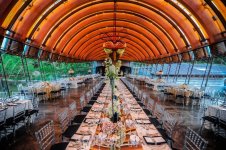
No Audience. It is in some type of hall I believe the photo attached is correct.
We have the ability to position musicians and cameras where we want.

Delivery viewing is web/computer/mobile.

They want it to look and sound good, not CD master quality, but small budget is big determining factor.

We can do multiple takes with adjustments.

The audio is the part I'm concerned about. I would use multiple camera angles and maybe a jib if we can fit it in budget.
Here is what gear I have in case any of this is useful:

Mics:
(2) Tascam TM-PC1
(1) Shure PG57
(1) Shure PG58
(1) Audio Technica AT822
(1) Audio Technica AT 4053B
(1) Rode NTG-3
(1) Sennheiser MKH 416 P48
(1) Sennheiser ME66
(1) MXL 890
(2) Panasonic MIC 150
(3) Sony ECM XM1
(1) Azden SGM PDII
(1) Audio Technica AT 875R

Recorders:
(1) Tascam DR701D
(1) Tascam DR 40
(3) Sony PCM M10
(1) Zoom H1
 
Last edited:
To be honest, this is the wrong forum for this type of question. A few people may have enough experience with this to advise, but I would recommend the location recordist section of sound forums like Gearslutz. Even if you end up going with a handheld recorder on a tripod (I wouldn't recommend doing that even on a tight budget), there are things to consider with regard to placement, acoustics, etc, that are best answered by those who record large ensemble acoustic music on a regular basis.

BTW, in some ways a small string orchestra is easier to record than a piano trio like the video you linked to, mainly because the latter has piano involved and can be really tricky to balance unless you are an experienced location recordist. For a string ensemble, you can get away with a stereo pair if well placed in a good sounding hall. BTW, I'm an orchestra conductor and video producer, so I'm prone to being a bit picky about these things. I don't actually know what the expectations are from your client for the deliverables here, so take what I am saying with a grain of salt.
 
Last edited:
To be blunt, are you asking how to do the job? Or is it a paid job? As per the video, the setup is pretty straight forward. XY or two straight is always going to be a distant type of sound. Audience or wide shots might determine where you can place this.
 
Some of us do do this kind of thing - I certainly do, and the video only folk who come to it see a few mics dotted about and assume it therefore is a simple task.

This video is deceptive. A LOT of money has gone into this. Spend some time with the Shoeps and DPA websites to see the scale of event.

Mixing the stereo techniques, with coincident through to wide spaced arrays gives amazing scope and very venue critical differences, and if you do these things, it's critical to have some kind of loudspeaker monitoring system in the venue to set the spacings and angles of the array, and adjust the array itself in rehearsal. In familiar venues it means the location (in 3 axis) is pretty well known, but many people, me included use our ears then instigate a belts ahnd braces approach so we also close mic or semi-close mic each instrument so we can blend the thing together back in the studio. For video it's always a battle to give clean framing without the mics intruding, so always a compromise. My biggest battle is always with acoustics. The space needs the mics in a certain place, but the cameras say no. Sometimes it ends up being a client decision. Which is more important, sound or vision? This trio have 6 mics we are aware of, perhaps even a couple more we are not. To do something like this without being able to hear the results at rehearsal mean it's not a first recording scenario. It's also quite equipment heavy. Oddly, the biggest problem with these things are the flown mics. In concert halls there are normally proper rigging points that you can use to fly your kit - if you have it. various premade lengths of (in my case) 3mm aircraft type steel wire rope in black, all kinds of straps, shackles and shock mounts. In non-concert hall situations, like churches or theatres there may be no practical way to hang a microphone where you want it, unless you have with you ladders and the ability to use bridles between available structural points to get the hanging points in the right place. Portable recorders aren't that trick to get any longer - the zooms being very popular, or maybe an interface or mixer, direct into a mac or whatever.

If you look carefully, you'll see the flown mics are not X/Y. The DPA folk have a microphone university on-line where you can see many of the different mic techniques shown, with angles and spacing. X/Y requires the capsules to be near coincident, so the differences between left and right are done by the polar patterns, with the capsules time aligned, so the differences are in level between left and right. As you separate the capsules you start to get time differences AND level differences. This has a big impact on the stereo field, but also on mono compatibility. It's interesting to do some research on this, as some techniques have an inherent 'hole in the middle' where some player locations sort of drop or even vanish. It's a bit of a minefield for newcomers. Being frank, the people who do multitrack music recording assume 2channel recording is much, much simpler. In practice, the reverse is true. A two channel, stereo recording is the hardest to do if you base your success/fail criteria on the music you hear recorded by the folk at Deutsche Grammophone or any of the big classical companies. It's very much right mic, right place, right venue.
 
Thanks everyone. I have more information now:

Only 3 musicians - cello, violin, piano. No conductor.

No Audience. It is in some type of hall I believe the photo attached is correct.
We have the ability to position musicians and cameras where we want.

Delivery viewing is web/computer/mobile.

They want it to look and sound good, not CD master quality, but small budget is big determining factor.

We can do multiple takes with adjustments.

The audio is the part I'm concerned about. I would use multiple camera angles and maybe a jib if we can fit it in budget.
Here is what gear I have in case any of this is useful:

Mics:
(2) Tascam TM-PC1
(1) Shure PG57
(1) Shure PG58
(1) Audio Technica AT822
(1) Audio Technica AT 4053B
(1) Rode NTG-3
(1) Sennheiser MKH 416 P48
(1) Sennheiser ME66
(1) MXL 890

Recorders:
(1) Tascam DR701D
(1) Tascam DR 40
(3) Sony PCM M10
(1) Zoom H1


eleven-reception_51_526368-1556721052.jpg
I will also explore on the other site.
Thank you all very much for any input. This is a learning experience for everyone involved.
 
I used to assist on this sort of thing many many many years ago. And recently, I've gotten back into recording small ensembles, but mainly for fun (ie- low stakes and quality concerns). So the deal is I have a solid audio background and that's helped me from totally blowing it. Anyway, Oz and Paul here have suggested some good online resources. Namely:

DPA's Mic University:
https://www.dpamicrophones.com/mic-university

A sample article:
STEREO RECORDING TECHNIQUES AND SETUPS
https://www.dpamicrophones.com/mic-university/stereo-recording-techniques-and-setups

And Gearslutz, a site I search and read when looking for specific info... I greatly benefit from the contributions of everyone on that board:
https://www.gearslutz.com

Me, if I'm in a hurry, I find that an ORTF or NOS arrangement with my (recently bought) Line Audio CM4 cardioid mics can cover small acoustic ensembles decently (yes, they're not the ultimate ORTF mic, but they can work... depends on the space, instruments, etc). Often into a Sound Devices 442 and/or 744T since I like those preamps for music. But note that music recording is for me a hobby, not my bag (unlike production sound).

Here's a fun calculator/visualizer that can get across some of the differences in various mics setups. It's not a recipe generator, but it is useful and nicely made.
http://www.sengpielaudio.com/Visualization-ORTF-E.htm


[Edit since I just saw your post]
The piano's could make that a bit tricky to balance, ime. You might want to rent some good music mics to make everything work. Maybe go ORTF in the piano, and perhaps instrument (or at least solo) mics for the violin and cello. And then mix (that seems like what's going in in the Alice Tully video you linked to). Microphone rentals are really inexpensive, but as has been said, placement is key. Great question for gearslutz, but there are some cranky people over there (also a whole bunch of generous and smart people). Can you bring in someone with experience with this sort of thing to help?

I'll totally defer to others on this topic. Good luck and have fun!
 
Last edited:
You don't have too much choice here, only having one stereo pair of mics - the Tascams, but a few thing leap out. Concave ceilings are horrible, acoustics wise as they create very strange nulls and worse, the opposite where a certain position is at the focal point and everything seems mega loud if the sound source and the mic just happen to be in the wrong place.

With your mic choice I would record all using close/sem-close mic positions and get as much separation as possible and mix it in the studio and use artificial reverb to make it sound nice.

The 4ch 701 recorder will do the trick. I'd probably use the pair of Tascams on the piano, with the MXL on the cello and the 4053 on the violin. Position wise - two boom stands on the piano with lid on half-stick - favouring bass and treble strings in the usual close mic position, the cello to the players left about a foot out, looking down between bridge and the end of the finger board. Violin wise, tricky as you need to assess the instrument and the way the player thrashes about. Some are static so a high boom looking down from around 1-2ft at the area around the centre of the triangle created by end of fingerboard/brudge and f-hole. If the violin is very bright and screechy, more f-hole, if it's mellower, then anywhere. If the player moves a lot a bit further away, but use the mic nulls to remove as much of the piano as you can. That will sound fine - making it look nice is up to you! Close miking will hopefully remove what will almost certainly be horrible real acoustics. Expect the live sound to be dry and very changeable as you walk around the space. Hence getting mics in close and adding reverb when you blend the mics.Note - you are NOT using and stereo techniques here - the two mics on the piano need blending, they won't be hard left and right panned.
 
I'm happy to share what's worked for me but I want to start by deferring to members like paulears here, who are clearly far more knowledgeable than myself. In my experience doing some small concert recordings (which I haven't done in well over a year) I had success with a variant of what's being suggested by others here: i.e., separate mics for each performer and then mixing and adding some presence in post. Here's one example with a violin and harpsichord: https://drive.google.com/file/d/1Wjao98RxZ6pH1hjo6WaCg0SKPFDMw-ho/view?usp=sharing

I went with four Rode M5's going into a Zoom F4. On the harpsichord I used a stereo-spaced pair and on the violin I used X/Y spacing; this was a long time ago, but I went with these arrangements based on some research I did poking around on various audio sites and forums. Harpsichord is a very different beast than piano, though, so keep that caveat in mind.

I don't have the original files in front of me to confirm if this was the case on this concert, but generally I also ran a second recorder in case I wanted some sense of the space to mix in: often this was a Zoom H4n, H6, or H1.

In the end my client was happy and liked the sound. To my ears it sounds perfectly fine but I'm no audiophile.

One thing I'll add regarding mic placement and video: I've had at least one performer tell me that musicians are totally accustomed to sacrificing visibility for the sake of better mic placement, and that viewers expect this as well. Over the course of doing several concert recordings I've never had anyone complain about a mic being in a shot.
 
Oh - you've not lived then! I've had people complain about pretty well everything over the years. I've had all kinds of potential train wrecks. I spent ages sound checking and tweaking a choir's microphones, and then when the audience arrived we started and three pieces in. Half the choir got up and moved to the choir stalls, rather than from the proper tiered seating they used for the first section. No mics covering the choir stalls because nobody mentioned they'd be used! I'd got rather a nice reverse angle from a gopro, careful positioned on a magic arm, and the entire shot was the back of somebodies head from that point on. One soloist climbed into the pulpit to sing one of her pieces. This is why I always make a point in an email to ask about what is the most important thing, so you know when there is a compromise. Lots of my work take place in churches, and it's so common for there to be rules the client isn't aware of that wreck things.

In fairness, if the space sounds good when you are in it, it's pretty hard to get a bad sound. What actually happens is that the venues with nice acoustics sound good - the usual thing is it's over reverby - but sometimes that sounds perfectly acceptable. The snags are that balance issues cannot be fixed. If the piano is too loud, then as it also has the widest frequency range, it's tricky to fix as the usual tricks leave the piano sounding weak. Close mics give you scope to fix it - the balance between wanted and unwanted sound makes the job easier. I've made it a rule, wherever I can to only buy versatile mics in pairs. I'll buy a specialist mic as a single, but two identical modest condensers are so much more useful than one really good one. There are also 'rules' to follow and 'rules' to ignore. You'll find people recommending recording instruments in 'stereo' - and often this really doesn't work. if you are ten feet away from a violin, or a voice, or a guitar or a trumpet using two mics will NOT produce stereo from that instrument, because the instrument is a point source - it has no width. An X/Y or A/B pair of mics will record the sound of the space in stereo, but leave the focus instrument a bit of a mess in the middle. A piano, or a harp has real width, so using the harp as an example, you can hear with your eyes closed, that some notes are on one side, but others are on the other side. The trouble is that when listened to from the perspective of a member of the audience - at twenty feet away, it's point source again BUT the power from those short high strings is very low compared to the longer strings, so your two mics will allow the string and weak to be balanced in volume.


Whenever you do classical style recordings also consider the camera mics - with solid state cameras, the quality of the recording from the internal mics can be surprisingly high and perfectly possible to use once synced up. I've got an old handicam Panasonic SD9 that I often stick on a tall stand as a fixed camera for a really wide angle, and it has 5:1 sound that is surprisingly useful in churches and con cert halls to use with the closer perspective mics.

In nice spaces you can also experiment a bit when you have extra mics. If the performers have a natural balance when you are standing in front of them, you can capture that many ways. even mono! I'm not a huge fan of M/S for example, but when presented with too much distance, the 416 in that list can give you a bit more focus if you combine it with a pair of cardioids that have their nulls facing the direction of the 416. I don't think I've ever seen this technique in the books, but when you get back to the studio you can use the two cardioids as 'space capture' so the reverby, reflected sound of the things in the centre, panned hard left and right, with the centre mic capturing the performers. The 416 captures them in mono, and your two mics provide the stereo effect. You can, however experiment by reversing the polarity of one of the two cardioids which produces a kind of 'side' signal, which you can try to use as M/S. It's not real M/S which needs a figure of 8 mic, but can be quite effective if the space is very live. None of what they produce is accurate stereo field, but can sound really nice.

This doesn't work in poor acoustic spaces. It's just a mess, hence why close miking can solve the day. Recording real acoustic spaces is damn hard for beginners. I am happy to admit that I cheat frequently and the videos have far better sound than was really evident on the day.

I have friends who swear by Decca Trees and will do anything to get one hauled up to the optimum location. Me. I'll happily use X/Y or maybe ORTF which are more simple to rig and predict.
 
Oh - you've not lived then! I've had people complain about pretty well everything over the years. I've had all kinds of potential train wrecks.

Ha! I suppose I haven't. Over the years I've probably done only a dozen or so concert recordings (plus maybe another 5-10 I did for free when I was learning and experimenting). And while I've had a few moments of panic—e.g., showing up and realizing that whatever I was told over email is entirely not the case—I've been relatively fortunate. Probably the "worst" was being told that I had to move my camera for fire safety rules (totally fair) after I'd spent 15 or so minutes setting it up for the "perfect" shot.


In nice spaces you can also experiment a bit when you have extra mics. If the performers have a natural balance when you are standing in front of them, you can capture that many ways. even mono! I'm not a huge fan of M/S for example, but when presented with too much distance, the 416 in that list can give you a bit more focus if you combine it with a pair of cardioids that have their nulls facing the direction of the 416. I don't think I've ever seen this technique in the books, but when you get back to the studio you can use the two cardioids as 'space capture' so the reverby, reflected sound of the things in the centre, panned hard left and right, with the centre mic capturing the performers. The 416 captures them in mono, and your two mics provide the stereo effect. You can, however experiment by reversing the polarity of one of the two cardioids which produces a kind of 'side' signal, which you can try to use as M/S. It's not real M/S which needs a figure of 8 mic, but can be quite effective if the space is very live. None of what they produce is accurate stereo field, but can sound really nice.

Very interesting! I don't think I've ever come across something like this, but I'm certainly intrigued by how it might work out and sound.
 
Wow wonderful advice! Thank you!

I didn't think to mention these before because I figured they are wrong kind of mic but I do have 2 other identical microphones if they would be useful:
(2) Panasonic MIC 150


That must have been a stressful time when half the choir got up and moved, Paul. That reminds me of a live shoot I was doing and I asked more than once to confirm that everything happens only on the elevated stage, right? Yes. And then surprise they did an act on the lower floor and also behind me!
 
Last edited:
Based on your questions, the venue, and your equipment list, my best advice is that you hire an experienced audio person. You have too much to learn, and this is too difficult a venue, for you to have much chance of success, whereas a reasonably experienced, well equipped, and competent audio person might pull it off.

Too many people think that this kind of work is all about the video with audio being an afterthought. It does not work that way. People will put up with all kinds of bad video work, but if the audio is bad they'll get up and walk away. I've seen it happen more than a few times, and I've done it myself. Good audio is at least as important as the video, and just as difficult. One person can not do both at the same time -- it's too much of a work load.

BTW, how do you plan on monitoring what you record? IOW, how will you get sufficient feedback on what you're doing to know if you need to change it?

Anyway, if you insist on doing this on your own, head over to the Gearslutz Remote Possibilities in Location Recording & Production forum. Do some searching -- this type of question has been asked and answered many times before. There's plenty you can learn there, if you're willing to read some threads and pay attention to what the people there can tell you.


Thanks everyone. I have more information now:

Only 3 musicians - cello, violin, piano. No conductor.

No Audience. It is in some type of hall I believe the photo attached is correct.
We have the ability to position musicians and cameras where we want.

Delivery viewing is web/computer/mobile.

They want it to look and sound good, not CD master quality, but small budget is big determining factor.

We can do multiple takes with adjustments.

The audio is the part I'm concerned about. I would use multiple camera angles and maybe a jib if we can fit it in budget.
Here is what gear I have in case any of this is useful:

Mics:
(2) Tascam TM-PC1
(1) Shure PG57
(1) Shure PG58
(1) Audio Technica AT822
(1) Audio Technica AT 4053B
(1) Rode NTG-3
(1) Sennheiser MKH 416 P48
(1) Sennheiser ME66
(1) MXL 890

Recorders:
(1) Tascam DR701D
(1) Tascam DR 40
(3) Sony PCM M10
(1) Zoom H1


View attachment 141088
I will also explore on the other site.
Thank you all very much for any input. This is a learning experience for everyone involved.
 
pasted image 1008x768.jpg
Screenshot 2020-11-03 at 15.56.00.jpg
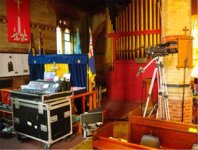
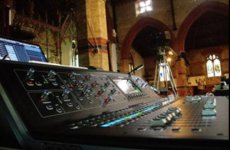
Here's a few images from Church style things we do (or more accurately did!)


That Panasonic mic is a OEM product, and the same one is on quite a few Sony's too - I have one here that's the same. They're a pleasant condenser, and don't sound too bad, but they're really a strange pattern - they're not a shotgun, but a kind of super-cardioid/hyper cardioid.
 
Last edited:
Despite Paul's great and generous posts, I think Bruce is right here. As I mentioned, I do some music recording and I'm kind of OK...and I have years of (long ago) studio and decades of (up to now) location audio experience. You may be able to get semi-decent tracks, but will you, the musicians and the clients be happy with them? Frankly, maybe not.

Someone who regularly records classical ensembles (or at least small acoustic combos) will have the needed equipment and experience to quickly set up and capture good tracks (including lots of cables and headphones that isolate them from the live instruments), collaborate on placing musicians in a way that works both visually and sonically, and get everything during the first good take (don't want to exhaust the musicians). The time savings and greatly-improved odds of great tracks and mix will help keep the shoot fun and a lot less stressful.

And then you can focus on everything else in the shoot.

Last week, I ran a focus group (ie- a Zoom chat) about improving a local performing-arts nonprofit's live streams of spoken word and music performances. As in: where should money be spent to improve the streams. Without leading questions from me :-) everyone in the group who watches the stream (ie- regular people, not those who produce it) said that they don't really care about video quality above a low threshold, and after months of cruddy videoconferencing images, it seem that threshold is lower (better is always better, of course). But audio quality is absolutely important. They're going to spend money to improve their audio (a bit of equipment, but mostly carefully tweaking what they have). Ya, same old story... but now regular people seem to know and are able to articulate that.
For you, maybe spend what budget you have on hiring a good audio person; if it's for a worthy nonprofit, you might be able to get a break on rates. Yes, I don't like to advocate that, but it's a reality. Is there a local radio station that sometimes broadcasts live performances? Or a recording studio that works with bluegrass bands or classical musicians (note that someone who's only worked in recording studios might not be ready to roll on location...but they might be up for the challenge), or a college with a small performance stage? Where are you located? Perhaps someone here can recommend good people...

OK. That's enough from me. Good luck!
 
Cool pics, Paulears. Thank you for sharing.


Ahh I see. I also have (3) matching Sony mics ECM XM1 too. And (1) Azden SGM PDII (1) Audio Technica AT 875R I didn't mention before.

Bruce and others have good points. Thank you all.
I know the audio is most of the video and anticipated the piano and the venue being challenges.
I have been trying to determine if I can pull it off.
It wouldn't be just me solo.
My original thought was to have them play the loudest and softest parts and then set my levels to that so auto gain doesn't adjust the music for me.
Mic each up close and then set up some extra mics and recorders around too as well as record with on-camera mics so I'd have a lot of audio tracks to work with.
As far as monitoring, my original thought was to monitor via the mixed line out of the Tascam DR701D so I could hear what was going on and adjust.

This may be too tricky and need someone with a lot more experience.
The plus side is we can run through this many times and adjust since there is no audience.
The down side is it needs to sound good, not great, but budget is small. I want a big car at a small car price, hahaha

At this point, I think the main burning question (from an outsider's perspective) is about the client/viewer. Who is the client? Is it the ensemble? Are they professional musicians looking for a video of their work? What is the purpose of the video?

You are getting a huge range of suggestions but you are also making it clear that there is a very small budget AND that you don't have any experience doing this type of thing, which is VERY difficult.

All that said, maybe it doesn't matter that much? Is this a student group? Are they playing a pop arrangement with classical instrumentation, or classical repertoire?

If the answers lean in the direction of: pro group, classical repertoire, need high quality audio, etc, then you simply cannot pull this off with the limitations that you've conveyed (budget, equipment, experience).

If the answers lean in a much more forgiving direction: non pro group, final product is not promotional for said group but used for something less critical, pop music, etc, then some of the suggestions in this thread can be employed and everyone lives with the results.

BTW, I'm only mentioning pop music vs classical because the former can be/frequently is recorded with close mics even when the instrumentation is classical. A more processed and mixed-in-box sound is typical in that scenario and even desirable, regardless of the acoustics of the space. It is absolutely not done that way for classical concert recordings. When you see all of those closer mics, they are spot mics, meant to reinforce and help balance the sound of the main stereo pair. The latter provides the air and a naturally blended quality to the sound that musicians are going for when they play classical repertoire. No amount of expert mixing, processing, convolution reverbs, etc, will ever get a close mic'd ensemble to sound like how musicians and audiences who participate in that kind of music want it to actually sound.

That's not mean to dissuade you or to counter any of what Paul Leers has mentioned. He's offering very practical suggestions based on your specifics of space and equipment. However, with some questions still unanswered, I thought I'd add a few points to the discussion that I haven't noticed mentioned yet but are absolutely critical depending on your client's neeeds/wants. Everyone wants good sound, but there is a huge range of what that means.
 
What is a reasonable rate for an audio person for this? I have no idea who to hire or how much to expect to pay
It's 2 songs, the one linked in the oP and this song so 4 min and 6 min
Same 3 musicians both songs

https://youtu.be/F56YRq8Na0A

They said sound good , clear, no static , but not a studio pro recording
Viewed online So they say expectations are not real high due to budget but they really want it to sound good. Yeah I know bad combo low budget low experience low gear does not = high result. I think more accurately what they mean is the audio "requirements" aren't really high but they really want it
It's a startup nonprofit the musicians are highly talented adults

I think I can pull it off at a level they are satisfied with but no question a good audio guy with right gear can do much better and much faster on location and save me post time too and the client will be very happy instead of just satisfied
So that is the direction I want to explore Sorry I'm typing on my phone on a job . have early shoot tomorrow too so I won't be able to answer all questions til later but tomorrow I plan to start reaching out trying to find audio pro Event is in Arkansas
Any suggestions on realistic rates to expect would be of great help please
I wish I could hire one of u but u guys are far away . I don't like collaborating but handling it all in house because my experience has been good people are hard to find but in this case I think a good audio guy is preferred

What would be an appropriate gear list and technique for this situation ?
 

Attachments

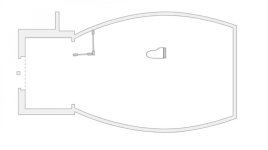
  • layout.jpg
    layout.jpg
    18.4 KB · Views: 0
Last edited:
Oooh - now we've moved to the serious bit. I scratching my head, but those pics I posted were from a choral recording. A one-shot, 4 camera live shoot. The rehearsal (as happens all the time) was believed to be for the benefit of the performers, NOT me - hence why things went astray. Rigging for the cameras started at 10am, the recording with audience at 7.30. Then, an extra 90 mins for the out. A different recording of a singer, which was to be edited far more carefully and have the audio really worked on involved 4 hours on location. We got three pieces recorded, with 4 takes on two, 6 takes on the other. I deliberately charge separately for the recording - so that was 4 hours of my usual rate, plus miles. The studio work, with the client was quoted and charged per session - and of course, she expected all of the pieces in one session, but once we started, she realised the quality depended on her - so it took two sessions for one piece - the hardest and trickiest with the most takes. The other two took a session each. This meant the quote for the project got extended on her request - she spent twice as much as she had planned, but could see the benefit. I like to work on my own, but having the client with you for at least some of the time makes them understand how long simple things take.

As I think I said - recording in real stereo on location is harder, in my view, than studio work. The put mics everywhere approach often doesn't work because as ozmorphasis said, you use spot mics to capture the little flute cadenza that is simply missing on the stereo pair that should be the main source. Nowadays, if you work in the studios where much UK classical music is recorded, you see some tested and sophisticated stereo mic arrays - We still like Decca Trees here, BUT, and it's important - the sections ARE also close miked, not just as spot mics, but as real sections. The violin desks, for example. You'll probably have 2 or even 4 mic coverage of 1sts - maybe unused in the final balance - but recorded all the same. 2nds probably just 2, same with violas. If the orchestra is a bit bass light, you might find them all individually miked. As channel count is not important - they take the braces and belt approach. I suspect the flown array does the majority of the work still - but it's not easy.

If you are not comfy, get somebody in - but in your example environment, the sound of the room will be er, less good - and probably noisy too, so close miking and fake it afterwards will sound better than a wonderful capture of a poor room - in my humble opinion. If we are talking concert hall - it's different. Live 'classical style' - using the word 'classical' really winds the musicians up, as it's always used wrongly - they know exactly what you mean, but it tags you as a heathen in some circles!

With your kit - close miking is perfectly possible and will at least record audio you can work on and fabricate into something nice. However - in the video, if the players sound like they are playing in a cathedral, when they're playing in a tent - even the thick viewers will notice.

I think I'm saying that if the visuals are more important, with the multitrack Tascam and your mic collection, you can do OK.

One thing - auto record levels are OUT - perhaps the limiter, but you need them to play, as you said - the loudest section in the music - BUT - be aware that there is no preset for fff. It can be FFF!!! or just ff - they will lie. They get to the forte sections level by the distance from piano, so they find it very hard to play just the loud bit. Rock bands don't. Whatever level you think the loud bit will be, it will be louder (or quieter) in the analogue days this was very annoying. With digital headroom, it's not a problem. whatever they think loud is, back off 3dB at least.

I think that if you have the energy and the time to learn - you should be able to do a good enough recording. Modest mics are never a drawback - the usual mistakes are not in microphone choice, they are always placement issues.
 
I am not the expert on this, but a few years ago, I added some studio type mics to my kit to do exactly what is happening here; quartet or smaller sized recording done solo. I am sure that a dedicated recordist could have made individual mic tracks for each individual instrument sound better than my efforts, but flying solo is always a challenge. Although I have been able to mount a 744 on my tripod, wear headphones and do both ride the audio levels on 4 tracks and monitor the video, it is far from ideal. At some point you have to just lock everything down and hope for the best. Under such circumstances, it really helps if your talent is understanding. If you intend to mic individually, you may need to separate the musicians to avoid bleed onto the other tracks, especially with a violin, so the ensemble may need to not play as a group the way that they would for a normal live performance, which may get them out of their comfort zone.

Since I don't record in a studio setting, with mostly amateur talent, I think it is best to just let them do what they are most comfortable with and do what you can with the venue as possible to improve things. For recording, I record an XY or MS configuration, do some level and placement testing (very important!!!) before recording and then let the musicians play normally instead of getting them out of their comfort zone. I monitor and if I hear something bad happen, we do more takes, but do two as a minimum so I can tweak things in edit if needed.

With a careful approach and decent mics, this can produce some pretty decent recording though will be more limited in post without the individual tracks. I have used some inexpensive CAD's and much better AT-4050's and gotten some very acceptable results. In this case, a simple but well recorded two track will probably work out better than a more complicated scheme that is poorly executed.

Last note, about mic selection. I didn't see where the OP had a decent pair to do this. My first set of LDC's, a pair of CAD's costing me grand total of $200 including mounts sounds surprisingly good.

Grant
 
Back
Top