Re: The PERFECT Indie Video/Cinema Camera

Open source, fully customizable firmware in an AF100 body sans EVF. Records to 2.5" SSD. Takes milwauke Li-ion batteries. Crank on the side for encoding metadata...never.
 
What would you do to the 1DC to make it more "perfect" for you?
Magic Lantern or the addition of many of ML features.

1. Focus Peaking
2. Histogram / Waveform
3. Crop/Zoom function
4. FPS over-ride (video encoded timelapse like ML but at 4k)
5. etc ....

The lack of focus peaking is the only real glaring omission. Hitting focus without it is very difficult for run and gun type work I like to do.

Cheers,
Pete

With respect to peaking, what kind of options would you choose? i.e. Contrast peaking vs red outline peaking vs peaking with black and white only?
 
With respect to peaking, what kind of options would you choose? i.e. Contrast peaking vs red outline peaking vs peaking with black and white only?
Not sure the what the difference is between those options. All the cams I've used peaking on (t3I, 5dii, tm700 and nex7) create blue dots around and on sharp edges. I film a lot of wildlife with a manual 600mm and this style of peaking highlights the edges that are in focus. I can walk the zone of dots right to my desired focal point quite easily. For stabilizer work it is a huge benefit to be able to see your focal point on the screen as you follow your subject with the camera extended out away from you a few feet.
 
Not sure the what the difference is between those options. All the cams I've used peaking on (t3I, 5dii, tm700 and nex7) create blue dots around and on sharp edges. I film a lot of wildlife with a manual 600mm and this style of peaking highlights the edges that are in focus. I can walk the zone of dots right to my desired focal point quite easily. For stabilizer work it is a huge benefit to be able to see your focal point on the screen as you follow your subject with the camera extended out away from you a few feet.

Sorry when I mentioned "contrast peaking" I meant to say "Edge Enhanced Peaking". These are found on the Manhattan LCD monitors and even the ones from China branded Camax.

The idea behind Edge Enhanced Peaking is that it allows the operator to see focus without having colored lines getting in the way of the composition of the frame, but this obviously depends on the preference of the operator.
 
Last edited:
Of course lenses are different as they are physical glass. A camera on the other hand is all transistors and software, so we can actually design the perfect camera based on what our aggregate use-case are.

No a camera is more than transistors and software, and there in lies the problem with most cameras today. They are designed by people with this same thought process, many times without regard to the end user when it comes to ergonomics. Designers don't care if the end user has to scroll through menu items to change their base ISO settings, or that the viewfinder is mounted in the wrong position for handheld work, or that they designed their camera as a little box which is unusable for shoulder work, or what they thought would be a cool touch screen is now covered with oil from the user's finger. At this time the camera closest to being perfect I have used recently is the ARRI Alexa. The ergonomics of the camera are pretty much dead on. But even the base model Alexa doesn't cover all the bases, which is why they came out with the smaller M model head unit, because sometimes you need a smaller camera.
 
No a camera is more than transistors and software, and there in lies the problem with most cameras today. They are designed by people with this same thought process, many times without regard to the end user when it comes to ergonomics. Designers don't care if the end user has to scroll through menu items to change their base ISO settings, or that the viewfinder is mounted in the wrong position for handheld work, or that they designed their camera as a little box which is unusable for shoulder work, or what they thought would be a cool touch screen is now covered with oil from the user's finger. At this time the camera closest to being perfect I have used recently is the ARRI Alexa. The ergonomics of the camera are pretty much dead on. But even the base model Alexa doesn't cover all the bases, which is why they came out with the smaller M model head unit, because sometimes you need a smaller camera.

Sorry I was trying to get at the fundamental difference between the inner workings of a camera vs the inner workings of a lens. One is inherently physical in nature (i.e. glass) and the other follows Moore's Law.

Having said that, yes ergonomics is an important factor. To date there are two dominant design philosophies ENG vs DSLR. One is shoulder mounted and the other is hand held (in general). I see you enjoy the ARRI Alexa's shoulder mount configuration. The "M" version appears to be a different story, geared towards larger productions needing a smaller footprint on the "head" side of the camera but can still budget for a more cumbersome break-out camera body.

I totally get your point in terms of usability of a camera, when I had the Sony NEX-FS100 last year, I didn't like the fact that there was no dedicated scroll wheel for ISO/Gain settings to adjust in 1DB increments on the fly and I didn't like how the viewfinder hindered shots from overhead or the fact the LCD screen was so indented into the camera body among other things (poor center of gravity, plastic body, flimsy top handle, hard to access side buttons...etc).

Ergonomically I really like the form factor and the usage of multiple scroll wheels on DSLR's. I like the fact the scroll wheel is placed right at my right-hand's index finger so I can make ultra quick adjustments. Function-wise for run and gun I love the C100's push auto feature for Gain, Shutter and ISO for situations that change very quick and I don't have time to test out the environment's exposure characteristics. And for me as a must the LCD screen MUST be placed at the very rear of the camera so it can be as close to my eye as I choose and so that I can adapt third party magnification viewfinders if I so choose.
 
Last edited:
There's no perfect camera other than the one thats in your hands or if you like, whatever tool you have - you've got to work to make it sing.
 
More than a dozen Indie feature films have been shot with DSLRs ( Canon 5D MK3, Nikon D800, Panasonic GH2 ) over the past year, so I don't think camera gear is holding anyone back at this point.
 
Flexible, functional, and most of all a beautiful image out of the camera. Then you need to make it affordable and that's where the compromises start.
However, with software you can even overcome a lot of these compromises. H265 might be able to keep data rates down without compromising image quality. Economies of scale in using common storage components make raw acquisition affordable. Software communication to the lens could make photo lenses act like cine lenses by slight zooms to compensate for lens breathing and slight focus corrections to make them par focal. IS already does a lot to eliminate jello shutter which is a compromise from global shutter. This is what we already have today or is known to be in the works.
What I really want in my next camera is something that I don't even know is possible.
 
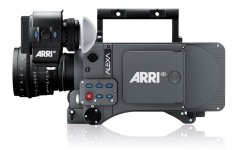
Image quality aside, look at how well ARRI designed the Alexa's ergonomics.

Perfect for balancing on your shoulder with the viewfinder also in the perfect position.

These other little box cameras like the Red Epic for example require add-ons to do handheld work, and place the camera out in front of the operator in an unstable position.
 

Attachments

  • arri_alexa.jpg
    arri_alexa.jpg
    47.1 KB · Views: 0
More than a dozen Indie feature films have been shot with DSLRs ( Canon 5D MK3, Nikon D800, Panasonic GH2 ) over the past year, so I don't think camera gear is holding anyone back at this point.

But through your experience, how could the cameras you've used been different or improved to benefit the way you tell stories?
 
Image quality aside, look at how well ARRI designed the Alexa's ergonomics.

Perfect for balancing on your shoulder with the viewfinder also in the perfect position.

These other little box cameras like the Red Epic for example require add-ons to do handheld work, and place the camera out in front of the operator in an unstable position.

But isn't "stability" defined by the story you're trying to tell?
 
Back
Top