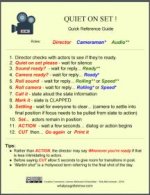
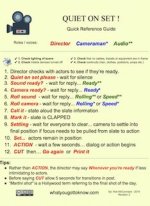
Quick Reference Card: Quiet on Set... Sound Ready, Camera Ready... ACTION!

mrmccormack

Active member
Here’s my free quick reference card Quiet On Set!. You can download various sizes and file formats. It is optimal to be displayed on mobile devices. Templates are also provided so you can customize your own card. This procedure is referred to as “calling the roll“. The best thing about the Quiet On Set! card is that it provides a step-by-step procedure for the shooting sequence.

Download in many formats, so you can customize for your requirements (Creative Commons Licensed).

Read more...
https://whatyougottoknow.com/2016/04/11/quiet-on-set/

I messed up on calling the roll on my short films many times, especially with audio not rolling. :cry:

It clearly states when to wait… until the camera or sound person is ready. Your film crew will experience a procedure which is smooth, methodical and never rushed. A smooth consistent work flow will vastly reduce the chances of something going wrong.

I don't think professionals will find this that useful, but for amateurs working with inexperienced crews, this may help a lot.

This card will fit easily into any camera or equipment case. It may be displayed in a plastic badge holder.
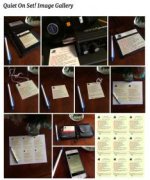
You might want to hang the cards in convenient locations such as on a tripod or light stand for easy access. See the image gallery for the “wallet size” version.

Comments and suggestions welcome.
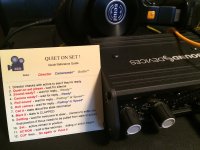

quietonsetimg_2661.jpg

quiet_on_set_screenshot.jpg

I use it as my iPhone lock screen - no faster way to refer to it.
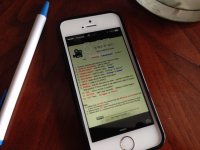
iPhoneimg_2672.jpg

Screen Shot 2016-06-05 at 10.57.13 AM.jpg
 
Last edited:
This is good - the advantage of having a checklist like this, especially when you're just starting out and don't have years of experience under your belt as yet, is that you are freed from the anxiety of "did I forget something", which is very taxing on the brain... you need as much mental energy to be devoted to the most important things, and so if you can automate or otherwise facilitate various tasks and leave more bandwidth and energy toward the important things, then this is a massive win.

So good on you for coming up with this, and especially providing the Word document to modify - this way anyone can make their own list for their own purpose, especially since we often work with equipment we've only used a few times and may not remember all the ins and outs and quirks of every piece of gear we have. Bravo!
 
This is good -... Bravo!

Hey thanks for comments OldCorpse.

I'm going to add "Lighting Ready" - near the top of my quick reference list (I've never seen or heard of that being part of "calling the roll").

A year ago, I was shooting a 3 hour shoot (without this checklist) on a 20 ft. green screen with 6 actors. One other person doing audio, I ran the camera and directed (2 man crew). My job was also to make sure all the lights were on (we kept some of them off due to heat) - and I forgot that twice, leaving the green screen poorly lit and footage barely usable . On a few of the shots the audio wasn't recorded. You see, on one of the two audio recorders was ready and levels set, but RECORD was not pressed. It seemed like we were "rushing", when we could have taken our time with a printed step-by-step check list.

Lesson Learned: even simple things belongs on a check list when you are starting out. ~Rob
 
The reason to have a check list when you've got lots of years under your belt is complacency. When you just expect things to be going, and then they aren't is when the trouble starts. Anyone who gets annoyed at having to yell out that XYZ is rolling should probably go work another job.
 
I've been saying the same lines for a long time in this order:
let's shoot - gets everyone focused
standby - actors & director now focused
waiting on me - literally getting the camera dept focused
sound rolls - waiting for "speed" from the sound dept
camera rolls - tells me I'm literally rolling
marker please - 2ac marks the shot
set - tells the director that we are set
action please - calls action
cut -
reset back to 1 -
repeat
moving on
 
With a less experienced crew, this many steps may help prevent someone from forgetting to do something.

Here's how it goes down on the sets I'm used to, more or less:

AD: (calls for quiet/settle). "Roll please" (echoed via walkie by PA's across and outside the set)
[both camera and sound roll simultaneously. In the film days sound would roll first and achieve speed before the camera would roll, to save film]
Mixer (or echoed by boom op): "Sound speeds"
2nd AC: (calls out slate info, or sometimes the mixer has already done so), then "A mark" [if two cameras, A 2nd says "2 cameras; A mark" followed by B 2nd "B mark"
Camera operator: [once they are ready] "Set" [if two cameras, "A set" then "B set"]
AD: "Action"

Regardless of budget level/crew size, the modifications I'd suggest to your list would be eliminating the "Mark it" from the director (AD's) end, as the call of "speed" is the cue to hit the sticks. And calling "set" should come from the camera operator (allowing for the instances you suggested during "settling").
 
With a less experienced crew, this many steps may help prevent someone from forgetting to do something.

Here's how it goes down on the sets I'm used to, more or less:

AD: (calls for quiet/settle). "Roll please" (echoed via walkie by PA's across and outside the set)
[both camera and sound roll simultaneously. In the film days sound would roll first and achieve speed before the camera would roll, to save film]
Mixer (or echoed by boom op): "Sound speeds"
2nd AC: (calls out slate info, or sometimes the mixer has already done so), then "A mark" [if two cameras, A 2nd says "2 cameras; A mark" followed by B 2nd "B mark"
Camera operator: [once they are ready] "Set" [if two cameras, "A set" then "B set"]
AD: "Action"

Regardless of budget level/crew size, the modifications I'd suggest to your list would be eliminating the "Mark it" from the director (AD's) end, as the call of "speed" is the cue to hit the sticks. And calling "set" should come from the camera operator (allowing for the instances you suggested during "settling").

I note there is no call of 'camera rolling or camera speed'

Personally when I operate I like to say one of these, it might be specific to the FS7/'Display off' mode but I need/like to look at the camera tally light as there is no 'red blob' in monitor, and mentally confirm to myself with a spoken call (almost to myself) that the cam is actually rolling. Im sure there are other situations (external recorders. cameras on jibs, steadicam low mode) where actually noting the red rolling light on a device is of value.

Generally this check will put the operator off position and he/she will certainly need to call 'camera set' too once position is regained.

Also on occasion I add 'frame' or 'frame clear' for example when the 2nd is running/crawling out of the shot or maybe there are public passing in the back of shot.

To some extent 'frame' could be called by someone else but that assumes they are actually watching a monitor and are fully observant of boom, background etc, which, kindly, many directors may not be.

One could therefore need to say..
camera rolling
camera set
frame

Charles. On a side note how do you deal with recomposing/focussing to get the board. For example your shot might open with an actor coming through the door and you will have attained headroom by them standing in a second position* but then can lose the headroom having gone for the board?? I do not like boards and look forward to them being consigned to history by reliable metadata :)

S

*where..
first position is out of shot in next room
second position is entrance to the room
third is where they play their play
 
Last edited:
I note there is no call of 'camera rolling or camera speed'

Personally when I operate I like to say one of these, it might be specific to the FS7/'Display off' mode but I need/like to look at the camera tally light as there is no 'red blob' in monitor, and mentally confirm to myself with a spoken call (almost to myself) that the cam is actually rolling. Im sure there are other situations (external recorders. cameras on jibs, steadicam low mode) where actually noting the red rolling light on a device is of value.

Generally this check will put the operator off position and he/she will certainly need to call 'camera set' too once position is regained.

To expand on what I noted previously, on productions of a certain size or where the technology involved requires it, more steps may be required. I have never used the FS7 myself. All of the cameras I find myself using offer onscreen data (preferably with lookaround, so the data including the REC indicator is outside picture not laid over it) so the operator and the 1st AC can confirm that the camera is rolling. Even in a situation where that isn't present, I would assume that if there is a tally light it would be on the front of the camera so the AC can see it before slating. And various cameras offer the option of a beep that indicates camera roll. So, there should be various ways for the 2nd AC to know that the camera has achieved speed without it being confirmed verbally. The default is to assume that the camera will be at speed a few seconds after rolling is called, so the 2nd can go ahead and slate without having to be told to. If there is an issue, the operator can indicate that and once resolved, give the AC the go-ahead. But yes, if this is not possible then an additional step would be added, where the 1st AC can call for "marker".

If all this fails and the 2nd smacks the slate before camera achieves speed, then "second sticks" should be called by the 1st (to avoid confusion during syncing later). If THAT fails, "third sticks". I think over the years I've seen "fourth sticks" come up once or twice which is a terrible embarrassment but usually met with good humor for the absurdity of it all.

Also on occasion I add 'frame' or 'frame clear' for example when the 2nd is running/crawling out of the shot or maybe there are public passing in the back of shot.

To some extent 'frame' could be called by someone else but that assumes they are actually watching a monitor and are fully observant of boom, background etc, which, kindly, many directors may not be.

One could therefore need to say..
camera rolling
camera set
frame

I've heard "frame" used ocasionally over the years but not sure why. There shouldn't be any difference between "set" and "frame" in the examples you gave, Sam, so, better to just make the single call of "set". Whether it requires the operator to get themselves or the camera back into a proper position, the 2nd clearing the shot or other cast or crew being ready to go etc., all of this can be noted by the operator, and this is why they are in the best position to make the call. If there is an issue that will take a few seconds to rectify, the operator should call "standby" until it is sorted (which avoids the director or AD from impatiently calling "set? are we set?"). If said issue is apparently going to need more time, operator would then call "we should hold the roll" and the AD will call cut. BTW, I'm using operator as a term to describe the person operating the camera; this may also be the DP, or simply the camera operator, but the protocol should remain the same.

Charles. On a side note how do you deal with recomposing/focussing to get the board. For example your shot might open with an actor coming through the door and you will have attained headroom by them standing in a second position* but then can lose the headroom having gone for the board?? I do not like boards and look forward to them being consigned to history by reliable metadata :)

S

*where..
first position is out of shot in next room
second position is entrance to the room
third is where they play their play

Fair question and with apologies to Rob on the sidebar, I'll address this. First part of the process is to be able to find the frame in the appropriate spot take after take. As the operator, I ask the actor to hit the appropriate mark, line up the shot and then when the actor walks out, I make mental note of any helpful objects in the shot that may line up with the framelines or crosshair so I can find that same framing again for each take. If there are none (ambiguous background) or the camera is in a mode (Steadicam, handheld, gimbal etc) where the spatial position has some flex and it's not just a matter of pan and tilt, you nicely ask the actor if they can give you that reference mark for every take. An experienced actor will then do exactly that, holding on the desired mark before or during the slating and then when the operator gives them the nod, heading back to one (out the door etc). A less experienced actor will probably have to be reminded to do this every time!

It is the 2nd AC's responsibility to find the lens with the slate, not the other way around. The operator should not have to re-frame for the slate unless it is unavoidable. On a wide lens this is pretty easy; on a longer one it can be tricky but hey, every job has its skillset. If they are slightly off, the operator or focus puller can give them verbal or sign language cues to help them get the slate into the shot. Just as the operator uses visual cues to find their starting frame every take, the AC should use muscle memory to land the slate into the frame every time. If the operator starts swinging the camera up to the slate, sometimes the AC thinks they need to compensate and moves the slate to where they think the camera is pointing and it becomes a ridiculous chase.

If it's a tough one to find and the AC needs guidance, they should go through this process just before roll is called so that they are standing there ready to go and no time is lost. Thus, after the slate the operator already has their frame and can call "set" that much earlier.

Exceptions to the rule are when the AC simply cannot get to where the frame is, such as on a crane/jib shot or if the terrain makes it impossible. The operator then has the choice of starting the shot framed for the slate and then re-framing (may include zooming in or out), or calling for tail sticks. Usually the latter is preferable as again, it wastes less time when it counts, which is the head of the shot.

While this all may seem a bit complicated or overly regimented, the bottom line is that the process should be as streamlined and fast as possible, with minimal disruption to the actors and director. Hence the least number of call and responses is preferred, with as much of the extra business kept before the roll or after the "cut" call. Many directors find this process frustrating and damaging to the performance energy, which is why (especially in our digital age) they often prefer to keep the camera rolling between takes, sometimes for a comical amount of time. It's good to give them less reason to feel this is necessary.
 
The Fs7 has a choice of "all or nothing", so you either have a clear screen or so much gubbins over the shot that you often miss boom in shot or whatever because is behind TCode or suchlike.

Thank you for taking the time to respond... yes 'set' will do.. I guess Im 'protective' in that the shot is being held up until 'set' by the camera department and 'frame' is delayed by other factors.

Interesting and logical that the board should move to the lens (where practical) .. is there not etiquette about slamming a board an inch in front of an actors nose?

Tail Sticks = Endboard in UK ? Should something be called at the front of the shot.

I hope the OP does not consider this to be a thread jack.

S
 
The Fs7 has a choice of "all or nothing", so you either have a clear screen or so much gubbins over the shot that you often miss boom in shot or whatever because is behind TCode or suchlike.

Yes, I'm familiar with such "gubbins"--amazing to me that this continues to be an issue in lower end cameras. It should be entirely obvious to manufacturers that if you have to overlay data on the image, nothing mission critical should be at the top of frame where heads tend to reside. And even "nothing" should have SOME version of a tally in viewfinder and monitor out, even if it was a thin colored border that changes to red when rolling etc. Ugh.

Thank you for taking the time to respond... yes 'set' will do.. I guess Im 'protective' in that the shot is being held up until 'set' by the camera department and 'frame' is delayed by other factors.

If I was behind the monitors I wouldn't know which referred to what, I think they just want to know when they can call action regardless of reason. If a particular shot requires some mandated kerfuffle every time after the slate, I'd inform the AD or director about it ahead of time so they don't get impatient and wonder what's going on.

Interesting and logical that the board should move to the lens (where practical) .. is there not etiquette about slamming a board an inch in front of an actors nose?

But of course, the call for "soft sticks" will be made if it must be done close to an actor (because the mike will also be quite close). A good 2nd will modify their volume on the clap based on the proximity of the mike and/or the actor. If it seems like the clapper will be visually distracting, then it will be done off to the side and the operator reframes (and of course in that instance the actor will already be on their mark, making that easy to do). If there is a specific request to do so, such as if it is a very sensitive scene and the actor is working into an emotional state, a tail slate may be called for.

Tail Sticks = Endboard in UK ? Should something be called at the front of the shot.

Generally the call will go out for tailsticks, the 2nd AC will announce it out loud and it will be echoed by the boom op or mixer through their talkback mike so it is indicated on the soundtrack. When possible we'll run a head slate with the sticks closed to further help the editorial team ID the shot. And after cut is called, a half dozen people will yell out "tail sticks!" to prevent anyone from turning off the camera prematurely. In the film days I'd often reach down to the switch out of habit and find the AC's hand covering it, or a piece of tape--they knew me too well!
 
Back
Top