Question: Which dB Level Setting on Mic is Best for HMC40??

Denniscasey

Well-known member
Given HMC40 built in audio amplifiers (which I know nothing about), which setting should I set Rode stereo videomic pro external mic (not XLR) Level switch to--options are -10dB, 0dB, or +20dB? That is to work best with HMC40 amplifiers; I understand I will need to adjust volume level according to which dB I select and sound level.

I have read recommendations to set mic switch to +20dB when using mic with DSLR cameras which apparently have very poor sound amplifiers.

Thankyou, Dennis
 
The amplifiers on most of these cameras are not that fantastic (I have an AG-AC160A).

I have two Rode mics (stereo and videomic) both of which have settings as you describe but the 160A has it's own menu settings -60db, -50db, -40db and then there are two little volume dials.

So there are, in my case, three levels of sound adjustments to worry about.

The objective is to be able to adjust the volume dials while recording such that what gets recorded is not too low on the one hand and not such that you red-line.

I find that the volume dials on the camera are too sensitive (i.e. there is not enough of a dynamic range in volume adjustment) so I need to check to see what settings I have on the Rode and see what happens to the dynamic range when I change the setting

I will get back to you with some results.
 
Thankyou kwkeirstead, and looking forward to your results.

I did get some "generally speaking" input from Rode which was for most "prosumer" cameras and camcorders (I put HMC40 in prosumer range) set the Rode mic to +20dB and set camera gain to what you need to keep record level out of the "red." The theory I guess is to get most amplification out of mic to minimize what cameras internal amps are providing. In case of HMC40 one can adjust gain (but only for both channels together I think, not individual adjustments) in main menu. It is looking like the -18dB setting on HMC40 and +20dB on Rode will keep sound in range I want, but will be trying it out tomorrow in real life. Dennis
 
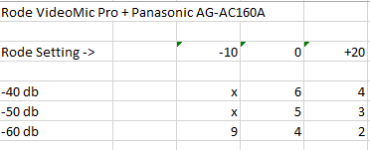
Here are some testing I did on my Ac160A which has 3 db settings (-40, -50, -60). ------------------------------------------------ Rode Setting -10 0 +20
-40db x 6 4
-50db x 5 4
-60db 9 4 2
 

Attachments

  • mic test Rode.png
    mic test Rode.png
    3.7 KB · Views: 0
  • mic_test_Rode.jpg
    mic_test_Rode.jpg
    19.6 KB · Views: 0
  • mic_test_Rode.jpg
    mic_test_Rode.jpg
    16.5 KB · Views: 0
Thank you kw, I just opened this and while you are still online I wanted to ask what the "x" and numbers mean--not intuitive to me. Are you saying that with Rode mic set at 0 dB and AC160A set at -60db you get some level (4) which you also get if you set Rode to +20 db and AC160A to -40db?? Except that seems backwards based on my assumption--Rode at +20 and camera at -40 should give higher number than Rode at 0 and camera at -60db??

I would guess you are using a format readily understandable by an audio engineer, but I don't have that expertise. Thank you, Dennis
 
Also, am I correct that the three attached files are showing the same thing, but just different formats in case I would have a problem opening one or the other?
 
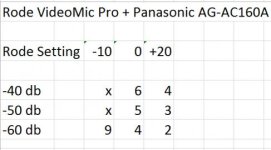
The three formats are all the same. ignore two of them.

"X" means that the setting is not usable. But, remember, my testing was done with a constant audio signal (TV at 10 feet), so at a rock concert you would want to be at -40db on the camera and probably -10 at the Rode.

Re "Rode at +20 and camera at -40 should give higher number than Rode at 0 and camera at -60db" the only thing we can say is that Rode at +20 and camera at -60db
will give a higher number than Rode at +20 and camera at -40 db.

We do learn something from the fact that +20 on Rode with -40db on the camera is the same as 0 on Rode and -60 db on the camera.
My observation is that whatever the combinations, you get a very narrow range of functionality, probably because of the volume dials on the camera - if you
set the dials so that you don't get red lining, they are too low for much of the sound you are trying to record and if you ramp them up a bit you get red
lining.

It would be nice to get a commentary from experts.

I have an additional problem actually at stage/music events which is from a sound board, I often get a bad mix of voices to instruments so what I am thinking
is 2 XLR feeds one consolidating voices and one consolidating instruments and a field mixer that will allow me to adjust the relative strength of the two
signals.
 
Thank you again kw, but with apologies for my inexperience, can you tell me what your numbers designate? Are they volume levels?---for instance 5 would be a "normal" volume level and 9 would be a "very loud" volume level??

Also, my past understanding was a minus dB level (-40) was attenuating signal while a plus dB level (+20) was amplifying volume. If that is correct, and if I understand what your numbers (4,5,9 etc) mean, then I don't understand how -10 on the Rode and -60 on the AC160 can give the highest volume (9)??

Thank you in advance for your patience explaining your nomenclature to beginner like myself. Dennis
 
Dennis Do a test it depends on your microphone and connection, is it XLR or 1/8, How loud is the source get some good Headphones, like the Sony Pro
 
Dennis Do a test it depends on your microphone and connection, is it XLR or 1/8, How loud is the source get some good Headphones, like the Sony Pro

Thank you Felipe. This is 1/8 Rode stereo videomic pro (I could not wait until new Shure you mentioned earlier became available). Always good advice to do testing because of so many variables, but at this point I was looking for general guidelines. For instance, I had read that most cameras in price range of HMC40 did not have the best internal amplifiers so one should set the mic at high output (+20 in case of Rode mic) and reduce amplification level of internal HMC40 amplifiers (range is minus 30 to plus 6) to lowest level (for instance maybe minus 18) that would get sound level you want.

The source will be race cars on a road course so sound level will vary quite a bit (low level with cars approaching corner where I will be, and getting very loud going through corner and accelerating away). Dennis
 
Hi Dennis, Yes the numbers are settings on the camera volume dial. A setting of 0 is low, 10 is high. On rhe Rode +20 gives a high signal, -10 gives a low signal. Things are different on the AC160. i.e. -60 boosts the incoming signal (interviews) whereas -40db is the setting you would use for a rock concert. Confusing..
 
Hi Dennis, Yes the numbers are settings on the camera volume dial. A setting of 0 is low, 10 is high. On rhe Rode +20 gives a high signal, -10 gives a low signal. Things are different on the AC160. i.e. -60 boosts the incoming signal (interviews) whereas -40db is the setting you would use for a rock concert. Confusing..

Thank you for clarification kw, results did seem a bit backwards but the AC160 dB settings being backwards from "normal" explains it. From my testing the HMC40 camera sound recording volume follows the industry norm (a minus value attenuates sound level). Dennis
 
Hi Dennis You must not mix up attenuators and pads with sensitivity. The Rode SM Pro has a base sensitivity of -38db and you can attenuate that to -48db using the -10db pad switch OR boost it to -18db with the 20db pad switch ....Because mic sensitivities are always negative the higher the number the less output the mic has!! So a Rode at -38db will drive your input channels a lot harder than one with a -60db sensitivity. On any HMC camera forget about the +20db pad as all it will do is overload the inputs. Karl is 100% correct about the 130/160 cams having -40, -50 and -60 but if you use a stereo jack input on the camera it's usually at the top range of XLR sensitivities. If it helps any, I used to have my HMC70's (which still had the stereo jack) connected to Rode VM's and I found that if you leave the Rode at 0db it works pretty well. That is well within the OP amp's range on the camera and you can then adjust levels so with loud music it barely peaks into red bars. Just bear in mind that if you overdrive the preamps on the camera you are screwed (to be polite) you cannot fix over-modulation !! Rather err on the lower side for inputs as you can always boost the signal in your NLE but you cannot use a distorted one!! Just stay away from the +20db switch ...if you are out of range at a loud party then snap the mic down to -10db Chris
 
Thank you Chris for recognizing my level of understanding was stuck at dB in the context of volume levels. I will read up on this now that I see the different contexts of dB settings. Fortunately with the earlier help from kw and Felipe I avoided disaster recording a big car race event July 19-20. Set Rode at 0 dB and adjusted HMC40 at around -6 and watched level meters on HMC40 to be sure I was not getting into the red. Haven't edited the footage yet, but looks ok when I plug the SD card into my Panasonic Blu-ray player and watch it on tv.

I can tell you I had spent some time researching mics and most of the time the manufacturers were telling people with DSLR's to set Rode at +20 dB. I even called Rode tech service and asked them their recommendations--recognizing they can not know all about all the different cameras they even suggested setting Rode at +20 dB even though I explained I was videotaping race cars. I hopefully would have found the error of that when I was at the races, but I don't like to be experimenting that much when filming an event, but Felipe's warning to be at 0 dB on Rode and NOT at +20 dB gave me a good starting point. Dennis
 
Back
Top