Question: Shotgun vs. Hypercardioid?

Sammy D

Member
Everyone says that you should use a hypercardioid indoors and a shotgun outdoors. I understand the explanation for the shotgun outdoors; shotgun mics are more directional and so they allow you to better isolate your subject in the noisy outdoors. But why doesn't this principle also apply indoors? I've read numerous times that shotgun mics indoors suffer from "echoes," but what exactly does this mean? I've also read that this has to do with the shotgun's off-axis coloration of sound; a shotgun mic is better at rejecting high frequencies than low frequencies. But then why is this coloration only noticeable indoors?

Now before I get flamed for not using the search, please know that I've spent hours and hours looking for the answer on this forum and elsewhere online. I'm sorry if there was a clear answer somewhere and I just missed it.

Thanks to all in advance for any help.
 
Since a shotgun will often be boomed, it'll be placed near the the ceilings. So you end up with low frequency echoes coming back into the rear of the mic, thereby affecting your recorded dialogue.

(I'm new, did I get it right?)
 
Since a shotgun will often be boomed, it'll be placed near the the ceilings. So you end up with low frequency echoes coming back into the rear of the mic, thereby affecting your recorded dialogue.

(I'm new, did I get it right?)

Kind of.

Shotgun mics reject almost everything that's off-axis. The one thing they cannot ignore, even from the sides, is bass spectrum. As that bounces around the room, it will muddy up the sound (whether the mic is next to the ceiling or not). Shotguns also have a small, narrow lobe of acceptance at 180º (to the rear of the element). This pulls in direct reflections that clog the signal and make everything sound hollow and "bathroomy" in highly reflective rooms. Basically, the same interference tube design that makes it reject so well outdoors is what pulls in too many acoustic problems indoors.

A hypercardioid also has a lobe of acceptance to the rear, but it's a slightly wider lobe. While it also will pull in secondary reflections, it's not trying (and failing) to reject most of them and it ends up with a much more "natural" sound in a reflective space. The tighter-than-a-standard-cardioid lobe to the front also helps isolate the dialog above the reflections of the room, while the off-axis rejection to the sides does keep many of the problems in the room at bay.

Shotguns will behave perfectly well indoors if the room is a pretty dead space, meaning lots of absorption from carpeting and furniture and wall/ceiling treatments. But that kind of space is very, very rare. You can also use shotguns in super-large places (sound stages, etc.). But for most of what film makers will incur for interiors (houses, apartments, offices) the hypercardioid is going to be a better choice.
 
Last edited:
So you seem to be saying that it's three things: the front pickup pattern, the rear pickup pattern, and off-axis rejection:


The tighter-than-a-standard-cardioid lobe to the front also helps isolate the dialog above the reflections of the room
I thought (though I may be wrong) that many shotguns have a super-cardioid pickup pattern. Isn't the front pickup pattern of supercardioids very comparable to that of hypercardioids?


A hypercardioid also has a lobe of acceptance to the rear, but it's a slightly wider lobe.
Shouldn't a wider lobe cause more reflections to be picked up? And then shouldn't more reflections make a more muddy sound?


The one thing they cannot ignore, even from the sides, is bass spectrum. As that bounces around the room, it will muddy up the sound (whether the mic is next to the ceiling or not).
Why is this not a problem outside? In other words, why do shotguns have a problem when sound bounces around the room but then don't have a problem when it comes straight from an off-axis source?
 
Outdoors we have not many reflections and shotgun picks mostly only the sound from the front. The sounds which come from the sides are not reflections of the main signal but "natural", even if bass heavy. Indoors a shotgun picks up some reflections of the intended signal from the sides, but the frequency balance is wrong. While hypercardioid also picks up reflections, the frequency balance is better and sounds more natural.

Sanken CS3-e is a shotgun with 3 capsule array giving it better and more even frequency balance for the sides. Many have found that it is a shotgun which can be well used also indoors, it is also fairly compact in length.
 
So you seem to be saying that it's three things: the front pickup pattern, the rear pickup pattern, and off-axis rejection:
I thought (though I may be wrong) that many shotguns have a super-cardioid pickup pattern. Isn't the front pickup pattern of supercardioids very comparable to that of hypercardioids?
They're very close. The hyper is a smidge wider than the super but they're both highly directional with good side rejection.

Shouldn't a wider lobe cause more reflections to be picked up? And then shouldn't more reflections make a more muddy sound?
The problem is not so much the lobe as it is the physical principles used to obtain the directivity. A shotgun uses an interference tube that relys of phase interactions between that portion of the sound wave hitting it from the front, entering the tube through the front and traveling down inside the tube and the portion of the same wave passing alongside the tube and entering it through the side ports. For sound coming from dead-ahead, the two wave sets in the tube reinforce each other but for sound hitting it from the side the waves are out of phase and cancel. However, when considering sound reflected from the environment, its phase is already shifted with respect to the direct component of the same sound and so the pattern of orderly cancellation in the interference tube breaks down and some frequencies are reinforced while others cancel. The result is called 'comb filtering' and results in distortion of the recorded sound, typically sounding like the source is down in a well or standing in a metal culvert. In comparison, hypercardiods do not use phase interference to achieve their directivity, operating instead on pressure differentials. As a result, they are not subject to the same degree of selective frequency distortion of the reflected sound that an interference tube mic exihbits.

Why is this not a problem outside? In other words, why do shotguns have a problem when sound bounces around the room but then don't have a problem when it comes straight from an off-axis source?
See above - it's not just the direction the sound is arriving from. Direct sound comes to the mic straight from the source, a person speaking for example. Reflected sound comes from the same source but has bounced off of some surface in the environment. The bounce shifts its phase with respect to the direct sound plus the path it travels is longer and that means it arrives slightly later than the direct component, also introducing what is effectively an additonal phase shift. When the two components interact with each other inside the mic's interference tube, all sorts of unpredictable frequency distortions can occur.
 
A shotgun microphone is a super-cardioid / hype-cardioid microphone with an interference tube on the front.

A gun mic. will basically act the same as a super-cardioid at low frequencies and get more directional as frequency increases.

Where this starts and how directional depends on the length of the interference tube - the longer the tube the lower the frequency that directivity increase starts and the more directional it will be at the higher frequencies.

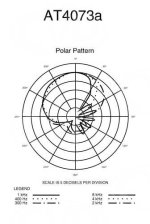
But you also need to be aware of off-axis response and you get comb-filtering effects with a gun mic., so at a certain degree off-axis you may get almost perfect cancellation at a certain frequency, but a degree or two further round you may get very little.

Look at the diagram below to see what I mean:

05%2007%202006at_4073a_pp.jpg

I hope this helps.
 
For sound coming from dead-ahead, the two wave sets in the tube reinforce each other but for sound hitting it from the side the waves are out of phase and cancel. However, when considering sound reflected from the environment, its phase is already shifted with respect to the direct component of the same sound and so the pattern of orderly cancellation in the interference tube breaks down and some frequencies are reinforced while others cancel. The result is called 'comb filtering' and results in distortion of the recorded sound, typically sounding like the source is down in a well or standing in a metal culvert. In comparison, hypercardiods do not use phase interference to achieve their directivity, operating instead on pressure differentials. As a result, they are not subject to the same degree of selective frequency distortion of the reflected sound that an interference tube mic exihbits... The bounce shifts its phase with respect to the direct sound plus the path it travels is longer and that means it arrives slightly later than the direct component, also introducing what is effectively an additonal phase shift. When the two components interact with each other inside the mic's interference tube, all sorts of unpredictable frequency distortions can occur.

That is by far the clearest explanation I've read and it makes sense. Thank you!
 
They're very close. The hyper is a smidge wider than the super but they're both highly directional with good side rejection.

The problem is not so much the lobe as it is the physical principles used to obtain the directivity. A shotgun uses an interference tube that relys of phase interactions between that portion of the sound wave hitting it from the front, entering the tube through the front and traveling down inside the tube and the portion of the same wave passing alongside the tube and entering it through the side ports. For sound coming from dead-ahead, the two wave sets in the tube reinforce each other but for sound hitting it from the side the waves are out of phase and cancel. However, when considering sound reflected from the environment, its phase is already shifted with respect to the direct component of the same sound and so the pattern of orderly cancellation in the interference tube breaks down and some frequencies are reinforced while others cancel. The result is called 'comb filtering' and results in distortion of the recorded sound, typically sounding like the source is down in a well or standing in a metal culvert. In comparison, hypercardiods do not use phase interference to achieve their directivity, operating instead on pressure differentials. As a result, they are not subject to the same degree of selective frequency distortion of the reflected sound that an interference tube mic exihbits.

I'm not quite sure about this and especially about the "two wave sets in the tube".

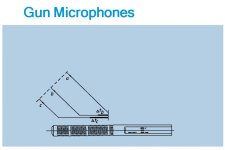
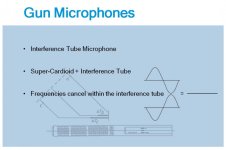
An interference tube works like this:-

Sound coming from directly in front travels directly down the tube to the diaphragm in the normal way - like any other mic.

For off-axis sound - the sound wave will hit the top of the tube first and is bent and travels down the tube - the next bit of the wave then hits the tube and is bent and travels down the tube - then the next bit, etc... These off-axis sounds are all the same wave and cancel themselves out in the tube.

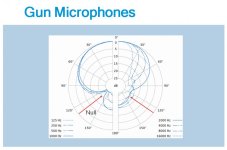
At least that is the theory - in practice some frequencies and angles cancel better than others, hence the comb-filter effect.

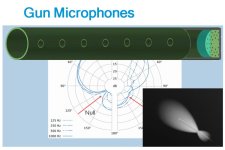
I hope the following screen shots from a PowerPoint will help explain:-

Gun 1.jpg
Gun 2.jpg
Gun 3.jpg
Gun 4.jpg

These are just four grabs from a large PowerPoint and I do a lot of talking with it - but I hope this helps explain it.
 
We're saying pretty much the same thing, John. The idea is that for sound arriving from the sides, the wavefronts coming through the side ports and the top are out of phase with each other and cancel while that doesn't happen to waves arriving at the mic from on-axis. For reflected sound arriving from the side, OTOH, the phase relationships are already distorted and shifted with respect to the phase of the direct wave and when they start interacting inside the tube a h**l breaks loose with the timbre of the sound.
 
We're saying pretty much the same thing, John. The idea is that for sound arriving from the sides, the wavefronts coming through the side ports and the top are out of phase with each other and cancel while that doesn't happen to waves arriving at the mic from on-axis. For reflected sound arriving from the side, OTOH, the phase relationships are already distorted and shifted with respect to the phase of the direct wave and when they start interacting inside the tube a h**l breaks loose with the timbre of the sound.

Yes, I think we are - it was just that double wave from the front bit you mentioned that threw me.

But I thought the diagrams would be helpful to explain it.
 
I've just noticed something which I thought was quite an important issue and hasn't been mentioned, which is the difference in Directivity Coefficient between Supercardioid (including shotguns) and hypercardioid microphones.

Hypercardioid microphones are designed to pick up an optimum level of sound in a free field (i.e. directly from what the microphone is pointing at, before any reflections occur), to a reverberant field (sound which is bounced from walls in an interior). Their directivity coefficient is 4.0

Supercardioid microphones have a polar pattern which emphasises front to back, but loses some directivity- typically their directivity is 3.69 but I think some of the Sennheiser and Schoeps microphones are a balance between supercardioid and hypercardioid.
 
Back
Top