question regarding 3point lighting for video documentaries

aratari10

New member
Hello, I have done much reading and I would like some suggestions at to how I should go about a new project of mine. I am an avid photographer who has done a great deal of video for a while now. I am looking to get much more serious moving forward however, I am shooting on a T3i with several prime lens which have pretty wide apertures. I use a rode pro shotgun mic and just invested in a 300 dollar 220w led light that rhymes with porch(not sure about brands being bale to be mentioned on here), I also bought a t bracket to house both the mic and the bolt when needed. I am looking to build a three point lighting kit.

Here is my question, should the key light always being off centered to the subjects left with a fill light on the right of my camera? Also.... I had clamp lights with tungsten bulbs I used for fill previously, can I use a clamp light for a kicker (back) light or do i need something more directional. I am looking to get the best bang for my buck, I have a light stand which I can use for bolt if it needs to be on the left of my camera.

So obviously I would need two new light stands.... what is the best bang for my buck.

I am looking at a 144 led light by a brand that ends with ray( not sure if there are forum rules about brands) because it is on sale for 100 bucks and has pretty good reviews online from diff sources. Does my fill light have to be inside a soft box?

I have a herniated disc in my back and this is my field of work,i I have to make this work because no one will hire me because of it and despite this injury, I am having good financial success with it. I just need to have a set up that is easy to travel with, mobile, and is not going to be a hinderance to me. I prefer led light because I dont want to have to fuss with cables, extensions cords and all of that. every movement brings potential pain so please keep in mind my situation.

Camera is mounted on a good tripod and also looking into AN AFFORDABLE but good track slider. Found a brand for 120 dollars the stars with the word glide which has good feedback.

I realize you get what you pay for so all of these variables would also be considered. If something needs to be putt off for a while then let me know if ican make do such as using the torch mounted and a clamp light as kicker.
 
In most cases, your key and fill should be on opposite sides of the camera, especially for sit down interviews. I'm very confused about your rhyming scheme, so just tell us what kind of lights you have.

Clamp lights can be very useful, but since they don't have any focus control, be careful of flares or spill that you might get from them. Blackwrap, aka cinefoil, aka black aluminum foil, makes for good lighting control around lights.

Do you need the fill to be in a softbox? Absolutely not. It depends on what you want. I typically bounce light or put diffusion on it if I want a softer light.

There are no "rules" to what types of lights are to be used for key, fill, and backlight. It's personal preference, and experimenting and working with your lights is most important. "Does it look good, is it safe, and is it repeatable" are the only requirements for a good lighting setup.

Personally, I usually key with a focussable fresnel or leko (if in a studio.) Then fill with a bounced PAR or open face, or another fresnel with diffusion. Backlight is usually a small source 150 fresnel or leko cut to the right size. Because we're in the world of LEDs now, you can use a brighter fixture and dim it without having the color shift that tungsten has. So three of the same light at different intensities might work perfectly for you.
 
all I have is a torch bolt 220 watt... I am looking at getting a [h=1]Genaray LED-5700T 240 LED Variable-Color On-Camera Light[/h]
to use as a fill light would this be strong enough. I am on a budget and want to travel light due to the back injury.

looking for most band for my buck.
 
I almost never use a fill light. I use a reflector for fill in interview situations. That would save you both money and weight, if you're open to that idea.
 
I'd say overall, try to wipe the phrase "three point lighting" from your mind and instead, picture the look and feel you want for a given clip. Some subjects require big soft light, others something more cinematic, etc. Look at the space you're shooting in and picture what's best for the project. If you don't want every project you do to look exactly the same, you really need to toss the (for lack of a better word) knee-jerk 3-point autopilot idea.

For things like kickers, a fresnel is really hard to beat and is really versatile. I have a couple of the Cool Lights 300 watt units which are a great value. I also have lots of fixtures from ebay, many are theatrical units I got for $30-$60. Just make sure lamps are available, and if they have a pipe hook, get a spud and replace the hook (just takes a wrench). (Get an Avenger TVMP adapter to be specific - the Matthews versions have little thumbscrews, the avengers have a big t-handle).

To light more creatively, you'll need some heavier stands (you just can't boom a light out 3' on a cheap steel tripod stand). A couple c-stands (with turtle bases makes moving easier) and something like a beefy baby (c-stands are the knee-jerk stand when moving up but not nearly as useful as a beefy baby, same price as a good turtle-base C too).

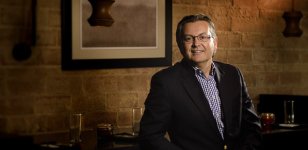
Here's what I mean by "feel" though... this is in no way "3 point" but the client was very happy. 36" strip light softbox as the key, an open faced light with a metal grid for the side/cheekbones, and a fresnel washing the back wall. I think I had a 150 watt 2" lens fresnel on the glassware (subject is a bar & restaurant consultant) to give it a hint of sparkle. There was a 1-stop mesh flag cutting the light below his face, to knock down the brighness of his shirt and keep the focus on his face.

DSC_0900b.jpg
 
It's possible to bounce a back light from a front reflector, but the key usually points away from the usual fill source location, but 3 point lighting is rarely formulaic to precise rules. Think about what 3 point lighting does. It provides a light source (the Key) that produces shadows that reveal form. The dark shadows look wrong, so you fill them with something soft. To make the subject pop-out from the background a bit needs some rear light. The angles, including the height can be adjusted and with 3 to consider, the variables give loads of scope. The light sources are important. Big lenses are naturally soft, small ones tend to be hard. Light falls off gently and evenly, or horribly. Work lights can be bright, but usually unflattering. Fresnels might give shadows for the key, but a soft edged shadow. A work light is not nice to look at. Reflectors can be great - and if you use the gold ones, the result can be better, or worse - depending on what the purpose of the shot is. Three point lighting is like the old three point manoeuvre to reverse a car in a narrow street to face the other way. Some people prefer 4 not 3, and many people do 3 point versions very badly! There is one rule. It MUST look good, or else you did it wrong.
 
heres the thing, I have a herniated disc in my back and all videos will be done mobile at diff locations, thats why I am looking at led lights. obviously i need stands, but im looking for best bang for my buck, I am in a small town and I dont really need an amazing professional kit. Looking to make do with less.
 
Well, here's the thing.

With ONLY LED lights you will be severely limited on the look you can achieve.

They are nice, but you can't focus them like a fresnel, they generally do not have a single source shadow because the leds are like mini spot lights, and they are less controllable with barndoors.

Also, this statement: "I dont really need an amazing professional kit" does not wash.

Spend the money on a good kit.

The lights will outlast MANY of the cameras you will purchase throughout your career.

and if you are charging for your work, you need good, reliable gear.

Period.
 
I was always told to think of three-point lighting as three areas of light. Paulears explained it very well. Your key is your main source, the fill gets rid of your shadows caused by the key, and a backlight separates your subject from the background.

LED lights are also not necessarily lighter or easier to work with than small tungsten fresnels. I have some Elation TVL2000 fixtures that weigh more than an Arri 650, yet have less output.
 
You could argue that buying second hand tungsten light sources now is a very good deal, as the unaware run headlong into LED land. An Arri 650W Fresnel really isn't heavy - in fact an extension cable to power it might weigh more! Would you buy a cheap lens for an expensive camera to save money, confident it will perform as well?

'Professional' in terms of lighting usually means quality - but quality of the light, and quality of the mechanics. Professional LED fixtures tend to concentrate on the green-ness, or size, that kind of thing. I have a few bits of my video gear with me on the current job, which sadly as PM leaves me mainly doing paperwork and sorting problems - but in the camera bag is an on-camera LED light, but in one flight case, at the bottom is an old rechargeable small halogen version. Pulling them out, and just shining them at the wall, the LED is bright, hard, brash and torch like, the Halogen has shadows, interest, warmness and in every way possible, apart from battery charge life, is better - and 20 years old!

Lighting equipment, historically, has an amazing lifespan. Here in the UK we never had huge quantities of Mole equipment, but I got one, and a stand, second hand in 1991. It still gets used. I have some 2K Fresnels that were made in 1972 - and this year they've been used quite a bit to light big spaces.

Every time I have ever bought a lighting kit - it just doesn't get used. I have a redhead kit, a compact Flu kit, and I still fall back to the older stuff, perhaps borrowing one light from a kit every now and then.

This isn't new. Plenty of people bought redhead kits, but then replaced one with a softer light, or a bigger wattage one - as jobs came in. Other people in busier areas have the luxury of hiring in to suit the job - by far the best option. I don't have local hire sources, so my lighting inventory has steadily grown as I've needed specific items. Buying a lighting kit is as silly as buying a DSLR kit with a stock range of lenses, tripods and accessories. A few get used all the time, some never.

If you would like a Fresnel, but baulk at the cost of something like an Arri - then I'd urge you to consider one of the Chinese ones. Build quality is poorer, you might need to spend an hour or two tightening up screws and checking electrical safety - but if you can do that (or know someone who can) then you will save quite a bit, and then if it sits on a shelf unused, you won't feel so bad. If you end up using it all the time, and the defects start to annoy, then it's sensible to invest in a real one that you will still have in 20 years time.

Lighting is clearly an art - a creative process. Too many people treat it as a formula based process. I know how to dance, I understand dance language, but I am not a dancer. Lighting is the same.
 
If you're getting paid to expose images, I feel like you're kinda obligated to spend enough on decent lights to get good results in any circumstances - and I think you're LED only approach is probably going to limit you in that regard somewhat (unless you put the money towards some remote phosphor units, or one of the nice new Mole Richardson fresnels - so that you're getting good colour and nice shadows).

Personally I'm not big 'conventional' 3-point lighting guy, I prefer to use larger, wraparound key lights and only reflectors for fill. So if I do bring in a 3rd light, it's as a kicker from the side or to create some other point of interest.

To answer your actual questions though! - key and fill can come from whichever side you like, left or right doesn't matter; as for best bang-for-buck - that still lies with tungsten lighting. Nice daylight balanced lights are expensive (totally worth it IMO, but expensive).
 
... and I think you're LED only approach is probably going to limit you in that regard somewhat (unless you put the money towards some remote phosphor units, or one of the nice new Mole Richardson fresnels - so that you're getting good colour and nice shadows)...
This is not to argue about advantages of tungsten light, but LED technology evolves quickly. I recently bought Arri L7-C Fresnel as a holiday treat and see what it can do. True, damn expensive but as value proposition is amazing. Color, convenience, versatility combined with 220W of draw for 750w tungsten equivalent. When I have another $2.5k - that's the way to go. I am done with tungsten.
 
thanks everyone, looks like im gonig to go with a lowel dv creator kit, I never meant to say lighting is not important. I realize its everything, but what I am going to be doing is short documentaries on non profits. Im 25 with a spinal cord injury that is permanent and gives me nerve pain in leg. So I was trying to do it as cheap as possible so that it it gets worse and I cant do this any more, then I dont lose too much money. I live in a small town and people expectations are small... I know in a big market, people would scoff at me going the easy way, but all things considered... I know I am in the right for doing it this way. The lighting is not for modeling or short films, I have no intention of getting into that. Just needed supplemental light for interviews and b roll. I also do real estate which i know light is important in.
 
Not a bad choice at all. For whatever it's worth, I've been primarily using a Lowel DV Creator 55 kit for going on 6 years of freelancing, and have added only a bit to it over time. Those little Pro Light especially are a marvel... not a single lit shoot where one doesn't find a use somewhere.
 
I recently bought Arri L7-C Fresnel as a holiday treat and see what it can do. True, damn expensive but as value proposition is amazing. Color, convenience, versatility combined with 220W of draw for 750w tungsten equivalent. When I have another $2.5k - that's the way to go. I am done with tungsten.

How do you like the L7-C?

I have been contemplating purchasing the L7-DT for it's better photometrics, but the ability to change color would be nice.
 
Back
Top