Question about using blankets to mask out echo.

Steve the OP is shooting video so the placement of the talent will be dictated by the scene and the camera position.

But clapping his hands together where the talent is positioned will eventually teach him what level of room reverberation can be tolerated when recording on the shoot.

Cheers.
 
To cut reflections from a wall, the blanket should hang vertically, ideally extending from ceiling to floor, parallel to the wall a few inches away from it.

Steve, I'm not sure I understand the logic of this, exactly. Can you help me?

My understanding is that to reduce sound reflection, you want to prevent the sound waves from hitting a hard object (like a wall) and reflecting back towards the microphone, or towards other hard surfaces which would eventually reflect the waves back to the mic.

It would seem right to me to hang the blanket close to the wall, but not parallel or equidistant from it. In other words, I would think the blanket would need to be at a bit of an angle to the wall. This way any sound waves not absorbed by the blanket, and thus reflected off of it, would tend to move in a direction away from the source -- and, most likely, the microphone. Rumpling the blanket a bit would also tend to break up the uniformity of any reflected sound waves, which is why sound absorbent foam is shaped the way it is.

Like I said, these are my assumptions, just from my own little brain. Can you educate me here?
 
David, I concur with you as far as setting up the blankets non-parallel to the walls with some air between the blanket and the actual wall.

In my own experience (and I use blankets almost every job I'm on in some capacity) I would rather have
the blankets hanging from a c-stand as close to talent as possible more towards the middle of the room rather than near the walls.
As the camera angle becomes wider it will start to make an impact on my decision to
bother with blankets or not.

If a scene's angles are all over the room or there is a lot of movement on screen throughout a room I'll usually quickly
come to a decision to live with the room as is, but most of the time if it doesn't interfere with other dept's doing their jobs
even a couple blankets breaking up the parallel walls can help.
 
Room reverb is so "obvious" that most people don't notice it. (in small rooms). In bigger rooms they will start to notice it and in churches and caves they play with it.

You get the "impact" of reverb in a small room (like your bedroom or so) when you once have been in a dry room. Where everything is absorbed. That sounds creepy...

For the shoot of a docu (the interviews parts) I had used white sound pannels (the setting was where a sound/music studio was too) and it helped for the sound
AND for the light :-p
The frames were always the same (well, no extreem long shots, not the same same...there was medium and extreem close...)
 
In hanging blankets parallel to a wall, you are taking advantage of a algorithm known as Quarter Wave. Meaning when you hang an absorbtive material on the wall, you distance it 1/4 the wavelength of the frequency. But, that is to target frequencies. It's not a broad spectrum solution.

It also depends on the material. A packing blanket hung is great for your higher frequencies, but does nothing for lower ones. They just punch right through.

And reverb is more pronounced in your lower frequencies due to wavelengths and the Fletcher Munson curve. In order to control RT60 times, you need to use broad spectrum abfusors. There are many ways to make them, none of them really easy or quick.

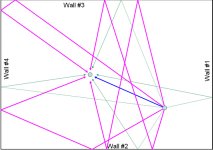
Reverb is an odd thing. Sound acts like light here, and reverb is caused by the reflections. And with reverb, you have to be familiar with 1st, 2nd, and 3rd order reflections. it's the 1st and 2nd orders we are most concerned with, because by the 3rd order the energy levels are fairly low.
Primary_Reflections_2_L.jpg
Blue is direct, Green is 1st order, Pink is 2nd order. Point on the right side is the sound source, the left point is the location of the mic. And this diagram is just two dimensional, add the floor and ceilings, and you will start to get a better idea.

But much more info is needed here about the exact location.

Note: Dre, you are talking about what we called in the studio: Gobos. Moveable sound absorbers.

The idea of moving around to find the best sound might work, if it works visually. By doing this, your are looking for the nodes and anti-nodes in the room, but again, these are frequency specific, you might not be able to hear a problem, until you are in post. This is because you are in the same environment and not too many headphones can totally isolate you from your surroundings.

My suggestion: If the room has a side room, do ADR/Wild dialogue in that room with the door open to take advantage of the room coupling. Or just ADR it, and get a nice long take of room tone and get them to snap the slate at the beginning (this will help you calculate the RT60 time so you can rebuild the appropriate amount of reverb in post, just at a lower level). If the reverb is that bad in the room, then nothing you can do will actually help make it sound "good", especially if it is a large open space with highly reflective walls. Rippie's idea of hanging blankets near the talent would help a little (coupled with engaging your roll-off on the mic), but if it's a Gym or a tiled public bathroom, I'd say record the audio just for a sync track and plan on ADR. Because you can never remove natural reverb in post.

Oh, and if the reflective room measurements are multiples of each other (example: 10'W by 20'L by 10'H) or just having 2 of the measurements be a multiple...........prepare to go bald, because you'll be pulling your hair out. You will get comb filtering.

Normally we, as indie film-makers, are never concerned with this kind of stuff, because where are the normal places we film? In a house, in a car, out in the open, sometimes a bathroom scene. The reverb in these places are usually negligible and easy to control if it's a little much.

To the OP, when you do record/film this, please post it, and tell us what you did. I think it would be a great thing to share.
 
Last edited:
You guys are correct about the being parallel to the wall not being optimum, I should have been clearer ... What I was trying to get at is that setting up a few folding chairs whose upper back is at most maybe 3 feet from the floor, and draping some blankets over them, as the OP suggested he was going to do, is going to do nothing at all to damp soundwaves traveling around the room and bouncing off the walls and ceiling - the sound is going to zip right over them. The blanket must intercept the direct sound and prevent it from getting to the potentially reflecting surface or intercept the reflected sound and prevent its getting to the mic. That means it has to obscure the potentially reflecting surface from the sound source or come between that surface and the mic, (or both).
 
Steve the OP is shooting video so the placement of the talent will be dictated by the scene and the camera position.

...
True, but he may well be able to choose where in the room to place the talent. Let's say it's an interview with the talent on a stool, plain cyc for the background. Plenty of options to move the stool a few feet one way or the other.
 
True, but he may well be able to choose where in the room to place the talent. Let's say it's an interview with the talent on a stool, plain cyc for the background. Plenty of options to move the stool a few feet one way or the other.

Ahh, talking-head shots. I wish I had more of them. Life would be so much easier. Steve is right, if that is the format you are going, OP.
 
On a different note, care should be used when placing dark or black blankets close to a subject as it can have the effect of acting as negative fill.

All the Best!

Dave
 
Okay so folding chairs, do nothing, cause the blankets are too low... sucks, as I have already shot some of it like that. Anyway of dealing with reverb, other than having to go out and by a bunch of T stands for the blankets? Is it just the shotgun mic, you need to do this with, or the hyper pattern as well?
 
Last edited:
Okay so folding chairs, do nothing, cause the blankets are too low... sucks, as I have already shot some of it like that. Anyway of dealing with reverb, other than having to go out and by a bunch of T stands for the blankets? Is it just the shotgun mic, you need to do this with, or the hyper pattern as well?
Haven't you listened critically to the footage you've already shot in order to evaluate with your own ears if your strategy was working? You should have discovered if your blanket placement was working or not while you were on the set as you were shooting the first scene, if not the first rehearsal. And who knows, maybe the scenes you've already shot do in fact sound okay - every location and setup is different. That's why we harp on "monitor as you shoot, monitor as you shoot..." like a stuck record so much - if you hear something isn't working, change the setup and re-shoot the scene right then instead of waiting until you're in post to discover you've got a problem. .

Reverb is reverb and shotgun, hyper, or any other mic won't make a difference in the acoustics of the location. Hypers ARE better behaved in the presence of short-term reflections in terms of their timbre and and consistency of frequency response at various points around the polar pattern but If your room has noticeable echo, either type of mic will hear it. Hypers aren't deaf to echo but they don't exhibit the metallic ringy, hollow, "shooting inside a metal culvert" distorted tonality 'guns often do in the presence of reflections.
 
+1. You'll have advance notice of a shoot, so in your early stages you should try and go to the location and suss it out. If necessary and you have time take the rig and run some tests.

Sound is 70% of what you see.

Cheers.
 
Well I already tested out the location with the shotgun before, and there was some echo (before I bought the cardioid). I've tried listening to samples recorded on other rooms with both mics. I can here the reverb in both but my friend says that the cardioid is better because there is less echo of some sort. Perhaps its that metal culvert thing, as it was put. But is that a huge deal, or was buying this cardioid really worth it? If it wasn't I could return the cardioid, get my money back, and buy mic stands to hang the blankets on instead.
 
Well I already tested out the location with the shotgun before, and there was some echo (before I bought the cardioid). I've tried listening to samples recorded on other rooms with both mics. I can here the reverb in both but my friend says that the cardioid is better because there is less echo of some sort. Perhaps its that metal culvert thing, as it was put. But is that a huge deal, or was buying this cardioid really worth it? If it wasn't I could return the cardioid, get my money back, and buy mic stands to hang the blankets on instead.
How huge a deal it is depends on a) now bad it actually is; and b) how high your professional standards are. If you're shooting for network/studio quality it could be a huge deal. If you're interested in adequately intelligible sound for a YouTube posting, then maybe not so much.

You keep using the term "cardioid" for the mic you have bought as an alternative to the shotgun. The generally recommended mic for a reflective interior situation is a HYPER-cardioid, quite a different pattern from that of the less directional cardioid mic. I may have missed it earlier in the thread but what make and model shotgun do you have and what make and model "cardioid" is it you've purchased?

You also need to be careful with the distinction between echo and short-term reverb. Echo is a reflection that arrives at the mic well after the direct wave ... clap your hands and if you hear "clap...(silence)...clap," that's echo. Other then when the directional pattern of the mic puts the direction to the reflecting surface into a lower sensitivity null, mic choice doesn't influence echo very much. Reverb is when the arrival time of the reflection is much shorter so the reflection arrives before the direct sound ends. Reverb sounds like a trailing off of the sound after the source sound stops, there's no gap between the direct sound's ending and the reflection, sounding sort of like striking a single note on a piano and holding the key down so the note gradually tapers off. Where the shotgun/hypercardioid distinction comes into play is when the arrival time of the reflection becomes so short that it is hitting the mic within a few wavelengths of the direct sound so that the two wave fronts interact with the shotgun's tube to "beat" with each other, causing comb filtering where some frequencies reinforce each other and other frequencies cancel. When a person is standing in a normal room with a non-absorbing ceiling speaking into a mic that is 2 feet away, the phase-inverted reflected wave from the mouth bouncing off the ceiling travels maybe 5 feet compared to the direct wave's 2 feet and arrives at the mic about 3 milliseconds later than the direct wave from the mouth to the mic. This is well within the time difference where comb filtering can take place as the two wave-fronts interact within the shotgun mic tube, resulting in distortion of the tone. Hypers don't have an interference tube so this interaction doesn't take place.
 
Last edited:
Okay thanks, so basically I better use the hypercardioid indoors then just to be safe right? I have the 4053B hypercardioid, and the NTG-3 shotgun. The NTG-3 seems like a much better quality mic, and costs more, but I better use the hyper to be safe. My sound guy had to leave production (before we were to start) on personal emergency so I'm left to handle it myself as director.

So about hanging blankets. Wouldn't I result in getting rid of so much reverb, that it does not sound natural? I guess I can add reverb later in post, although never dealt with that before. But if I record the reverb on set, wouldn't that make it sound more natural and kill two bird with one stone? But I am going for network/studio quality, so therefore I'll see about hanging the blankets higher, if that's my best shot. I have a few days till my next shoot. Is there anyway I can get something that will hold the blankets high enough, that I can find in time? Anything that will work well, that doesn't cost as much as those more expensive mic stands? And sorry by echo, I meant reverb. Do I need to hang blankets in rooms with reverb, or just echo rooms?
The objective on location is to get the voices as cleanly as possible. You want to be able to intercut footage obtained at different times and sometimes even different places without a jump in tonality that breaks the illusion for the audience. You capture room tone, the 'sound of silence' on location to mix with the voice to establish the location and fill gaps introduced by editing.

Nothing wrong with the quality of the AT4053b. If it doesn't sound as good you might not be using it right, 9 times out of 10 such issues are caused by not getting it close enough to the talent. A hyper should be about 18 inches from the speaker's mouth.

BTW, you probably don't want mic stands to hold your blankets as many of them aren't very substantial nor reach as high as you'd need. C-stands are a much better bet, designed to hold relatively heavy things up near the ceiling. Don't forget sandbags to weight their legs so they don't tip over with the high centre of gravity when holding blankets high.
 
Okay thanks. I found one store in town that sells C-stands. They go up to nine feet high. However the mic stands which I considered buying before go up to 10 feet tall. How high should the C-stand go before I consider buying? Are we talking about C stands or T stands? The guy at the store said a T stand would be more ideal for holding blankets up, cause of the T shape of course.
 
Last edited:
Okay here's the problem. I have been recording with the trim at 75% and the level control at the 1:00-ish position. But in some rooms those levels are just not loud enough, and only reach 24 on the recorder, instead of 12-6. If I have to go higher, which do I turn up, or do I turn up both, since going behind 75% on the trim can result in possible hissing?
 
This is why you need a preamp. But since you don't I suggest you leave it where it is and turn up in post. That will result in less noise than if you increased the gain on your recorder.
 
Normal stuff with knobs:

- turning completly right to have the "right" levels: this can happen...it depends on the mic, how far the mic is from the source and if it causes hissing depends on the pregain, the quality of it, the
quality of the recorder... or have the -20dB pad on, or have 12v instead of 48v phantom power (when using phantom powered mics), or you have line level selected instead of mic...could be also
mic level = "I still have to pass the pregain to level me up", line level = "I'm high already".

- turning completly left, almost closed because it's to hot: this is because you have a line level signal going into a "mic level input". So there you have to switch the input to line level
 
Back
Top