CharlesPapert
Director of Photography
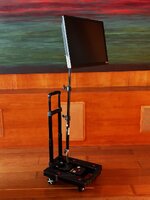
Back in 2019 I shot the reboot of the Comedy Central series "Crank Yankers", my first foray into the world of puppets. When I started my prep, the line producer told me that they had a massive line item for an extended rental of twelve 24" broadcast monitors as requested by the puppeteers, and could I figure out a way to bring the cost down? I embarked on an extensive research mission to see if consumer TV's or computer monitors could do the trick--viewing angle and latency being the key factors. Eventually I settled on Vizio TV's, which were close enough to zero latency in gaming mode, and at $150 ea, an easy sell to production. They were also requested to be mounted onto rolling stands with a capability to be height adjustable within a given range. The puppeteers use these extensively to ensure that the puppets are looking in the right place, at the right height to avoid their own arms being seen, as well as the tops of their heads. The more puppeteers working the shot, the more monitors were needed placed just so.
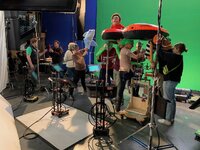
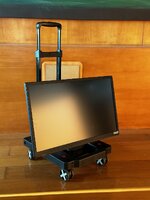
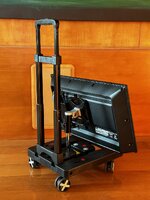
Flash forward to this past November, when one of the same puppeteers was starting a new series that needed monitors, and they reached out to me to replicate my design. While the old ones lived on stage fulltime, this show was all on location, so I needed to make them fold up for transport quickly and effiiciently. And of course, as cheaply as possible. I ordered a bunch of parts from Amazon and other vendors including B&H, Modern Studio Equipment and Filmtools and landed on a pretty good system. Instead of training a utility to work with them, I took the job since no other work was on the horizon. It was a bit humbling to drop down to "monitor wrangler", and a lot more physical work than I'm used to, but it was nice to see how well my concepts worked in practice.
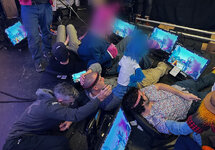
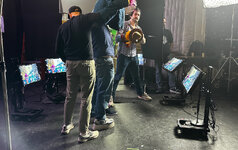
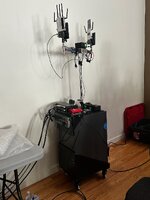
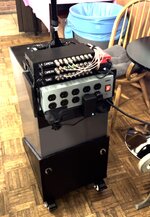
After the first week we went dark for a month, and I assessed the weakest link in the chain: power and video distro. I had built a rolling cart with power strip and DA's and each monitor had a 50' cable harness that delivered AC to the monitor and the SDI signal (with an SDI to HDMI converter on the back of the TV's).
It became apparent that running a monitor and then cabling to it, and moving them around the set as per the puppeteers request meant a lot of cable to run and wrangle. I pitched the producer on converting to battery power and wireless, and they felt it was worth the expenditure. We used the Teradek Ace 750, a relatively inexpensive model that is HDMI only but maintains the zero-delay hallmark of the bigger Teradek systems, at only $1000 per tx/rx package. While it is a 1:6 capable system, we had 8 monitors in the fleet so it required two transmitters and 8 receivers. I looked into typical camera batteries but then learned about late-model power tools batteries which after calculating loads and battery capacities, I determined would do the track at a fraction of the cost. I used 9.0 aH 18v batteries, with a breakout mount that terminated in bare leads, which I mounted to a 5/8 clamp that attached to the baby plate mounted on the rolling stand (keeping the weigh of the battery on the cart and not up by the monitor, to make the monitor easier to manipulate and configure). A coiled cable delivered the 18v up the baby extension to a voltage stepdown at 12v, then out to both the Teradek and a 12v to 120vAC car inverter to power the monitor. Even though this system lost about 15% in the conversions, each battery ran the setup for a full 3 hours or more, the same as a 150Wh camera battery--and at $50 per battery, an entire 14 battery army cost just $700, or the same as two camera batteries!
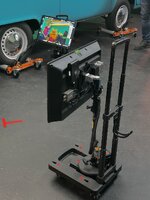
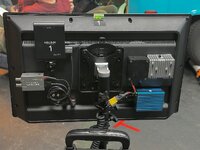
The build took me many hours to complete in the two phases, between the design aspect and trying out various options (the Amazon deliveries were arriving fast and furiously) drilling, soldering and assembly .Ultimately, everything was off-the-shelf and no machining or 3D printing was needed. Everything on set is as efficient as I could possibly hope for. The puppeteers (who come from a variety of other TV and film environments, including Henson) have said that this is the best and most versatile monitoring system they have ever worked with, which is gratifying.
Flash forward to this past November, when one of the same puppeteers was starting a new series that needed monitors, and they reached out to me to replicate my design. While the old ones lived on stage fulltime, this show was all on location, so I needed to make them fold up for transport quickly and effiiciently. And of course, as cheaply as possible. I ordered a bunch of parts from Amazon and other vendors including B&H, Modern Studio Equipment and Filmtools and landed on a pretty good system. Instead of training a utility to work with them, I took the job since no other work was on the horizon. It was a bit humbling to drop down to "monitor wrangler", and a lot more physical work than I'm used to, but it was nice to see how well my concepts worked in practice.
After the first week we went dark for a month, and I assessed the weakest link in the chain: power and video distro. I had built a rolling cart with power strip and DA's and each monitor had a 50' cable harness that delivered AC to the monitor and the SDI signal (with an SDI to HDMI converter on the back of the TV's).
It became apparent that running a monitor and then cabling to it, and moving them around the set as per the puppeteers request meant a lot of cable to run and wrangle. I pitched the producer on converting to battery power and wireless, and they felt it was worth the expenditure. We used the Teradek Ace 750, a relatively inexpensive model that is HDMI only but maintains the zero-delay hallmark of the bigger Teradek systems, at only $1000 per tx/rx package. While it is a 1:6 capable system, we had 8 monitors in the fleet so it required two transmitters and 8 receivers. I looked into typical camera batteries but then learned about late-model power tools batteries which after calculating loads and battery capacities, I determined would do the track at a fraction of the cost. I used 9.0 aH 18v batteries, with a breakout mount that terminated in bare leads, which I mounted to a 5/8 clamp that attached to the baby plate mounted on the rolling stand (keeping the weigh of the battery on the cart and not up by the monitor, to make the monitor easier to manipulate and configure). A coiled cable delivered the 18v up the baby extension to a voltage stepdown at 12v, then out to both the Teradek and a 12v to 120vAC car inverter to power the monitor. Even though this system lost about 15% in the conversions, each battery ran the setup for a full 3 hours or more, the same as a 150Wh camera battery--and at $50 per battery, an entire 14 battery army cost just $700, or the same as two camera batteries!
The build took me many hours to complete in the two phases, between the design aspect and trying out various options (the Amazon deliveries were arriving fast and furiously) drilling, soldering and assembly .Ultimately, everything was off-the-shelf and no machining or 3D printing was needed. Everything on set is as efficient as I could possibly hope for. The puppeteers (who come from a variety of other TV and film environments, including Henson) have said that this is the best and most versatile monitoring system they have ever worked with, which is gratifying.