Proper Exposure with Slog2 and the Odessey 7Q

For S-Log 2 on the 7Q, what do you guys suggest for low light situations such as a nighttime, dim interior scene that may only be lit with 2 or 3 lights?

In daylight it's easy to over-expose or expose in the middle, but in low light it's often a struggle to even get to the middle on a histogram. Nighttime run-and-gun situations are even more difficult with exposure.

Any suggestions?
 
With 14 stops of DR, my advice is always pretty simple: get as much light on there as possible. If it's dark it's dark, and lifting the shadows will mean lifting the noise. Better to get a bright exposure and then knock it down in post.

If you simply cannot get the light, you may wish to experiment with altering the gain level (or ISO, depending what you like to call it) on the camera. It is applied at sensor level and will transfer through RAW to the Odyssey7Q. You should experiment to see how you feel about the artifacts of applied gain then darkened to lower sensitivity then raised. It's a matter of taste.
 
After re-reading Sony's white paper on Slog2, and doing some dangerous thinking, I'm experimenting with a new way to set exposure that, so far, seems to be working well. Using the False Color option on the O7Q, I've set GREEN to be 30%-50%, then adjusting the exposure so my most important picture elements are displayed in green. Considering that 18% grey should be around 32% for Slog2, using False Color to indicate where 18% gray should be is a workable approach that leaves lots of headroom and sufficient shadows to avoid the dreadful noise. ETTR was not working out and led to consistently over-exposed footage.
 
After re-reading Sony's white paper on Slog2, and doing some dangerous thinking, I'm experimenting with a new way to set exposure that, so far, seems to be working well. Using the False Color option on the O7Q, I've set GREEN to be 30%-50%, then adjusting the exposure so my most important picture elements are displayed in green. Considering that 18% grey should be around 32% for Slog2, using False Color to indicate where 18% gray should be is a workable approach that leaves lots of headroom and sufficient shadows to avoid the dreadful noise. ETTR was not working out and led to consistently over-exposed footage.
This is a great way to work. Think of it as using a regular light meter. You're measuring for middle gray. If you want to tighten up the shadows, try overexposing a little bit, but just a bit. 30-50% should do that well.
 
After re-reading Sony's white paper on Slog2, and doing some dangerous thinking, I'm experimenting with a new way to set exposure that, so far, seems to be working well. Using the False Color option on the O7Q, I've set GREEN to be 30%-50%, then adjusting the exposure so my most important picture elements are displayed in green. Considering that 18% grey should be around 32% for Slog2, using False Color to indicate where 18% gray should be is a workable approach that leaves lots of headroom and sufficient shadows to avoid the dreadful noise. ETTR was not working out and led to consistently over-exposed footage.

I dunno. I know 18% grey is supposed to be at 32% for SLOG2, but that gives really noisy mids in my experience. What are you defining as 'Important picture elements?' If it's skin tones that seems a little low to avoid the noise (again, in my experience - a lot of it being about taste and noise tolerance). It's a good idea though, basically using false colour as zebras and setting for skin tones.
 
What are you defining as 'Important picture elements?' If it's skin tones that seems a little low to avoid the noise (again, in my experience - a lot of it being about taste and noise tolerance).

Well, I think it's an understatement to say "a lot of it being about taste". Isn't that the essence of art? Even a documentary needs to set tone. If one shoots only in controlled lighting situations, then a reading on a known reflectance source, like an 18% gray card, will always point to the proper exposure. But, in uncontrolled situations, a gray card can't always be put in the scene. It, then, becomes dependent on someone's experience, taste, artistic license, and judgment.

I will say that ETTR was not a successful approach for me. I was ending up with as many blown shots as I was getting noisy shots with some other process. Using False Color, so far, anyway, is working for me. Again, discretion, taste, and a hint of magic is the order of the day.

I meant it was more a question of taste about where you put 18% grey to get acceptable (to you) noise in the shadows and retain highlights. As regards documentary filming - the approach I've always taken was to place caucasian skin tones at highlighting at 70%IRE (or 67, if I could set it at that) and slightly guessing darker skin tones (based on experience of course). The point being that for documentary you generally want to keep skin tones consistent. When it comes to Slog2, I haven't really used it enough to get a feel for it, but I do worry that putting skin tones where Sony says they should be would not be a good start in terms of noise levels.

Do you have a gretamaceth or something similar? If so, where does the 'caucassian' skin tone fall using your method?
 
Do you have a gretamaceth or something similar? If so, where does the 'caucassian' skin tone fall using your method?

Good question! Yeah, I have a G-M. I'll get back to you.
BTW, the school of thought on setting skin tones for conventional exposure really varies from 40-70%. Myself, I've found 60% works better at protecting those specular hilights on fair skin.
 
Good question! Yeah, I have a G-M. I'll get back to you.
BTW, the school of thought on setting skin tones for conventional exposure really varies from 40-70%. Myself, I've found 60% works better at protecting those specular hilights on fair skin.

It's more about where to put it when you don't know if or when it will be graded. I know that 70% looks good ungraded, rather than worrying too much about over exposure. I'll generally make a judgement call about overexposure, 'underexposing' skin tones if I have to to hold highlights, or splitting the difference a little if I have to. Or I just move. Quite often moving the camera position and/or subject helps to deal with any of those problems.
 
Well if you don't know if it will be graded, better not shoot SLOG2 or RAW!

"Normal Caucasian skin tone" -- whatever that may be -- is usually exposed one stop hotter than middle gray. Or in the old school way of doing things, take a spot reading off the back of your hand and then open up a stop. So in Slog2 if you like middle gray at 32, then put skin tone at about 38. Me, I don't like where Sony puts middle gray because I think it's a little noisy. I put it closer to 40, which is essentially overexposing by 1.3 stops. That means I'm rating the camera at 800 in this mode.

I'm the guy who used to light everything by footcandles, and always did the filter compensating in my head. I don't fool myself by calling something a different sensitivity or rerating things somehow. That just obscures the reality which leads to greater confusion. I pick the point for normal exposure which I feel gives best results and then I have a number which will always work for me.
 
Well if you don't know if it will be graded, better not shoot SLOG2 or RAW!

AMEN brotha!!
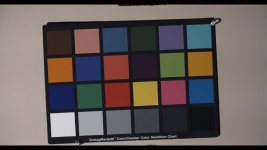
Here's a G-M exposure, middle gray set at 32%, then "Resolved" with the LINEAR to SLOG2 LUT and the C-D workflow applied. In addition, saturation boosted and minor correction to WB to "zero" the white and black swatch. Looks pretty good to me. I see a tiny bit of noise in the black swatch, indicating Mitch's overexposing another stop may be about right. Back to another test.Untitled_1.1.1.jpg
 
Well if you don't know if it will be graded, better not shoot SLOG2 or RAW!

Clearly you missed the last couple o' years. Or possibly Geoff's comment on CML the other day. Haven't you heard? Ungraded RAW/Log is the new uncoated lens.

Besides, in my world! ungraded can mean 'applied the LUT and left it at that'. Or or, more to the point, I was talking about Rec 709/hyper gammas (hence the reference to 70%).

Either way the aim is to get a system that allows for quick exposure setting in documentary environments (no time for spot meters I'm afraid), but still provides a consistency of exposure that means you can be confident that the ignorant 20 year old who edits your rushes can be relied upon to produce a decent cut without complaining about 'exposure continuity problems' to make himself seem more important.
 
AMEN brotha!!
Here's a G-M exposure, middle gray set at 32%, then "Resolved" with the LINEAR to SLOG2 LUT and the C-D workflow applied. In addition, saturation boosted and minor correction to WB to "zero" the white and black swatch. Looks pretty good to me. I see a tiny bit of noise in the black swatch, indicating Mitch's overexposing another stop may be about right. Back to another test.View attachment 80564

Its's kind of hard to tell from the still, all the chips look noisy to me (that might just be compression artefacts thought). But I've found opening a stop up from that sort of level gives a cleaner result. Of course, if you need the extra stop to hold important shadow detail...
 
I am very confused by how everyone here is saying to expose skintone to 38-40 IRE. Yet most are saying when exposing for SLOG2 you need to overexpose at least a stop. I dont get it... I usually expose skintone to 60-70 IRE depending on the person. So that would be underexposing going down to 40. It has been our findings that the ONLY way we have been able to get a decent exposure that would give us any shadow and midtone detail was to have skintones fall in the 80-90 IRE range. I must be completely missing something here because when we expose skin to 40, most everything falls in the shadows and there is no midtone or highlight information.
 
I am very confused by how everyone here is saying to expose skintone to 38-40 IRE. Yet most are saying when exposing for SLOG2 you need to overexpose at least a stop. I dont get it... I usually expose skintone to 60-70 IRE depending on the person. So that would be underexposing going down to 40. It has been our findings that the ONLY way we have been able to get a decent exposure that would give us any shadow and midtone detail was to have skintones fall in the 80-90 IRE range. I must be completely missing something here because when we expose skin to 40, most everything falls in the shadows and there is no midtone or highlight information.

Are you applying a de-log curve or LUT in post? If not you'll need to expose differently (feel free to ignore the oncoming howls that you have to apply a LUT to log footage. Clearly you don't as a lot people aren't these days and the 'log look' is become quite trendy, but I digress...)

Technically if using the Sony Slog2 LUT (which is technically for the F55) then you should be placing mid grey at 32% and skin tones in the region of 50%.

However, if you want to be overexposing by one stop (to lose some of the noise you get exposing 'correctly' on the FS700) you'll need mid grey to be at about 50% and skin tones in the region of 65% (at least that's how it looks to me based on the Slog2 graph Sony provided).

If you're shooting uncorrected then I'd put skin tones at the 70% that most people expect - and let the rest fall where it will.
 
Besides, in my world! ungraded can mean 'applied the LUT and left it at that'. Or or, more to the point, I was talking about Rec 709/hyper gammas (hence the reference to 70%).

Your earlier comment did not go un-noticed. I think the status of footage is a big wall that the video production chain needs to learn.

We've had, and not entirely won, the same battle with stills. Some stills might be six shots, with the intent of merging them together, then the client wants all frames - bla bla - you hand it over and it looks like a dogs breakfast.

I don't know the correct terms - or if there are any yet but I think it goes like this..

1) edit ready - footage you can just go with
2) single pass - footage that will work with a single pass (ie a batch look applied to all)
3) secondaries - footage that will need specific work

I dont shoot 1 at all - because you cant without a HMI truck.
Negotiating the 2 and 3 is a little more complex, especially with the 1970's meta data applied to video files.

When shooting 2 and 3 I think this should be contractually agree before you roll..

Blog entries like this you will see I am examining shots as how they handle single pass, and where they can go with secondaries..

S
 
Nice work, M-M. Pretty much confirms my own conclusions.

As is the case in things these days, there are enough variables to make any choice problemmatic. There is, without argument, less noise in the conventional gamma's. But, there's also less dynamic range. So, selecting the proper gamma becomes a function of the available scene lighting, yes? I would think the CINE's work well for controlled lighting situations, such as in a studio. SLog2 might work best in high DR situations, i.e. outdoors or in a room with brightly lit windows.

And then, there's the question of post acquisition workflow. Who's going to edit the footage? And is it for the evening news where turnaround is critical, or for a movie where tonality is more critical? Personally, I feel it would be irresponsible of me to deliver footage shot on SLog2 to an editor not familiar with Slog2 and LUTs. Yes, there are still a lot of them.

So, as the acquisition variables change, so does the choice of shooting mode. And post workflow has to play a part in the final decision by the cinematographer. And, to add a final source of complications, how does the client/director/producer view dailies? And are they aware of the tradeoffs the DP has to make?

As for the choice of exposure with Slog2, perfect is always close enough (borrowing a cue from Goldilocks and the Three Bears). While I say that tongue in cheek, I want to over-expose a wee bit(1-f/stop?) so that I can eliminate/mitigate the shadow noise in post, but not completely ETTR, as this makes the post grading much more difficult and prone to too much post contrast and vinyl looking skin.
 
Last edited:
There is, without argument, less noise in the conventional gamma's. But, there's also less dynamic range. So, selecting the proper gamma becomes a function of the available scene lighting, yes? I would think the CINE's work well for controlled lighting situations, such as in a studio. SLog2 might work best in high DR situations, i.e. outdoors or in a room with brightly lit windows.

Very nicely put! I find myself shooting very much in that way. I still go for the cine gammas most of the time - when there is not a big need of the high DR, and then flip to slog2 when there is - high bright areas, sky exterior etc. Shooting all slog2 simply gave me too much noise to often and the over-expose-by-this-and-that-much was a hassle. This might change once my Odyssey 7q arrives, given the bigger bit depth, but for now i'm happy with the above practice. Anyone else finding themselves in this situation , or is it just me?
 
Very nicely put! I find myself shooting very much in that way. I still go for the cine gammas most of the time - when there is not a big need of the high DR, and then flip to slog2 when there is - high bright areas, sky exterior etc. Shooting all slog2 simply gave me too much noise to often and the over-expose-by-this-and-that-much was a hassle. This might change once my Odyssey 7q arrives, given the bigger bit depth, but for now i'm happy with the above practice. Anyone else finding themselves in this situation , or is it just me?

I tried Slog2 a in a couple of projects after I got the update. In one project the director loved it totally ungraded (go figure) and another it worked quite well, because the project benefitted from a slightly desaturated look - and it was docco so the extra DR really helped. The third was a magazine show - while the extra DR was also helpful, I felt it needed a more saturated look and the codec started to break down a bit, so... Yeah. Ever since I've mostly been shooting Cinegamma, because Slog2 using the internal codec needs quite gentle handling, but I've never been able to guarantee I'd be able to do the grade.

When I finally get the Odyssey 7Q I ordered back in June, things will probably change a bit - as the extra bit depth and more importantly the extra DR really does give you a much better, richer image. I'll probably save the cinegammas for studio work (as it really is only studios where you have the control necessary to keep the DR within the restricted range of the cinegammas) or more likely some flavour of burnt in look via the user selectable LUTs (when that feature is available).
 
Hmm, do i jump in? Yes, of course :)

IMHO the dynamic range of a cinegamma and 12 bit RAW is the same, what is different is the usability of the range. With RAW the camera does not suddenly see more highlights or shadows but the level of detail between the upper and lower extreme is much greater and it becomes useable. What detail was crushed in the highlights and shadows for a cinegamma is stretched out in Linear, especially the highlights.

I say this because if someone buys an O7Q expecting to see magic new range, they won't. If they shoot RAW then they might finally be able to use the range that the cinegammas hint at.

The biggest difference can be seen quite clearly with adjusting exposure in the ACR dialog when ingesting RAW. The exposure control works as you would expect. A hot element in the scene remains hot as you bring the exposure down whereas with a cinegamma, because of the lack of post support for profiles, darkens immediately. There was a post a while back on this and i showed a sample image. I will attempt to show some more examples because the RAW makes it easier to demonstrate now. I really feel that picture profiles are not broadly understood in post because they 'look okay' whereas log is understood better because it looks wrong. Well, okay, it used to look wrong now what's wrong is right! But a Profile ought to be 'unfolded' in the same way that a log image is.

For our particular camera in this forum, it does make sense to expose higher up on the curve and bring down, just because of shadow and noise performance. But to avoid headaches expose at the same place wherever possible for your particular scene. Not arguing with anything that's been said already...

cheers
Paul
 
Back
Top