Pro use/Home use...

I have 2 HPX 500's and use 16 and 32 GB cards all of the time. In over 2 years of use, I have never lost a single card or the data therein. I would much rather put one card in and leave it, as opposed to swapping 2 and 4GB cards out all day and trying to keep track of those - especially those tiny SD cards. But hey - to each their own.:happy:
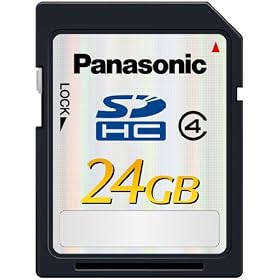
I am not a pro, and usually shoot less than 20 minutes of footage a day, so 4GB works for me. But here is something that might interest you:

51qPQzEZLhL._SL500_AA280_.jpg


A perfect match for 25GB BD disc :) Just yesterday I saw a BD burner at local store for just $200. In comparison, I bought my DVD burner for $150 and my external 2x CD burner for $350. It is time to upgrade, I guess.
 
My new computer in 2000 had a floppy drive, but came with a CD burner, which was exciting in those days. I was so psyched over being able to record a custom made CD and then play it back on a regular CD player. Looking back, it now seems quaint. It's funny how we can get excited over new technological innovations and then, when the novelty wears off, we can't wait for something better to become available. It's almost like being a drug addict looking to get a bigger high. :laugh:

Makes you wonder what we'll be working with in 10 years...


Bob Diaz
 
Makes you wonder what we'll be working with in 10 years...
Bob Diaz

Hopefully, 4k camcorders, with 1/8" imaging chips (super easy to focus - none of that silly shallow DOF!) that all but see in the dark (shooting by candle light with no gain and no grain!), recording pristine images (with 4:4:4 color of course) to flash memory cards with recording capacities we measure in days (or weeks), not minutes (or hours).
 
Hopefully, 4k camcorders, with 1/8" imaging chips (super easy to focus - none of that silly shallow DOF!) that all but see in the dark (shooting by candle light with no gain and no grain!), recording pristine images (with 4:4:4 color of course) to flash memory cards with recording capacities we measure in days (or weeks), not minutes (or hours).


I think you're a little optimistic there....

Probably won't get get all of that in one package, but I would be surprised if we didn't see an "artificial DOF" where the camera simulates shallow DOF using some trick (that some will despise) in realtime. I think that is doable in the next 10 years.

Also, technology to make smaller chips more sensitive to light so shooting lower light is easier.
 
Interestingly enough about future products... Those folks on Panasonic's PASS network probably received an email announcing the release of their 3D camera that records to solid state later this year. The picture looks like an HMC150 body refitted with 2 lenses.

I watched the preview presentation, and thought, "COOL" right up to the point that they pointed out the last step... using a 3D non-linear editing system. Then I thought, "And where is that coming from?"

Point being, whatever innovations come about, there will have to be some synchronization between the different elements in the workflow and in some cases, within the elements of the workflow. Case in point, with AVCHD. AVCHD was great and all that, but we really had to wait for some editors and tools to better manage it before it took hold.

Another case in point: What we are talking about here with SD/SDHC chips and some folks using no more than a 4GB chip since the larger capacity can't be as easily stored to DVD's (personally, I'm using larger chips, 16 and 32, but there is a bit of "quilting without a hoop", as my wife says, when doing that).

It's a chicken/egg thingy.
 
I think you're a little optimistic there....

Probably won't get get all of that in one package, but I would be surprised if we didn't see an "artificial DOF" where the camera simulates shallow DOF using some trick (that some will despise) in realtime. I think that is doable in the next 10 years.

Also, technology to make smaller chips more sensitive to light so shooting lower light is easier.

Perhaps 1/8" full raster 4k chips that see-in-the-dark is a wee bit optimistic (might take 20 years for that). :laugh:

Simulating shallow DOF is probably pretty reasonable, along with a lot of other things. We are just now starting to see only the beginning of what will almost assuredly turn out to be a very rich set of "intelligent" tools, like face recognition for focusing.
 
A perfect match for 25GB BD disc :) Just yesterday I saw a BD burner at local store for just $200. In comparison, I bought my DVD burner for $150 and my external 2x CD burner for $350. It is time to upgrade, I guess.

I bought a USB 2.0 external BD Burner about 6 months ago for $149. You should be able to easily match that (of course - it's not the faster drive but for the price I'm pretty happy). Media is still pretty expensive, but it's starting to come down.
 
I'd love to get 24GB SDHC cards, but last time I looked at pricing on Panny SDHC cards, it sort of made me gasp and then start hyper-ventilating (a bit like looking at their battery prices). :shocked:
 
I have 2 HPX 500's and use 16 and 32 GB cards all of the time. In over 2 years of use, I have never lost a single card or the data therein. I would much rather put one card in and leave it, as opposed to swapping 2 and 4GB cards out all day and trying to keep track of those - especially those tiny SD cards.

I agree... I also use 32GB cards. That's enough... before I bought the HMC40, I rather though I'd wait for SDXC before moving full time to tapeless, but the specs and price were too good. And while I've often been nervous near the end of an 83 minute tape, I have yet to need much beyond that in one shooting. And of course, swapping SDHC cards is dramatically faster than tape (well, particularly because my Sony HVR-A1 was bottom loading -- one of its major flaws).

The other thing about SDXC is exFAT... you lose the 4GB limits. But that's actually not a big deal, the 4GB chunks are ok, particularly if you're using DVD5 for backup. I use BD-R if I have enough material, but for shorter shots, DVD does fine.

It also seems to be common that folks experiencing data loss are swapping cards. A card in your camera is pretty unlikely to experience damage of any sort. Once its out in the real world, it is exposed to potential damage, particularly static. There's some protection, and I always use an SD case to store my out-of-camera cards.

The other great thing about SD these days... its everywhere. My laptop has an SD reader. I have a cheap video camera, a pocket still camera, a GPS, a PS3, a audio field recorder, and other devices that use the cards. I even got CF to SD adaptors, so I could use SD cards in my older DSLRs.
 
I even got CF to SD adaptors, so I could use SD cards in my older DSLRs.
Before the T2i/550 came out I searched for adapters like these, but found only CF Type II (thick) ones. Don't know whether the 5D/7D take Type II cards, but the Sony's MRC1K apparently does not. Whatever, I just sold my V1U, so I am not interested in MRC1K anymore.
 
I am not a pro, and usually shoot less than 20 minutes of footage a day, so 4GB works for me. But here is something that might interest you:

51qPQzEZLhL._SL500_AA280_.jpg


A perfect match for 25GB BD disc :) Just yesterday I saw a BD burner at local store for just $200. In comparison, I bought my DVD burner for $150 and my external 2x CD burner for $350. It is time to upgrade, I guess.

I looked at BD-R as the last piece in the HD chain... cameras to delivery. Before BD, I used to author combination DVD and WMV/HD discs, for shot material anyway... at least these play on PCs. But BD is the real thing. And being current with my Vegas upgrades, I already had the tools.

$200 was my threshold sometime back. My first CD drive and first CD-R were both around $200. Doing more pay-for video (a sideline, but I keep busy), plus the value for backup/archive, I could justify $400 for the first DVD writer, and about the same for the BD-R drive, two years ago.
 
Before the T2i/550 came out I searched for adapters like these, but found only CF Type II (thick) ones. Don't know whether the 5D/7D take Type II cards, but the Sony's MRC1K apparently does not. Whatever, I just sold my V1U, so I am not interested in MRC1K anymore.

Yeah, I'm adapting a Canon EOS Rebel Xt, and a Nikon D70, both of which take the type II cards. I think only devices planning for support of CF microdrives left enough room for the Type II cards.

Like the end of tape, I expect CF will vanish, though it might take SDXC getting popular. CF is still somewhat useful, but decreasingly so.
 
Well, I have only had the camera for 3 days, so still checking out all of the new toys, but so far, I am really glad that I went with this camera. I was pretty much ready to pull the trigger on the HPX170 as it matches up really well with our 500's, but this really is a nice little camera, and the picture is great (as long as you can feed the light demons).

I'm not a real fan of the touch screen monitor (I loath finger smudges!), and you're right - running this thing in auto causes the settings to slide all over the place. But overall - very nice, and frankly, much more solid than I was expecting. I can't wait to try this thing out on my Kessler Crane - the 500 is a real pig sitting up there.

Thanks for all of the feedback, you all really made my decision very easy to make.

-Brad
 
Like the end of tape, I expect CF will vanish, though it might take SDXC getting popular. CF is still somewhat useful, but decreasingly so.
CF has ATA interface and can be used as a direct replacement of a disk drive. SD has its own interface, so using in applications where ATA is expected is not possible without additional adapters.

MRC1K using CF was an unusual move from Sony, but seeing that it finally adopted SD I agree that CF will vanish sooner than later.
 
Brad,

Have you done any scene file matching to your 500? I have been working on matching an HPX to HMC, and thus far, the mojo seems roughly tit for tat. If you match the scene files by line item, it seems workable. I need to do some real testing next to narrow it down to the best recipe.

Grant
 
Hi Grant,
Actually that's next up on the list. I have not gone there yet, but I will get a few of the basic scenes dialed in and tested soon. If there is anything I need to know going into it, any pointers would be appreciated.

I am traveling out to NC in a couple of weeks for meetings and will have some down time to play around with the camera then.

-Brad

Brad,

Have you done any scene file matching to your 500? I have been working on matching an HPX to HMC, and thus far, the mojo seems roughly tit for tat. If you match the scene files by line item, it seems workable. I need to do some real testing next to narrow it down to the best recipe.

Grant
 
Perhaps 1/8" full raster 4k chips that see-in-the-dark is a wee bit optimistic (might take 20 years for that). :laugh:

Yeah... I'm not holding my breath. They're doing very nicely at reducing the noise in CMOS chips. Some that's simply making quieter chips. It's relatively new tech, compared to CCDs, and dramatically lower power. Ideally, lower power == lower noise, but sometimes you have to get tricky. They're implementing cool tricks to eliminate fixed noise and process variations, but things like random thermal noise have minimum levels guaranteed by physics. That same annoying physics thing sets practical limits on how small sensors can go.

I actually expect them to get bigger, not smaller. The success of DSLRs is bound to get someone making a more traditional pro/prosumer model with a Red Camera sized single sensor that rivals the best 3-chippers, but doesn't have all those DSLR compromises. But even that's not a cure-all... it needs a big lens. I've always favored the more moderate sized cameras myself, in still or video.


Simulating shallow DOF is probably pretty reasonable, along with a lot of other things. We are just now starting to see only the beginning of what will almost assuredly turn out to be a very rich set of "intelligent" tools, like face recognition for focusing.

A bunch of these things, like DOF simulation, are in real plugins today. I wouldn't be surprised if some of these migrate in-camera, but probably more for consumers. I don't add FX, audio or video, in the field -- just grab the best you can, totally dry, and work on it later.
 
Back
Top