
Barry_Green
Moderator
Hey folks, got my hands on a preproduction UX90 to play with, and one of the big questions I've had is: what's the real difference in terms of sensitivity and DOF between these various sensor-sized cameras? Since the big-sensor cameras (UX90 and DVX200) both are limited to no more than f/2.8 and the small-sensor camera can open up to f/1.6, is there much real-world difference between them? And how much difference is there between a 1" and a 1.333" sensor camera? They sound pretty close, right?
We could get all math-y on it, or show various tricks to try to enhance DOF, but in the real practical world, it comes down to: I'm standing here and the subject is standing there. I've got to zoom in a certain amount in order to frame them properly, and I've got to set the iris to a certain level for proper exposure. You don't necessarily always get to pick your distance, your lighting, etc., so what are the "event" or "run 'n' gun" practical aspects of DOF? Do you gain anything by going to a 1" camera, and do you gain anything else by going to a 4/3 camera?
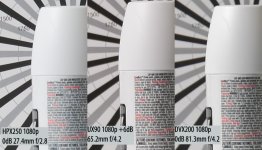
Accordingly, I set up a can of spray paint with a resolution chart as the backdrop. I set the light such that an HPX250 could expose properly at 1/60 shutter, 1080/24p mode, with a wide-open iris, at 0dB of gain. I set the zoom to frame the chart width and height, and focused on the can. The res chart in the background gives us an absolute reference as to how far it's in or out of focus.
(why a spray paint can? Because it was nearby and it had itty bitty text on it).
And the answers?
Well, first of all, yes a UX90 with its 1" sensor definitely exceeds a 1/3" camera in terms of ability to create shallow DOF. It's obviously a notable difference. It's not full-frame DSLR DOF of course, and it's not night-and-day, but it's clearly substantially better than the 1/3" camera, even though the 1/3" camera was at f/2.8 and the 1" UX90's lens would only open up to f/4.2 at that zoom setting. That's a big difference, but so was the zoom; the UX90 framed up the chart properly at 65.2mm, but the HPX250 on the exact same tripod and at the exact same distance needed to be zoomed out to 27.4mm to be able to frame up the chart.
On the other hand, the UX90 was not as sensitive; it needed gain to be able to expose it properly. It required about 6dB of gain, whereas the HPX250 was running at 0dB of gain, so the image is cleaner on the HPX250.
How'd the DVX200 do? Notably shallower than the UX90, that's for sure. The 4/3" sensor in the DVX200 is literally twice as big as the 1" sensor in the UX90 (which is about 6x bigger than the sensor in the HPX250!) so that twice-as-big sensor, combined with the deeper telephoto necessary to give comparable framing, made for notably shallower DOF on the DVX200. Again, the UX90 needed about 6dB of gain to be able to match the brightness of the DVX200 at 0dB, using the same gamma and shutter speed.
I then compared UHD against UHD; this made an even more notable difference between the DVX200 and the UX90. Both cameras were on wide-open iris; on the UX90 it needed a zoom of 47.9mm and an iris of 4.0, on the DVX200 it required a zoom of 81.3mm. That difference is much greater than the difference in the FHD test; in FHD the UX90 was 65.2mm vs. the DVX200's 87.6mm, but the field of vew changes when you go from FHD to UHD on these cameras; on the DVX200 it gets a very slightly tighter FOV (thus requiring 81.3mm) but on the UX90 it crops in significantly, so you need to zoom out to 47.9mm to frame the same image. That difference makes a substantial difference in the DOF delivered.
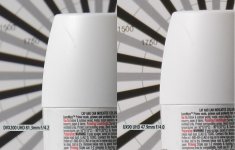
Now, keep in mind the UX90 is an incredibly inexpensive camera, at $2,095-ish it's about the same size as the HPX250 but it does deliver noticeably shallower DOF. However, if shallow DOF is what you're after in a power zoom camcorder, the DVX200 does deliver notably shallower DOF.
What's really impressive is that the 1080p on the UX90 looks to be pretty much exactly as sharp as the HPX250 is. I can't say the sharpening or other image aspects were exactly the same between them as I didn't even really look at those settings, but I can say that reading the text on the spray can seems the same legibility on the UX90 as on the HPX250. And the HPX250 is a very sharp 1080 camera. The DVX200's 1080 isn't as sharp (but we knew that already). It's nice to see that the UX90 looks like it'll be a very sharp, very good 1080p camera, as well as being UHD. I don't think I'd say that the UX90's UHD is as sharp as the DVX200's super-ultra-crisp UHD, but it's certainly not far off. The 6dB of gain probably didn't help the UX90 in this test either, but -- it's a factor, so it has to be considered to get comparable brightness.
Initial impressions: the UX90 is a lot of camera for $2000. It's bigger than the AC90 was, definitely; it's a little smaller than the DVX200 but much lighter (about 2 full pounds lighter). This preproduction unit seems to clock in at about 250 ISO, so about 1 stop slower than the DVX200, which is about right given the difference in sensor size. Can't wait to put a UX180 through its paces.
Also note, none of this has necessarily any applicability to the UX180. The UX180 is different, it's at a different price point and I suspect there are differences under the hood (for at least one example, the UX180 doesn't have to crop in on the sensor in UHD mode). So the UX180 may deliver practical DOF that's somewhat closer to the DVX200 than the UX90 does, when in UHD. When in FHD the UX90 and UX180 are probably comparable, although I haven't seen a UX180 yet and so am only speculating.
We could get all math-y on it, or show various tricks to try to enhance DOF, but in the real practical world, it comes down to: I'm standing here and the subject is standing there. I've got to zoom in a certain amount in order to frame them properly, and I've got to set the iris to a certain level for proper exposure. You don't necessarily always get to pick your distance, your lighting, etc., so what are the "event" or "run 'n' gun" practical aspects of DOF? Do you gain anything by going to a 1" camera, and do you gain anything else by going to a 4/3 camera?
Accordingly, I set up a can of spray paint with a resolution chart as the backdrop. I set the light such that an HPX250 could expose properly at 1/60 shutter, 1080/24p mode, with a wide-open iris, at 0dB of gain. I set the zoom to frame the chart width and height, and focused on the can. The res chart in the background gives us an absolute reference as to how far it's in or out of focus.
(why a spray paint can? Because it was nearby and it had itty bitty text on it).
And the answers?
Well, first of all, yes a UX90 with its 1" sensor definitely exceeds a 1/3" camera in terms of ability to create shallow DOF. It's obviously a notable difference. It's not full-frame DSLR DOF of course, and it's not night-and-day, but it's clearly substantially better than the 1/3" camera, even though the 1/3" camera was at f/2.8 and the 1" UX90's lens would only open up to f/4.2 at that zoom setting. That's a big difference, but so was the zoom; the UX90 framed up the chart properly at 65.2mm, but the HPX250 on the exact same tripod and at the exact same distance needed to be zoomed out to 27.4mm to be able to frame up the chart.
On the other hand, the UX90 was not as sensitive; it needed gain to be able to expose it properly. It required about 6dB of gain, whereas the HPX250 was running at 0dB of gain, so the image is cleaner on the HPX250.
How'd the DVX200 do? Notably shallower than the UX90, that's for sure. The 4/3" sensor in the DVX200 is literally twice as big as the 1" sensor in the UX90 (which is about 6x bigger than the sensor in the HPX250!) so that twice-as-big sensor, combined with the deeper telephoto necessary to give comparable framing, made for notably shallower DOF on the DVX200. Again, the UX90 needed about 6dB of gain to be able to match the brightness of the DVX200 at 0dB, using the same gamma and shutter speed.
I then compared UHD against UHD; this made an even more notable difference between the DVX200 and the UX90. Both cameras were on wide-open iris; on the UX90 it needed a zoom of 47.9mm and an iris of 4.0, on the DVX200 it required a zoom of 81.3mm. That difference is much greater than the difference in the FHD test; in FHD the UX90 was 65.2mm vs. the DVX200's 87.6mm, but the field of vew changes when you go from FHD to UHD on these cameras; on the DVX200 it gets a very slightly tighter FOV (thus requiring 81.3mm) but on the UX90 it crops in significantly, so you need to zoom out to 47.9mm to frame the same image. That difference makes a substantial difference in the DOF delivered.
Now, keep in mind the UX90 is an incredibly inexpensive camera, at $2,095-ish it's about the same size as the HPX250 but it does deliver noticeably shallower DOF. However, if shallow DOF is what you're after in a power zoom camcorder, the DVX200 does deliver notably shallower DOF.
What's really impressive is that the 1080p on the UX90 looks to be pretty much exactly as sharp as the HPX250 is. I can't say the sharpening or other image aspects were exactly the same between them as I didn't even really look at those settings, but I can say that reading the text on the spray can seems the same legibility on the UX90 as on the HPX250. And the HPX250 is a very sharp 1080 camera. The DVX200's 1080 isn't as sharp (but we knew that already). It's nice to see that the UX90 looks like it'll be a very sharp, very good 1080p camera, as well as being UHD. I don't think I'd say that the UX90's UHD is as sharp as the DVX200's super-ultra-crisp UHD, but it's certainly not far off. The 6dB of gain probably didn't help the UX90 in this test either, but -- it's a factor, so it has to be considered to get comparable brightness.
Initial impressions: the UX90 is a lot of camera for $2000. It's bigger than the AC90 was, definitely; it's a little smaller than the DVX200 but much lighter (about 2 full pounds lighter). This preproduction unit seems to clock in at about 250 ISO, so about 1 stop slower than the DVX200, which is about right given the difference in sensor size. Can't wait to put a UX180 through its paces.
Also note, none of this has necessarily any applicability to the UX180. The UX180 is different, it's at a different price point and I suspect there are differences under the hood (for at least one example, the UX180 doesn't have to crop in on the sensor in UHD mode). So the UX180 may deliver practical DOF that's somewhat closer to the DVX200 than the UX90 does, when in UHD. When in FHD the UX90 and UX180 are probably comparable, although I haven't seen a UX180 yet and so am only speculating.

 regards from Poland

