Photos from the "old days"

This is a "finger gun" we had in the 9th grade.

Ak47-e1363724603451.png


And I ain't kidding. We had to assemble and disassemble it in under two minutes. (which was a piece of cake, actually) Girls too. (I don't mean we had to assemble and disassemble the girls too but that boys and girls were in the same Military Readiness class ... only boys got to shoot it at the actual Army training ground though ... no earplugs ... and that's a loud MoFo)

I remember visiting a school in Moscow in 1982 and they were doing military drills, singing nationalistic songs and all the other indoctrination stuff. It seemed to totally whacko to someone like me coming from a college in the UK where music, art and partying were the main things that occupied us.

I've been there a lot over the years. Fair to say, it's changed a bit!
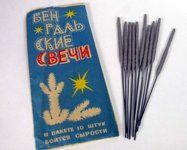
 
As long as we're on a New Year theme. The Olivier salad was a Soviet era staple.

View attachment 142052

I cite Wikipedia :

Olivier salad (Russian: салат Оливье, tr. salat Olivye)[Note 1] is a traditional salad dish in Russian cuisine, which is also popular in other post-Soviet countries, many European countries, Iran, Israel, Mongolia and also throughout Latin America. In different modern recipes, it is usually made with diced boiled potatoes, carrots, brined dill pickles (or cucumber), green peas, eggs, celeriac, onions, diced boiled chicken or bologna sausage (sometimes ham or hot dogs), and tart apples, with salt, pepper, and mustard added to enhance flavor, dressed with mayonnaise. In many countries, the dish is commonly referred to as Russian salad. A variation called Stolichny salad (Russian: салат "Столичный", "capital city salad") exists, and is also popular in the Russian cuisine.

In Russia and other post-Soviet states, as well as in Russophone communities worldwide, the salad has become one of the main dishes on zakuski tables served during New Year's Eve ("Novy God") celebrations.
.

https://en.wikipedia.org/wiki/Olivier_salad
 
Last edited:
I remember visiting a school in Moscow in 1982 and they were doing military drills, singing nationalistic songs and all the other indoctrination stuff. It seemed to totally whacko to someone like me coming from a college in the UK where music, art and partying were the main things that occupied us.

I've been there a lot over the years. Fair to say, it's changed a bit!

Prior to the late 1980's, this was something one had to do during the school hours, regardless of how one felt. Some of my classmates were very "patriotic" and did the whole drill ... right up until perestroika. Then they all rushed into the commercial world. Which implies that their allegiances to the regime were mostly fake.
 
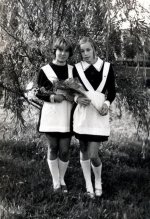
A duo of the Soviet high school students in their typical/mandated "French maid" uniforms. Bouquets of flowers in their hands suggest either the first or last day of the school year. The left side of the chest has a Lenin pin, a sign of the membership the Communist Youth. Also mandated.

489955ac30be7ec_587_fewr355r_012.jpg
 
And here's that pin upclose and personal. It looks like what I had (version used 1958-1991)

Komsomolskiy%20znachok.jpg
 
Last edited:
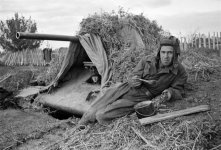
1942, Stalingrad. A camouflaged T-34, with crew enjoying a lunch break. Probably staged.

d258e28828.jpg
 
5.jpg

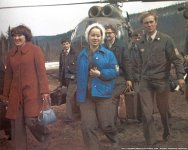
BAM construction crews arrive at the scene.

BAM (the Soviets pronounced it as "bum", rather than B.A.M) was a 2,700 mile Transsiberian railroad construction project that began as far back as the 1930's and ended somewhere in the 21-st Century. It picked up steam during the Brezhnev era and, along with the invasion of Afghanistan in 1979 and the military buildup following operation Mole Cricket 19 in June, 1982, became the cause of the financial ruin of the USSR. The official cost of BAM was given as 17 billion rubles (average wage was ~ 100r/mo in 1970, 120 in 1980, 200 in 1990) but it also had additional costs, such as building livable towns across the way, shuffled into different accounting entries.

https://en.wikipedia.org/wiki/Baikal–Amur_Mainline
 
If they played "Find DLD", where would they have found you?

The above photo is from "Artek", a famed (by the Soviet standards) youth resort for the pioneer age kids.

https://en.wikipedia.org/wiki/Artek_(camp)

One had to apply to be allowed in any pioneer camp and I absolutely refused the subject to be mentioned in my presence. We had a dacha and that's where I liked spending my summers.

Something like this -

original.jpg

PS. Brezhnev & Chernenko photo is from 1981. Brezhnev's summer residence wasn't far away. The kids in that photo were obviously selected from the kids already at that camp but with a special preference for diversity. They also have very clean "parade" uniforms.
 
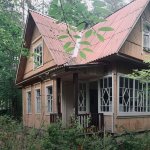
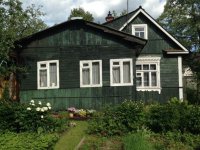
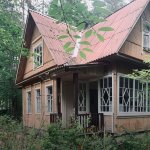
Another typical for that time dacha.

aHR0cHM6Ly9hc3NldHMuYXRsYXNvYnNjdXJhLmNvbS9tZWRpYS9XMXNpWmlJc0luVndiRzloWkhNdmNHeGhZMlZmYVcxaFoy.jpg

My grandparents built it in the late 1950's. I'd usually spend May-September there with both of them before I started the elementary school (i.e., as son as the temps got above 40's in the spring and no later than they dipped below 50 in the fall ... the cottage wasn't made to be an all-weather place), although my parents took me with them in the summer to wherever they planned to vacation. Dachas were also known for their micro farms, where every parcel of land had something growing. That took care of the nutrients and vitamins requirement during the summer and fall seasons.

PS. I tried deleting the old photo but something went wrong somewhere.

So, I'll use this opportunity to add that the micro farms were much needed during the Soviet era due to the costs and the availability of buying fruits and vegetables at state stores or private farmer markets. These days, they're mostly for hobbyists, as one can buy pretty much anything anywhere.
 

Attachments

  • original.jpg
    original.jpg
    101.2 KB · Views: 0
Last edited:
A typical Russian country village. The photo itself is recent but that's how it looked back in the 1960-s too.

scale_2400
 
Valentin Gubarev is a Russian born artist, who's been living in Minsk for many a year. He's got a tongue-in-cheek view on the old Soviet lifestyle. This one is called a "Slow Dance".

1.19_%D0%9C%D0%B5%D0%B4%D0%BB%D1%8F%D0%BA.jpg
 
Back
Top