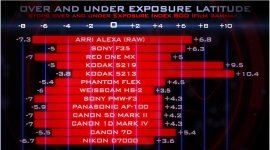
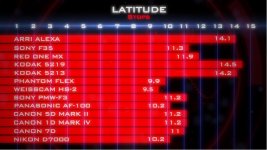
People who have done their own tests agree with this?

Sttratos

Veteran
I have been trying to find where mid gray stand with cine gammas and B.press and how many stops above and under mid gray with AF100. Friend and I did some tests but arrived at inconsistent results. So I try again to find this info online. Again I can find nothing. I only find this article from pre production model: http://www.creativeplanetnetwork.com...ag-af100/17080

It say AF100 has 2 stops of overexposure and 6 to 7 stops of underexposure for a total of 10 stops. Is this true? Only 2 stops of overexposure? If true this explain a lot of why is so hard to work with in sunny shots. FS100 has 4 stops of overexposure for example: http://blog.abelcine.com/2011/06/17/sony-nex-fs100-dynamic-range-test/
I know it is pre production model but production model also has 10 stops. I can't find another article to contest this one.

It is very strange the way the professional community looks to neglect and ignore the AF100. You can find deep tests for any camera even GH2 but not AF100. Abelcine has tested many many cameras but not AF100.
Do you agree with article? If not what have you find in your tests?
 
Thank you. I have watched this test long ago. But because it is not detailed enough is difficult to understand. This would put mid gray where exactly? -5.9 and +4.3 with which gamma? Gamma change this things. Why ISO 800 when AF100 is ISO 400? This make test not so useful. ISO 400 will be more accurate. But I think ISO 800 was because of too many cameras.
 
Not trying to come off like a jackass here, but I'm having trouble understanding why you feel a test conducted by a group of very well qualified ASC cinematographers is not useful, inaccurate, or you question their camera baseline settings, when you yourself admit that you are unsure about testing??? Might I ask where mid grey falls on the waveform monitor in your tests?

In my book there is not a standard one size fits all mid gray position. Unless of course you are shooting test charts for a living. Scenes vary in contrast, look and feel, and your post workflow should also be taken into consideration when exposing an image. For example... Are you going to take your footage and apply an s-curve film look in post changing your mid value? Your end color space will also have an impact on how things look. For example fitting over 10 stops into a 6 stop Rec-709 bit bucket.

In the above shootout, they give a very accurate example of what each camera is capable of under best conditions.

All the best!

Dave
 
Thank you. I have watched this test long ago. But because it is not detailed enough is difficult to understand. This would put mid gray where exactly? -5.9 and +4.3 with which gamma? Gamma change this things. Why ISO 800 when AF100 is ISO 400? This make test not so useful. ISO 400 will be more accurate. But I think ISO 800 was because of too many cameras.

I would guess that they would have used a standard scene file and would have picked either cine-v or more than likely cine-d (think that's F6 scene file on standard), in any case you only have 6 options on standard to choose from and are only trying to ascertain mid grey so half of the scene file tweaks can be ignored, pretty much gamma choices and it would have been the cine gamma s I'm sure.
 
Not trying to come off like a jackass here, but I'm having trouble understanding why you feel a test conducted by a group of very well qualified ASC cinematographers is not useful, inaccurate, or you question their camera baseline settings, when you yourself admit that you are unsure about testing??? Might I ask where mid grey falls on the waveform monitor in your tests?

In my book there is not a standard one size fits all mid gray position. Unless of course you are shooting test charts for a living. Scenes vary in contrast, look and feel, and your post workflow should also be taken into consideration when exposing an image. For example... Are you going to take your footage and apply an s-curve film look in post changing your mid value? Your end color space will also have an impact on how things look. For example fitting over 10 stops into a 6 stop Rec-709 bit bucket.

In the above shootout, they give a very accurate example of what each camera is capable of under best conditions.

All the best!

Dave

Yes but where is mid gray? What gamma used?
 
I would guess that they would have used a standard scene file and would have picked either cine-v or more than likely cine-d (think that's F6 scene file on standard), in any case you only have 6 options on standard to choose from and are only trying to ascertain mid grey so half of the scene file tweaks can be ignored, pretty much gamma choices and it would have been the cine gamma s I'm sure.
I also think cine gamma. But we have 2 cine gammas with AF100. Where is the white paper they promised? Was it ever released?
 
I also think cine gamma. But we have 2 cine gammas with AF100. Where is the white paper they promised? Was it ever released?

I grabbed this from Alistair Chapman (Sony F55 owner! Lucky kit), anyway, the AF100 is not really a log camera but our Cine D gamma is the closest we have to it so;

"When shooting log you have to consider that in order to record the increases dynamic range, each stop of exposure is allocated a very similar amount of data. But as each extra stop is a doubling of brightness range there is in effect more and more image compression occurring as the image brightness increases. For maximum grade ability, you don't want all your picture information up in the highlights. So generally with a log curve you will underexpose slightly compared to a standard gamma. The norm is to use a mid grey card and expose it so that it is at 38% and reflected white should be somewhere around 70%. Reflected white at 70% then allows headroom for direct light sources like the sky or reflections off shiny surfaces.

That's the theory at least, in practice things will vary from scene to scene, but the primary concern is to not overexpose and to keep highlights well controlled"

So I am guessing our mid grey point will be around this region in Cine D and a little higher with Cine V as it has more contrast?

Without knowing Zacutos camera profile I can only guess this is the right way of going about this but keep in mind you're talking to someone who only started using a light meter this year!
 
Friend and I did some tests but arrived at inconsistent results.


Can you say why you got inconsistent results and tell us how you tested? (Got any frame grabs from your test.)

Also..I am wondering exactly what you are trying to achieve here.
 
Back
Top