
Navigation
Install the app
How to install the app on iOS
Follow along with the video below to see how to install our site as a web app on your home screen.
Note: This feature may not be available in some browsers.
More options
You are using an out of date browser. It may not display this or other websites correctly.
You should upgrade or use an alternative browser.
You should upgrade or use an alternative browser.
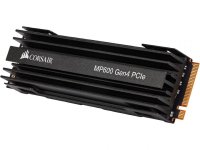
PCIe 4 Drives Are Here : 4,950 MB/Sec Read Speed 4,250 MB/Sec Write Speed
- Thread starter TheDingo
- Start date

Thomas Smet
Veteran
Now we just need Thunderbolt 4 for the poor Mac users.
filmguy123
Veteran
I plan to do a new threadripper build late this year or early next. glad to see pcie4 supported devices already!
This could make a great boot drive or media cache drive.
This could make a great boot drive or media cache drive.

cyvideo
Veteran
... or media cache drive.
+1 Awesome media cache drive! Well priced too.
Chris Young

Vik Kamenicky
Active member
That heatsink is massive! Sad that Intel isn't pushing PCIe harder (looking at you new Mac Pro).

Samuel H
Major Contributor
I plan to do a new threadripper build late this year or early next...
Why ThreadRipper? I'm getting a Ryzen 9 3950X: new gen, 16 cores 32 threads, 3.5-4.7 GHz, works on regular boards with regular chipsets
Bob Loblaw
Active member
Why ThreadRipper? I'm getting a Ryzen 9 3950X: new gen, 16 cores 32 threads, 3.5-4.7 GHz, works on regular boards with regular chipsets
Threadripper has 64 pcie lanes, while Ryzen only has 24. A pcie ssd uses 4 lanes, and a GPU uses 16 lanes. Threadripper gives far more options for a workstation.
It's TLC chips: https://www.enterprisestorageforum.com/storage-hardware/slc-vs-mlc-vs-tlc-nand-flash.html & https://www.pcworld.com/article/299...ng-problem-storage-makers-dont-advertise.html
While I expect that things have changed for the better in recent years, TLC is still the "bargain" method of making storage devices.
While I expect that things have changed for the better in recent years, TLC is still the "bargain" method of making storage devices.
This gives a good break down of why it may not be best for high performance needs: https://www.anandtech.com/show/5067/understanding-tlc-nand/2
I have stopped looking at all cheap SSD drives because they are all TLC now. The SLC are still expensive when compared to the size of the disk.
I have stopped looking at all cheap SSD drives because they are all TLC now. The SLC are still expensive when compared to the size of the disk.
Bassman2003
Veteran
Go to know. Thanks for the link and "no free lunch" is still alive and well!
That article was from 2012 and a lot has changed in the SSD market in the several years since. For example, there are very few pure SLC drives these days, instead SLC has shifted to being used for high performance specialty applications (in small capacities), or as a smaller SLC cache in a larger TLC or QLC based SSD.This gives a good break down of why it may not be best for high performance needs: https://www.anandtech.com/show/5067/understanding-tlc-nand/2
I have stopped looking at all cheap SSD drives because they are all TLC now. The SLC are still expensive when compared to the size of the disk.
The consumer SSD market pretty quickly shifted away from SLC to MLC and then TLC, and now even the enterprise SSD market has been following the same path:
https://www.anandtech.com/show/13704/enterprise-ssd-roundup-intel-samsung-memblaze
Technologies like 3D NAND have closed some of the performance and endurance gap between TLC and older planar NAND SLC or MLC drives. And as drive capacities continue to increase, this tends to favor the shift toward higher density NAND like TLC. It's entirely possible that a few years down the road MLC-based SSDs will slowly fade from the market as well.
In addition to the NAND itself, the drive controller and caching structure can also have a significant impact on overall drive performance. So while the basic performance differences between types of individual NAND cells still apply, it's no longer so simple to just look at the type of NAND used in a drive and know what the overall drive performance will be.
Here's an interesting test of the new PCIe 4.0 SSD drives, where the TLC drives are delivering the performance promised but the software we use ( like Adobe Premiere, etc... ) may not be designed to take advantage of this speed. ( I wouldn't want to use a TLC drive as a cache drive, unless I was prepared to replace it when it wears out, which might be sooner than you think ) All of this is brand new, so I expect there to be a "learning curve" as we find out what works and what doesn't when it comes to tweaking the performance of our computer gear.