Panasonic's organic sensor

First of all, haven't we been hearing about an organic sensor from Panasonic for years? Here's an article from 2013. Where's the product? Even in these most recent press releases, they're still calling it just "a technology" and "research."

Second, this sounds just like Invisage's QuantumFilm: a layer of stuff on top of a conventional sensor. Of course Panasonic claims over 100 patents. Here's a second press release that emphasizes its global shutter.
 
First of all, haven't we been hearing about an organic sensor from Panasonic for years?
Yes. But they are a lot more concrete now.

Second, this sounds just like Invisage's QuantumFilm: a layer of stuff on top of a conventional sensor. Of course Panasonic claims over 100 patents. Here's a second press release that emphasizes its global shutter
isn't Invisage shipping? At least, we've got some video clips from them.

http://www.digitaltrends.com/mobile/invisage-quantumfilm-camera-news/

And these guys were just a startup. Panny is a serious player.
 
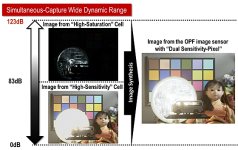
* Panasonic says the photoelectric conversion happens in the organic part.
en160203-5-1.jpg


* 123 dB is just over 20 stops of DR. Let's see if they can really achieve that within each photosite (they say "simultaneous capture", but that could mean different ISO on alternating rows), but if they do, it's indeed a huge step forward.
 
123 dB is just over 20 stops of DR. Let's see if they can really achieve that within each photosite (they say "simultaneous capture", but that could mean different ISO on alternating rows), but if they do, it's indeed a huge step forward.
I think the description states simultaneous capture within each photosite, via two cells (one for darkness and one for brightness). This should produce somewhat better results than dual readout.
 
That sounds like the dual-pixel thing from Canon, but instead of using it for AF, putting a darker CFA or a higher ISO configuration for one side of the dual pixel. I picture it as having a sensor with twice the pixels and a 6-color CFA, and it sounds like a great idea in my head.
 
Going by their diagram it appears to be two electrodes stacked on top of each other, one being a transparent electrode. So I think this is an entirely new beastie...
 
Just a note... This is being co-developed with Fujifilm and will very likely come with their color science behind it. The last thing I read is that they have this working on very small sensors, but scaling up to MFT or APS-C is the hard part. I haven't really been following this for more than a year.
 
Just a note... This is being co-developed with Fujifilm and will very likely come with their color science behind it. The last thing I read is that they have this working on very small sensors, but scaling up to MFT or APS-C is the hard part. I haven't really been following this for more than a year.

I've read that 2020 is the target date for this to start being implemented in actual products. The sensors in R&D right now must be pretty crazy compared to what we're using.
 
I'm left a little confused by that report. The main stated advantage behind developing OPF as I understood it was to end up with a stacked design capable of R,G,B on each photosite (so three OPF films on top of each other). To give the best of both three chip with prism, and single chip at the same time. According to that report, they talk of using conventional R,G,B filtration on top of a single film.... so it seems the biggest reason behind OPF development isn't being utilised......? It's possible that whilst it may be possible to tailor films to only respond to R,G, or B, it may not be possible to tailor the exact frequency responses accurately enough for photographic work? (At least at the moment.)

(As example, look at http://www.imagesensors.org/Past Workshops/2003 Workshop/2003 Papers/02 Aihara et al.pdf )

It's also worth noting what they say about "The area of the light receiving section becomes limited in conventional image sensors because of the existence of metal interconnects and the need to form a light shield film to prevent light incidence into areas other than the photodiode in each pixel." Well.... that may be true in Panasonics "conventional image sensors", but I thought other manufacturers had already got over that by factors such as back illumination? So it's really saying "this may enable us to catch up in the future"?

The HDR aspect also seems nothing to do with the OPF side, and is due to what I believe Fuji did in the past with CMOS - double the number of photosites for a given resolution, and have half much larger than the other half. The smaller ones capture the bright areas, the larger the shadow areas. So when they say "These technologies enable high-speed, high-precision imaging without time distortion in high-contrast scenes......... In addition to, synthesizing multiple exposures data which are captured at the different times is not necessary, so it enables accurate imaging of moving objects at high speed." that's what is really meant. And true, it may "enable high-speed, high-precision imaging without time distortion"...... but at the expense of spatial distortion. There's no such thing as a free lunch.

Yes, technology moves on, and who knows what we'll see in the next five years, but I'd treat those announcements with a certain amount of scepticism for now. The real science seems to be heavily overlaid with a lot of marketing spin, and "blind them with science".
 
^ I think you're completely right about the RGB CFA and the divided-photosite thing.

A friend of mine had a Fuji S3 Pro, and it did have more than two stops better DR than competing bodies back in 2004 (in fact it kept on being competitive in that area until very recently; he was still using it on weddings back in 2010). The downside was that it had less Mpix than the competition, and not stellar lowlight abilities. But really: today we have more Mpix and lowlight abilities than we need, I'd happily trade some of those for an extra couple of stops of DR (e.g. if the a6300 had 12 Mpix instead of 24, and offered three stops more DR than the NX1 in RAW stills, and kept all of that alive in video mode thanks to a super wide log profile, and had 10-bit to make that usable... yes, I'm dreaming, I know, but that's what this thread is about, right?)
 
Back
Top