Barry_Green
Moderator
PANASONIC ANNOUNCES APRIL DELIVERY OF FASTER, HIGHLY RELIABLE, LOWER-COST MICROP2 CARD SERIES
World’s First UHS-II Compliant Memory Cards
World’s First UHS-II Compliant Memory Cards
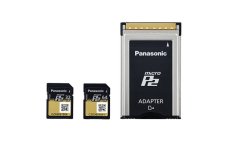
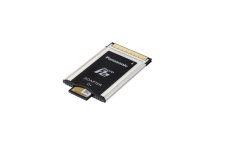
SECAUCUS, NJ (March 20, 2013) – Panasonic today announced delivery and pricing information for its new microP2 series, the world’s first UHS-II compliant memory cards*, which continues the company’s evolution to higher-speed, lower-cost, more compact media. The simultaneous introduction of a microP2 Card Adapter assures that the new series of 64GB and 32GB microP2 cards will operate in current P2 hardware**. Panasonic has also announced a two-slot microP2 drive for plug-and-play offload of content.
The AJ-P2M064A 64GB and AJ-P2M032A 32 GB microP2 cards will be available next month with suggested list prices of $380 and $250, respectively. The AJ-P2AD1 microP2 adapter will likewise be available in April, with a suggested list price of $199. The AJ-MPD1 microP2 drive will ship in April, with a suggested list price of $350.
Panasonic has at the same time introduced two new products, the AJ-PX5000 P2 HD camcorder and AJ-PD500 half-rack recorder, both with built-in microP2 slots and AVC-ULTRA recording, which will be available in fall 2013. The microP2 cards will guarantee data writing up to the class200 mode of AVC-ULTRA, the company’s newest compression system***.
With an SD card form factor, the MicroP2 cards will ensure high-speed transfer, high reliability and the writing assurance of all P2 frame rates, formats and codecs. Furthering the versatility of the microP2 card adapter and microP2 card slots, their design allows Class 10 SDHC/SDXC cards (at bit rates only up to 50Mbps)to be used in P2 products****.
The microP2 card’s double-layered UHS-II interface facilitates transfer speeds of 2.0 Gpbs (1.7 times faster than standard P2 media, and 12x faster than ordinary SD media). Reliability is defined by Proof7 strength (resistance to water/dust, static electricity, bending and twisting, magnet, X-ray, wide temperature range, and safety built-in-fuse ); a flash memory error correction system, equivalent to a RAID system, to greatly strengthen data retention reliability; a Lifetime Counter that gives a notification when the card approaches the end of its life cycle, which is defined as reusable for up to five years when recorded on once daily, at full capacity; 100% screened flash memory; a Content Protection System (CPS) that password-protects the card; and a QR code for scanning and identification.
The microP2 drive and microP2 Adapter both feature CPS password protection. The microP2 drive has a USB 3.0 interface for transfer speeds up to 2.0 Gbps, and its two slots accommodate offloading of spanned clips. To use the microP2 card adapter, a firmware upgrade of current P2 hardware is required. P2 hardware can be upgraded to microP2 use on the following schedule: in April 2013, the AJ-HPX3100, AG-HPX250, AG-HPX255, AG-HPX600 camcorders, AG-HPD24 deck, and AJ-PCD20, AJ-PCD35, AJ-PCD30, AJ-PCD2 drives; in June 2013, the AG-HPX370 camcorder and AG-HPG20 recorder; in August 2013, the AJ-HPX2000 camcorder, and AJ-HPM200 and AJ-HPD2500 recorders. To download the free upgrade, visit http://pro-av.panasonic.net/en.
Panasonic’s microP2 solid-state UHS-II compliant memory cards ensure highly reliable video, audio, and metadata recording, especially in challenging conditions of extreme temperature range, shock, and vibration. P2 cards allow professional users to benefit from a fast, easy, file-based workflow and exceptional reliability.
* As of UHS-II compliant memory card, March 2013
** The microP2 card and microP2 card adapter will not support all P2 products.
***With the exception of 1080/60p/ 50p within class 200.
****The performance of the Class 10 SDHC/SDXC card will depend on the quality of the card being utilized.
Panasonic Solutions for Business
Built on a celebrated engineering foundation, Panasonic architects business technology solutions that help build a better world. Customers in government, healthcare, production, education and a wide variety of commercial enterprises, large and small, depend on integrated solutions from Panasonic to help them acquire, manage and interpret the information that drives innovation. The complete suite of Panasonic solutions addresses unified business communications, mobile computing, security and surveillance systems, retail information systems, office productivity solutions, high definition visual conferencing, projectors, professional displays and HD video production. As a result of its commitment to R&D, manufacturing and quality control, Panasonic engineers reliable and long-lasting solutions as a partner for continuous improvement. Panasonic solutions for business are delivered by Panasonic System Communications Company of North America, which is a division of Panasonic Corporation of North America, the principal North American subsidiary of Panasonic Corporation (NYSE: PC).
All brand and company/product names are trademarks or registered trademarks of the respective companies. All specifications are subject to change without notice. Information on Panasonic solutions for business can be obtained by calling 877-803-8492 or at www.panasonic.com.
# # #