Panasonic pre-NAB press release: AJ-PX5000G P2 & MicroP2 AVC-Ultra camera

Barry_Green

Moderator
PANASONIC ANNOUNCES 2/3-INCH, 3-CHIP AJ-PX5000G AVC-ULTRA P2 HD SHOULDER-MOUNT WITH MICROP2 CARD SLOTS, AVC-LONGG
Class200 Option Delivers Master Quality Recording for Network-Level Program Creation,
Film Outs and Large Screen Display
​
SECAUCUS, NJ (March 20, 2013) – Panasonic today announced the AJ-PX5000G, its first P2 HD camcorder with native AVC-ULTRA recording and built-in microP2 card slots. The 2/3-inch, 2.2M 3-MOS camera combines superb image production, light weight and innovative expandability. The PX5000 features 720p and 1080p/i recording, and is the first P2 camcorder that will record in full-resolution, 10-bit 1080/60p (in AVC-Intra100). AVC-LongG is standard. The PX5000G will offer optional AVC-Intra200 recording, which at twice the bit rate per frame of AVC-Intra100 is virtually lossless, delivering a master quality codec in an affordable, file-based shoulder-mount camera. High-resolution AVC-Proxy recording is likewise an option.
With its breadth of recording options, ultimate image quality, variety of professional I/Os and powerful expandability, the PX5000G will address niches in network news, documentary, high-end corporate and sports production, as well as the rental market.

“With AVC-ULTRA recording, terrific image quality and a variety of cutting-edge, selectable options, the PX5000G is Panasonic’s best-ever shoulder-mount,” said Steve Cooperman, Product Manager, Panasonic System Communications Company of North America. “The camcorder is absolutely customer-driven, with 1080i appealing to broadcasters, 720p ideal for news and sports, and, now for the first time in P2, 1080/60p for higher frame rate, higher-resolution recording.”

“Outfitting the PX5000G with the AVC-Intra200 option will yield a cost-effective approach to network-level program acquisition, film-outs and higher levels of color correction, he added. “And recording prime programming in AVC-Intra200 today will facilitate up-rezzing to higher-level formats in the future.” The PX5000G’s three 2.2M pixel MOS sensors deliver a horizontal resolution of 1000 TV lines, and sensitivity of F12 over 60i.The camcorder’s 2/3-inch shoulder-type design accommodates a variety of interchangeable lenses. The PX5000G can record in AVC-LongG and AVC-Intra100/50, with optional recording in DVCPRO HD, DVCPRO50, DVCPRO and DV; the unit is 50 Hz and 59.94 Hz switchable for worldwide use.

Panasonic’s AVC-ULTRA offers master-quality and/or low-bit-rate 10-bit, 4:2:2 recording in Full HD to meet a variety of user needs from mastering to transmission. AVC-LongG, designed for applications where file size is critical, offers up to 10-bit, 4:2:2 sampled recording in a much smaller file size, saving storage cost and transfer times over MPEG-2 while maintaining equal or better video quality. The PX5000G incorporates a selection of AVC-LongG quality levels, including AVC-LongG50 (10-bit, 4:2:2) and AVC-LongG25 (4:2:2, 10-bit).


Addressing the need for high-speed file exchange, AVC-Proxy encodes, optional in the PX5000G, are made in parallel with higher bandwidth production formats. AVC-Proxy enables fast, efficient offline editing, at bit-rates from 3.5 megabits down to 800 kilobits per second.

Like the current AG-HPX600, the PX5000G is “future-proofed” to provide inventive functionality and improved workflows, with additional options such as wireless metadata input and variable frame rates. The PX5000G features wireless and wired connection ability with Wi-Fi, USB and Gigabit Ethernet, including wireless control of key camera functions from a smart phone. In addition, an option will support operational integration with live video uplink transmitter devices from partners, LiveU, AVIWEST, Streambox and TVU Networks.

Weighing just over eight pounds, the PX5000G is the first P2 HD camcorder with built-in slots for the company’s new microP2 cards, which have an SD card from factor (see separate news release). The PX5000G has two microP2 slots and two standard P2 card slots,* as well as an SD card slot for proxy/metadata recording.

The camcorder will be equipped with Chromatic Aberration Compensation (CAC) to maximize lens performance; Dynamic Range Stretch (DRS) function to help compensate for wide variations in lighting; and a highly accurate flash band detection and compensation algorithm that minimizes this effect. The PX5000G delivers seven-mode gamma selection and extensive digital image settings.

Innovative features include a smart user interface that permits accessibility to the camera’s extensive functions from an LCD display on the side of the camera; a 16:9, 3.5-inch, 920,000-dot resolution LCD color viewfinder, which doubles as a LCD monitor when open; a simplified waveform and vectorscope; a 10-pin remote terminal enabling remote camera operation; and an optional camera studio system.

Professional interfaces include MON out (can be set to output HD-SDI), HDMI out, HD/SD-SDI in/out, 3G-SDI out, genlock in for multi-camera operation, timecode in/out, USB 3.0 (host) and a two-channel UniSlot compatible wireless receiver. The PX5000 has two XLR audio inputs, and records up to four channels of 48kHz, 24-bit audio in AVC-Intra formats (16-bit in AVC-LongG, DVCPRO HD, DVCPRO and DV).

Standard features include Scan Reverse for use with a cinema lens adaptor; Digital Zoom function for 2x and 4x close-ups; Variable Shutter Speed from 1/12 to 1/2000 sec plus Synchro Scan; and a four-position (CLEAR, 1/4 ND, 1/16 ND, 1/64 ND) optical neutral density filter wheel.

The PX5000G will be available this fall, with a suggested list price of under $28,000.

For further information about Panasonic professional video products, visit www.panasonic.com/broadcast

*The PX5000G does not support spanned recording between the microP2 and standard P2 cards slots.

Panasonic Solutions for Business
Built on a celebrated engineering foundation, Panasonic architects business technology solutions that help build a better world. Customers in government, healthcare, production, education and a wide variety of commercial enterprises, large and small, depend on integrated solutions from Panasonic to help them acquire, manage and interpret the information that drives innovation. The complete suite of Panasonic solutions addresses unified business communications, mobile computing, security and surveillance systems, retail information systems, office productivity solutions, high definition visual conferencing, projectors, professional displays and HD and 3D video production. As a result of its commitment to R&D, manufacturing and quality control, Panasonic engineers reliable and long-lasting solutions as a partner for continuous improvement. Panasonic solutions for business are delivered by Panasonic System Communications Company of North America, which is a division of Panasonic Corporation of North America, the principal North American subsidiary of Panasonic Corporation (NYSE: PC).

All brand and company/product names are trademarks or registered trademarks of the respective companies. All specifications are subject to change without notice. Information on Panasonic solutions for business can be obtained by calling 877-803-8492 or at www.panasonic.com.

# # #
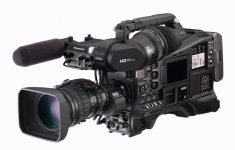
 
What a great looking camera. Too bad I am no longer in the market to make a should mount purchase of this magnitude worth it anymore. Ten years ago I would have been all over this camera.
 
1080 60p at 28000 USD? How is it exciting? Or am I missing something?

Yes you are missing a lot. It isn't just about the frame rate but the form factor and image quality in a wide variety of shooting environments and situations without having to take the time to setup a shot and switch lenses. If you are not excited about this camera then no it serves you no purpose but if you appreciate what it can do for you then it is a very nice camera.
 
It also looks like it is built like a camera should be for ENG. Able to take a solid beating on a daily basis & still work in 10 years from now.
 
Unfortunately ENG has changed a bit. How many stations in the U.S. still send out a reporter with a crew (crew meaning someone to operate the camera at minimum)? I'm certain the PX5000 is a well engineered, sturdy, professional camera, and I suppose it would be nice to have a something new to hang one of the jillions of used 2/3 lenses out there onto.
 
Well its good to see AVC Ultra being implemented here. AVC Ultra an do 4K.

See when Panasonic bring out 4k I think many people will really take notice. THey've always used propriety codecs considered some of the best going around. Thats quietened a little in the last couple of years and even though Intra is no different, there's been a shift in market. 4K varicam NAB announcement?
 
It records in 1080/60P? Wow!
The exact wording of the press release is "......is the first P2 camcorder that will record in full-resolution, 10-bit 1080/60p (in AVC-Intra100). ......... The PX5000G will offer optional AVC-Intra200 recording, ......."

So the 1080p/60 recording out of the box is AVC-Intra 100 - not AVC-Intra 200.

That matters. it's an I-frame only codec, each frame compressed by itself, so double the number of frames and keep the same bitrate and it means only half the no of bits to compress each frame. A 1080p/60 ability is good, but it needs to at least maintain the number of bits per frame of AVC-Intra 100, and that means you have to use AVC-Intra200.

And here it gets a little curious if you look at the other press release for the micro-P2 cards, and look at the small print:
....................... The microP2 cards will guarantee data writing up to the class200 mode of AVC-ULTRA, the company’s newest compression system***.
....................
....................
***With the exception of 1080/60p/ 50p within class 200.
Which seems to mean that micro-P2 can't be used to record 1080p/60!?! Not if you want the 200 mode, and I don't see a lot of point in recording it if you don't!
 
Well its good to see AVC Ultra being implemented here. AVC Ultra an do 4K.

See when Panasonic bring out 4k I think many people will really take notice. THey've always used propriety codecs considered some of the best going around. Thats quietened a little in the last couple of years and even though Intra is no different, there's been a shift in market. 4K varicam NAB announcement?

I hope they finally announce this (image from NAB 2012) via cinescopophilia.com :

Panasonic-4K-Varicam.jpg
 
That matters. it's an I-frame only codec, each frame compressed by itself, so double the number of frames and keep the same bitrate and it means only half the no of bits to compress each frame.
You're making an assumption that may not be warranted. I haven't heard them say that 1080/60p will devote half the bitrate. The number in the name of the codec has traditionally been associated with the bitrate, but that is not a set thing with their AVC. Instead they refer to the AVC modes as a "class", such as "class 200" or "class 400". And that doesn't mean that those modes will occupy exactly 200 or 400 megabits. As an example, 1080/24pN in AVC-Intra100 takes up 80 megabits. Each frame takes up exactly the same amount of space as it would have in 1080/30p, for example, but 20% fewer frames means 20% less space used. And using that as a model, I believe AVCI-100 1080/60p will likely take up 200 megabits -- exactly the same amount of space per frame as all other AVCI-100 modes.

A 1080p/60 ability is good, but it needs to at least maintain the number of bits per frame of AVC-Intra 100, and that means you have to use AVC-Intra200.
Again, you're assuming. I am assuming that it will indeed maintain the number of bits per frame of all other AVC-Intra 100.

But then again, we're both assuming. I'll ask and see if I can get clarification on it.

Which seems to mean that micro-P2 can't be used to record 1080p/60!?! Not if you want the 200 mode, and I don't see a lot of point in recording it if you don't!
Well, again, I submit that you are misreading it. If you read it again with the idea that the bitrate is fixed per frame, it all starts to make sense. It's saying that it *can* record Class 200, but not 1080/60p in Class 200. Which means, obviously, that the bitrate is fixed per frame, and that it could handle 1080/30p in Class 200, or 1080/24p in Class 200. And therefore, it should easily be able to handle 1080/60P in Class 100, which would be the same bitrate per frame as all other AVCI-100, and a max of 200 megabits per second. And, contrary to your statement of "not a lot of point in recording 1080/60p in AVCI-100", I think a whole lot of people would see very much point in recording 1080/60p at the same quality per frame as AVCI-100. It would be a master-quality recording at 10 bits and 4:2:2 at a full 60p, something you can't do on any other camcorder.

Again, I will check and see if I can get clarification, but just reading what it says (it can do Class 200, but not 1080/60p in class 200, then it certainly states that it can handle 200 megabits per second and it can also handle 1080/60p in AVCI-100, which, again, will fit in the 200mbps limit).
 
Well its good to see AVC Ultra being implemented here. AVC Ultra an do 4K.

See when Panasonic bring out 4k I think many people will really take notice. THey've always used propriety codecs considered some of the best going around. Thats quietened a little in the last couple of years and even though Intra is no different, there's been a shift in market. 4K varicam NAB announcement?
I'm sure AVC Ultra at 4K will look very nice, but for 4K acquisition the trend has been toward raw.
 
I'm surprised Panasonic has spent the time and money to develop a new 2/3" ENG camera. The other week I was in New York at a Canon event held at the DGA Theater and had a brief conversation with a supervisor in the CBS news department. He mentioned he is equipping his CBS news and 60 Minute crews with Canon C300 S35 cameras. Is there a market for a new high end 2/3" camera?
 
I'm surprised Panasonic has spent the time and money to develop a new 2/3" ENG camera. The other week I was in New York at a Canon event held at the DGA Theater and had a brief conversation with a supervisor in the CBS news department. He mentioned he is equipping his CBS news and 60 Minute crews with Canon C300 S35 cameras. Is there a market for a new high end 2/3" camera?

I asked that same question in another thread. 2/3" cameras are still pretty popular in freelancing. There's lots of work for Sony F800s, for instance. The people I know who own them are always busy with jobs.
But I wonder if they'll eventually be replaced by big sensor cameras like the C300 and the Sony F5/55.

It depends... breaking (or even just local) news or sports would make it awefully darn difficult to keep focus. Never mind the cost of a zoom lens comparable to what you get on a 2/3" camera. There are plenty of situations where the shallow depth of field would just get in the way. For a sit-down interview on 60 minutes, that makes total sense. But I can't imagine trying to shoot NFL or college football with my AF100 for live broadcast... an S35 chip would make me pull my hair out.
 
It depends... breaking (or even just local) news or sports would make it awefully darn difficult to keep focus. Never mind the cost of a zoom lens comparable to what you get on a 2/3" camera. There are plenty of situations where the shallow depth of field would just get in the way. For a sit-down interview on 60 minutes, that makes total sense. But I can't imagine trying to shoot NFL or college football with my AF100 for live broadcast... an S35 chip would make me pull my hair out.

I agree, but someone posted CBS News was buying C300s. If you have a TV crew with you, and have time to set up shots, that could make sense. But if you're a one-man band doing run-n-gun, a shoulder mount with a larger DoF is more practical. Think about holding a camera in one hand and a mike in the other shooting a quick interview. A shoulder mount fits the bill.
 
Back
Top