Paint Color for Studio Walls

cleverusername

New member
I have a 26'x12' room with an eight-foot ceiling that I am converting to a studio. I plan to paint the 12'x8' wall at the end of the room with the Rosco green paint. The walls and ceiling are white (and textured) and the linoleum floor is a light color. I am assuming that i need to paint the walls. What color should this be? I am leaning toward a charcoal, but I think a co-worker wants them to be tan to match the rest of the walls in the building. What are your suggestions? Thank you.
 
I've always preferred white walls and ceilings and most of the studios I've been in have had white walls. White walls and ceiling can be a more useful background and large reflective surface.

.
 
Your cow orker is wrong.

Black is first choice.
Dark grey if you have to do something.
White at last resort (although that would be great for car shots...!)

Tan would be bad.
 
I agree with dark walls. If you plan on lots of green screen type work, it might pay to make the corners of the room coved, as well as the floor. I believe you can buy trim that rounds out the corners with out going the expensive way of building the corners or pouring concrete into forms or even using shaped /bent/ or formed plaster.
Have the green paint come on to your side walls , say 3-5 feet on both sides. This way you have a little extra room in case your subject moves or you need a wider space to shoot in.
As far as the paint on the side walls. You can add something like a column , wood trim,
or small wall divider to lessen the green - meeting the darker color of your studio wall.
Perhaps build it out a bit, to make a light cove, to hide vertical Kino or Cool lights behind to light up the green screen.
Just thinking out load.
 
The basic walls and ceiling of a studio are very dark usually and may even be covered with some kind of sound treatment like fiberglass insulation and chicken wire to hold it down and protect it. The issue is controlling light reflection. Just like we try to control the sound reflections in a studio, we control the light ones too.

After that, you'll have interchangeable cyc's that go around the basic studio walls for various types of work. A neutral gray cyc is very common and of course your basic green screen cyc allows you to replace the background with any color or scene that you'd like. A nice seamless vinyl or linoleum floor is about the best surface for a studio floor as well.
 
It really depends on what kind of shooting you need to do in the space and what kind of lighting you'll need to use. I've been working in still studios for 20 years and they've all been white walled some with black ceilings. I myself would rather have the ability to use the walls and ceiling to bounce light off of because you're not going to get that kind of major reflective surface area without some considerable time spent.

I'd rather set up some floppies or teasers to control light only when needed.

If you search "studio rental" I think you'd find about 98% of them have white cycs and/or white walls and floors, while some of them have large wrap around black curtains on track.

.
 
Yes, black curtains on track is very common. If you could only have one option, no rolling curtains, which would you go with? I went with black; to me the ability to control where the light goes is paramount. Either way they are both valid choices.
 
I'm currently in the process of building a small general use TV studio for a local High School.

I chose black for the outer wall - which is covered in acoustic paneling.

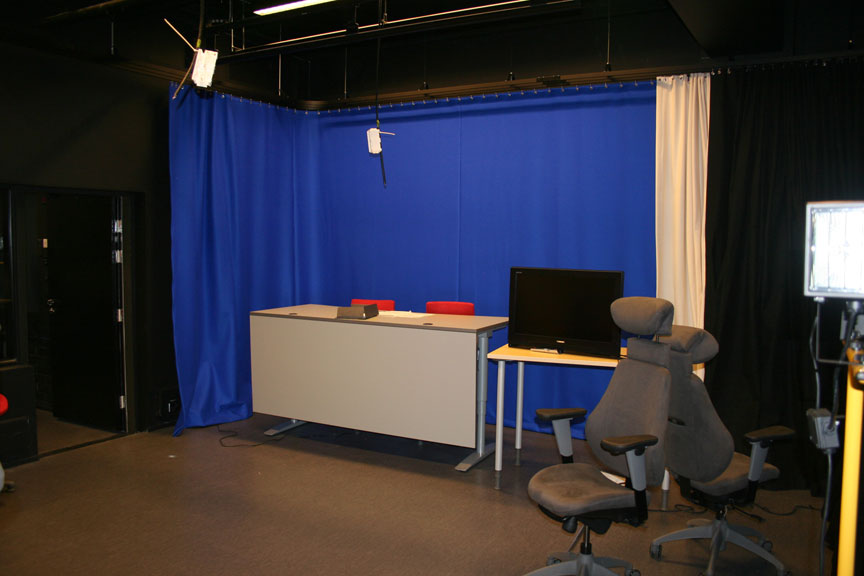
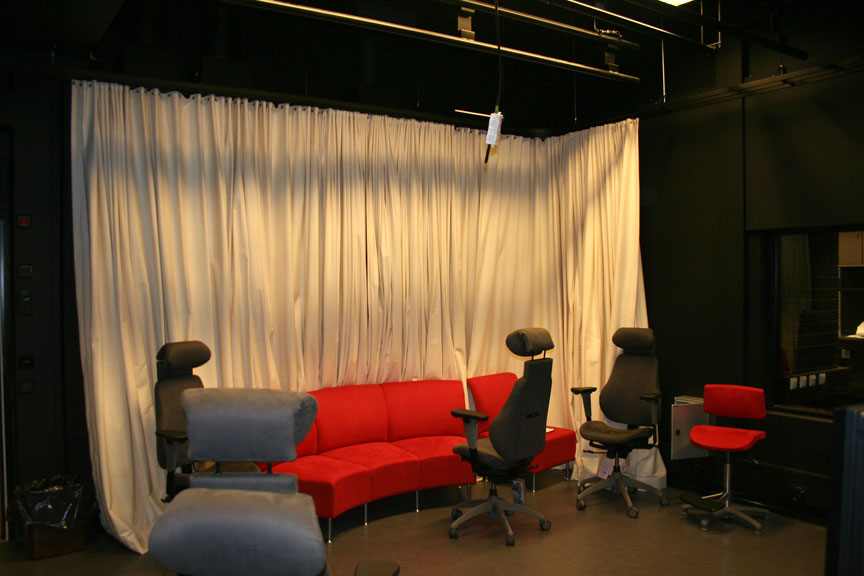
And then there are 3 curtains; black, off-white, and blue. The blue covers almost 2 walls, and the black & light ones can wrap around the whole room.

Black is on the inner rail, so it has priority to black out the whole room if necessary, even with white wrapped around, you'll still have the black (bunched up) somewhere in front of it.

Vaskis_Studio_Desk_070208.jpg

Vaskis_Studio_Couch_070208.jpg


---

Another approach, if you do have curtains (which really is a good idea), is to paint the wall blue or green. As you most likely would never be shooting against the bare wall anyway, why not simply make it "invisible". Of course you must be able to cover that up to prevent blue/green spill.

- Mikko
 
Yes, black curtains on track is very common. If you could only have one option, no rolling curtains, which would you go with? I went with black; to me the ability to control where the light goes is paramount. Either way they are both valid choices.


The talking head shots in this spot were shot in a studio not larger than 10'x15' with a normal ceiling height and walls that were white (the drop ceiling was white too):

http://www.csan2c.com/video/northwest.mov

The background is a gelled white seamless.

I could see advantages for having a black studio, but I see more advantages to having white walls and ceiling. And it just really depends on how you work and how you light and how badly your lights spill I suppose. With white, you have the potential to lose the background completely and luma key, not to mention make it any color you want or make it any value of gray or even black.

.
 
Back
Top