Open Source Digital Cinema Camera based on Elphel

the CMV12000 has 10 stops of DR, 15 if you use the HDR mode, which they call "dual readout" or "dual exposure"

I'd like to know if that means:
a) it's like the scmos sensor: it has twin readout logic, and can use both circuits in parallel and combine the results
b) it's like the EPIC HDRx mode: it does a short exposure after the standard one

if it's a), it would be great; if it's b), it's not perfect for every situation, and 10 stops in standard mode is too little
I think it does (a) a dual readout and the results are combined. I don't know whether it has dual ADCs like the sCMOS camera, which can combine the readouts into a composite 16-bit image. This, by the way, is essentially how the Alexa achieves its 15-stop dynamic range (its two ADCs are 14-bit).

I sincerely hope that you succeed, even if I think a less ambitious camera system would have been better like the Blackmagic camera which is more or less what I was asking for and seems the same for many people. But I am all for choices and will follow your progress.
If anything, the BlackMagic Design camera is one of the most ambitious digital cinema cameras around. Everything about it screams careful design. Sure, it doesn't have XLR audio connectors, but that's in part because they're larger than 1/4-inch jacks. And yeah, I wish it had HDMI to connect one of the several cheap(ish) EVFs available. A lot of people are disappointed that it's not an S35 sensor, but that will come, probably the CMV12000.

I wish the Apertus camera well. And I agree that a small, finished, easily tricked-out camera is the way to go. Partnering with an established company couldn't hurt. For instance, although it may seem to go against the grain of Apertus' open philosophy, working with CineForm to enable camera-generated CineForm RAW would enable far higher frame rates at 4K. The BMC's frame size is 5 MB, and the camera currently tops out at 30 fps, for a data rate of 150 MBps. CineForm RAW at 4K is ususally less than 50 MBps for 24 fps. That would mean 72 fps or greater -- at 4K! A high-quality SATA-3 drive can write at 250 MBps, that would mean up to 120 fps, which the CMV12000 is also capable of (although maybe not in HDR mode).
 
Last edited:
I think the BMC can't reach higher fps because of processing power issues, and those would get even worse with a more complex codec
but maybe it's bandwith, as you say
 
http://apertus.org/en/node/152

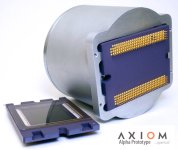
Now there is no turning back anymore. Today we announced the product name of our new camera in the first of the Apertus talks in the Media, Radio, Television and Professional Graphics category at LSM. The future of open cinema cameras from now on has a name: APERTUS AXIOM


We have actually been rather careful and secretive not to release too much information about the new camera on the Internet as we do not want to follow the unfortunately quite commmon practice of how other companies announce their products: they just promise you whatever you want to hear and a couple of years later they admit that this product is not ever going to see the light of the day. So we made sure that what we announce is solid and well thought through. But still a word of precaution: We will need your help to create Axiom, only if we manage to succeed with our kickstarter campaign we will be able to afford the development. Currently we are still working on preparing the material for the campaign, unfortunately its taking longer than we hoped it would - stay tuned.
 
Last edited:
http://apertus.org/en/node/152

Now there is no turning back anymore. Today we announced the product name of our new camera in the first of the Apertus talks in the Media, Radio, Television and Professional Graphics category at LSM. The future of open cinema cameras from now on has a name: APERTUS AXIOM


We have actually been rather careful and secretive not to release too much information about the new camera on the Internet as we do not want to follow the unfortunately quite commmon practice of how other companies announce their products: they just promise you whatever you want to hear and a couple of years later they admit that this product is not ever going to see the light of the day. So we made sure that what we announce is solid and well thought through. But still a word of precaution: We will need your help to create Axiom, only if we manage to succeed with our kickstarter campaign we will be able to afford the development. Currently we are still working on preparing the material for the campaign, unfortunately its taking longer than we hoped it would - stay tuned.

Whoa.
 
http://apertus.org/en/node/152

Now there is no turning back anymore. Today we announced the product name of our new camera in the first of the Apertus talks in the Media, Radio, Television and Professional Graphics category at LSM. The future of open cinema cameras from now on has a name: APERTUS AXIOM


We have actually been rather careful and secretive not to release too much information about the new camera on the Internet as we do not want to follow the unfortunately quite commmon practice of how other companies announce their products: they just promise you whatever you want to hear and a couple of years later they admit that this product is not ever going to see the light of the day. So we made sure that what we announce is solid and well thought through. But still a word of precaution: We will need your help to create Axiom, only if we manage to succeed with our kickstarter campaign we will be able to afford the development. Currently we are still working on preparing the material for the campaign, unfortunately its taking longer than we hoped it would - stay tuned.

I have some questions for you.

What kind of interface does it use, can't be GigE, Firewire, or USB2, those would all be too slow. Is it CameraLink DECA? CoaXPress? Thunderbolt? USB3? Hopefully one of the latter 2 so frame grabber isn't needed.

Also, what kind of lens mount does it use, F-Mount or EF-Mount, or something else?

Maybe get in contact with Birger and talk to them about their RS232 controlled EF Mount system for Industrial Cameras, maybe you could integrate it into your design and have it controlled over the camera interface from the computer, instead of having to use a separate connector to control it. Maybe even get to the point of having some sort of faux Contrast Detection AF.
 
Best of luck on your project. I am sure the community will be watching closely. -- 2 cents from seeing your first marketing imge -- I would be interested in buying a camera, not a sensor in a box. :) To me, this is a huge difference between startup and established company designs. Hope you can meet your goals and the community expectations!
 
nice work!
15 stops of DR sounds great - so you will beat the Alexa and the Epic (without HDRx)
the price doesn't sound that realistic to me for now... but go and show us the opposite!

I'd like to know what speeds, and what connectors for external devices we would get with the axiom...
 
Can you tell me the full scoop on the dynamic range? 15 stops only in a certain mode, right? And at what cost to other image characteristics?
 
Waiting for this for a while! All the very best. I know Adobe where looking for lossy compressed CinemaDNG implementations, any news on those? Even with the 2.5:1 lossless compression, I would imagine the 4K CDNG files would be a tad too much for this market. Of course, in the spirit of open source, what other options are there? Like everyone else, also awaiting the full story on dynamic range, and of course, samples showing off the colourimetry. Also, some information on recording, and would you be building a dedicated recording device as an option? I am sure many would prefer a reliable, compatible turnkey solution.
 
Last edited:
Can you tell me the full scoop on the dynamic range? 15 stops only in a certain mode, right? And at what cost to other image characteristics?

I don't know about this specific camera, but a lot of industrial cameras can offer higher than 13 stops by changing from global shutter to rolling shutter, when they are in global shutter, it is usually around 10-11 stops.
 
With rolling shutter, the CMV12000 has 2 modes: the standard one (10 stops of DR) and the HDR mode (15 stops of DR). The HDR mode uses dual exposure, like HDRx on the RED. I'm not sure if it can also be configured to give HDR with a single exposure, using piecewise linear ADC (I've read some comments saying that it can, and some that it can't)
 
Waiting for this for a while! All the very best. I know Adobe where looking for lossy compressed CinemaDNG implementations, any news on those? Even with the 2.5:1 lossless compression, I would imagine the 4K CDNG files would be a tad too much for this market. Of course, in the spirit of open source, what other options are there? Like everyone else, also awaiting the full story on dynamic range, and of course, samples showing off the colourimetry. Also, some information on recording, and would you be building a dedicated recording device as an option? I am sure many would prefer a reliable, compatible turnkey solution.

Cinema DNG patent spec does not allow for lossy compression. only Hufner lossless JPEG. It is an uncompressed raw format
 
Cinema DNG patent spec does not allow for lossy compression. only Hufner lossless JPEG. It is an uncompressed raw format

I am aware that CinemaDNG can use Huffman lossless compression (which is what I was referring to by "2.5:1 lossless compression"), although I do not know what Hufner is. Anyway, while the current spec does not allow lossy compression, Adobe have been vocal about exploring this avenue since 2011. To quote the CinemaDNG Official Specification version 1.1.0.0, Annex B.3:

The CinemaDNG interest group is considering adding lossy compression.

The current CinemaDNG format supports only lossless compression, giving about 2.5:1 reduction in size. Lossless compression does not guarantee a constant bit rate.

Some use cases call for lossy compression (8:1 or better) and constant bit rate. This would reduce storage needs and transfer times. Candidate methods for lossy compression would have to be evaluated against requirements such as performance, power consumption, complexity, licensing, availability, and standardization.

I was merely looking out for an update on the situation, looking to the future. I am not suggesting by any means whatsoever that the current spec allows for lossy compression, and if I was misinterpreted, I do apologize.
 
Nice to see some progress!!
Just for what it's worth, I'm working on something very similar, and I'm going exactly the other way around: FPGA codes first, then physical electronics, then mechanical parts. Do you even know what FPGA model you'll end up using, if you haven't written the code yet?
Also: I rented the CMV12000 evalsys in December. Nice images (incredibly sharp! also, good colors after processing), but DR is going to be a problem. The HDR mode solves this, but it has IQ issues (weird motion blur in the highlights). I've just started a thread asking if this is the reason people seldom use RED's HDRx mode: http://www.dvxuser.com/V6/showthread.php?299568-Question-about-RED-s-HDRx-why-don-t-people-use-it
 
Thank you for the news. Coincidentally, I went to your site this morning. I was wondering what visual artifacts the high-dynamic range modes introduced.
 
Thank you for the news. Coincidentally, I went to your site this morning. I was wondering what visual artifacts the high-dynamic range modes introduced.
I was hoping that CMOSIS might do a 16-bit, dual-readout (a la the Alexa sensor or the BMCC's CIS2051), stacked sensor with the global-shutter circuitry on a layer behind the photosites.
 
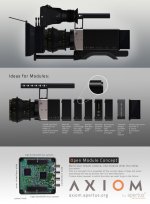
Been watching this project for a long time now, excited to see how it turns out! The modular concept looks incredible. I would love to support them!
 
I was hoping that CMOSIS might do a 16-bit, dual-readout (a la the Alexa sensor or the BMCC's CIS2051), stacked sensor with the global-shutter circuitry on a layer behind the photosites.
That would be sweet. But I also want it delivered by a guy driving a flying car.
 
Back
Top