Omni pair in blimp for recording ambience

Throwback

Well-known member
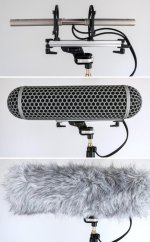
Having played around with various small omni capsule pairs in blimps using baffled arrays etc. - for stereo recording of ambience - I had a thought the other day, inspired by recent purchase of a pair of NT55 mics with omni capsules for music recording: why not simply place a pair of such SDC/pencil omnis end-to-end in a blimp?

A search of the web showed nothing (though, of course, others may have tried it), which surprised me, but one easily rewired and drilled female-to-female xlr coupler later, and here is the result: a simple robust set up, less fiddly and more portable than the common field-recording set-up of two baby ball gags on a stereo bar, and - being all enclosed - more windproof. Capsules in this case are at 350mm spacing, which isn't too bad, and, certainly the stereo image is fine: I wouldn't use this configuration for a classical music recording, but, for planned use, it is excellent. Anyway, might be a useful idea for someone out there.

Cheers,

Roland
 

Attachments
  • NT55_omni_pair_in_blimp_lo_res.jpg
    NT55_omni_pair_in_blimp_lo_res.jpg
    61.2 KB · Views: 0
Last edited:
Having played around with various small omni capsule pairs in blimps using baffled arrays etc. - for stereo recording of ambience...

Many (most?) people use M/S for recording ambience. Much easier to fit in a blimp (Rycote makes off-the-shelf setups just for M/S recording). That said, if you don't already have the mics for M/S, and you do already have the omnis, why the heck not? This should work just fine.
 
Many (most?) people use M/S for recording ambience. Much easier to fit in a blimp (Rycote makes off-the-shelf setups just for M/S recording). That said, if you don't already have the mics for M/S, and you do already have the omnis, why the heck not? This should work just fine.

I think that varies a LOT by where you are. In the US M/S is not at all universal. In three major sound post houses I worked for it was kind of despised.

THe "flaw" with the end to end would be a real drop in the center image. I put flaw in quotes because I have kind of gone on in other posts about the heavily flawed logic of most of the "realistic" stereo and surround mic set ups. Any set up that mimics a human ear placement is wildly inaccurate except played back on headphones. But since there are very few folks in the world who do recording with the idea of real true accuracy my feeling is for everyone else do what ever works for you.

The upside to the end to end is you will get a wider spread and that might work really well for big background recordings out in the middle of nowhere. I have done something kind of similar to get a really wide image, though your set up is a lot more portable!. For a lot of SFX recordings though you actually want a narrower field. Small things are often recorded in mono and even machines etc that you will record in stereo are often a relatively small portion of the screen so you don't want a huge wide field.

You can in post change the spread relatively easy so it's not a huge deal one way or the other for a lot of things. For smaller things that you are recording relatively close though I think you would notice a whole in the middle with this set up. Probably be nice for ambience though.

BTW I don't have any real hate for M/S. It's a PITA for me if your files are recorded that way because in post I need to use a decoder of some sort to really hear the recording, but it's not a big PITA since I can do that in my library software. Most people that I know who use a M/S mic decode when recording and actually end up with R/L recordings rather than M/S recordings. Sound wise I don't think there is any big plus or minus the only real minus with M/S for me is the workflow. If M/S is part of your workflow then X/Y would probably be a PITA so YMMV.
 
Thanks for comments.

Bruce, yes, I use mid-side a lot (on its own or as part of a Faulkner-inspired four-mic array), but for music recording, and don't have suitable mics for M/S field-recording - and, besides, it is interesting to use omni mics and - as you say - it works just fine. And, of course, with omnis there is the better bass response and tolerance of wind. Roll on a thunder storm!

Scott: hole in the middle with omni mics end-to-end? Not at 350mm either in theory or, I can assure you, in practice. As you know, 400mm is pretty normal omni pair spacing for classical music recording in the UK, with spacing more like 1m favoured in the US. Given this use/pedigree, it is not surprising that a spaced omni pair (on its own or, even, with a Jecklin disk) is neither binaural nor wildly inaccurate when played on loudspeakers: perhaps you were thinking of a different closely spaced omni set up? The capsule orientation has little effect, especially for ambience recording without a defined/directional source location (which, as I said, is the aim here, not SFX requiring a narrow sound field/mono). If anything, this set up gives a slightly narrower image than ideal at present, so I may after all try some spheres, half-spheres and mini-baffles: as long as they don't make the set-up too clunky/less robust or, indeed, tip the recordings more towards binaural (unlikely). I'll post some samples in due course.

Cheers,

Roland
 
Last edited:
Having played around with various small omni capsule pairs in blimps using baffled arrays etc. - for stereo recording of ambience - I had a thought the other day, inspired by recent purchase of a pair of NT55 mics with omni capsules for music recording: why not simply place a pair of such SDC/pencil omnis end-to-end in a blimp?

I've been messing around with recording stereo ambience for a little bit, and it's fascinating -- there's no end of room for experimentation. But I think one big principle is that the mic setup you use will be dictated heavily by exactly what you're recording. There's also a strong subjective element, since there's really no "right" way to record stereo -- except maybe binaural, which I haven't tried because it would require my audience to wear headphones. IOW, if it sounds good, you're doing it right!

Anyhow, in your case, since the mics are omnis, you effectively have an AB array with 350mm spacing. This should work well for some kinds of source. Maybe many kinds of source... maybe I should try it! (There should be no hole in the middle, since these are omnis.)

BTW I like your XLR coupler / stereo connector... neat!

I haven't tried it, but I have tried a spaced cardioid pair, which worked surprisingly well despite having both mics facing forwards -- I guess that's the time difference factor, which is what you will mostly get with your setup.

I've also tried cardioids end to end, with a centre forward-facing cardioid mic to make the middle. The concept was to get time diff plus pressure diff (due to the directional mics). That worked pretty well too. But the best setup I've found so far for the kinds of things I'm trying to record -- wide sources like streams, waves, etc -- is ORTF. I just like the soundfield it creates.

My next experiment is to try either XY or ORTF with wing mics to get sounds way out at the sides. Haven't tried that yet, but I'm looking forward to it.

For MS, it seems to be hard to find a decent figure-8 mic for field recording. Some folks use large-diaphragm condensers, but these aren't really good for outdoors. Some MS or figure-8 mics look good, and get great reviews, until they turn out to be noisy when used with quiet sources -- not too hot for recording a quiet ambience. (A lot of mic reviews are based on music recording.) Also working here in rainy N Cal, I'm struggling to find mics that aren't affected by damp. Sennheiser MKH mics are good for this, since they work on the RF principle, but they cost a packet too.

The Sennheiser MKH30 is what a lot of folks use for field/nature recording in MS, usually paired with an MKH40, but it's a bunch of bucks for a mic that isn't super versatile.

I've just invested in a pair of MKH 8040s, which I can use for ORTF, and also for any other setup involving cardioids. So far they seem great, and one plus is that they're so short you can blimp them in an ORTF configuration. The minus is that that blimp setup is pricey...

http://www.bhphotovideo.com/c/product/966593-REG/rycote_080211_ortf_windshield_kit.html

Currently I'm fiddling around with the two gags (softies actually) on a stereo bar, and hating it! It's just such a hassle, and the individual clamps keep coming loose and have to be re-adjusted... The blimp is calling to me. But short term I might try a couple of cheap mic clamps expoxied to a plastic strip in the correct ORTF configuration, which will reduce the hassle and still be cheap.

Anyhow, I aim to keep experimenting, and hopefully learn some stuff.

Cheers!
 
Last edited:
For some applications a slight hole in the middle can be an advantage as it leaves space for the dialogue, I used M/S and very wide effects adjustment using the A/B wide controls on the AMS Neve Logic and DFC digital consoles a great deal on doco and drama production.
 
Interested to hear about your experiences, Atticus, especially with ORTF. MKH 8040s in the dedicated Rycote blimp sound excellent, but, as you say, that is not cheap: my playing around with this new set-up was stimulated by using existing mics, although the xlr coupler did cost me the princely sum of £5! Your experience with waves etc. suggests, I should, however, try ORTF for such sources - which I can do with kit to hand: the same NT55s but with their cardioid capsules with baby ball gags on a stereo bar - notwithstanding the clunkiness.

Cheers,

Roland
 
Your experience with waves etc. suggests, I should, however, try ORTF for such sources - which I can do with kit to hand: the same NT55s but with their cardioid capsules with baby ball gags on a stereo bar - notwithstanding the clunkiness.

I would certainly give that a try, at least, given you have the kit on hand. I started with cheaper mics (Studio Projects C4 -- they actually seem pretty good); the problem is that in the very dank conditions where I was recording (deep in the redwoods, not raining or foggy but cold and very humid) they were getting affected badly by the moisture. But I got enough from them to hear that ORTF was going to work for me.

Happy recording!
 
Well will try ORTF, but in the meantime here are a few tests (for Atticus's benefit, including waves) with the NT55 spaced pair in blimp:

1. V. small waves on shingle beach, with strong offshore wind - https://soundcloud.com/norfolksoundman/cley-beach-waves-160124-0096s12

2. Footsteps on shingle beach, with waves in background and strong offshore wind - https://soundcloud.com/norfolksoundman/cley-beach-footsteps-160124-0099s12

3. Village garden (winter) ambience, with not much happening, but some birdsong, a distant shotgun and a car going past - https://soundcloud.com/norfolksoundman/nt55_omni_pair_in_blimp_testwav

Cheers,

Roland
 
Scott: hole in the middle with omni mics end-to-end? Not at 350mm either in theory or, I can assure you, in practice. As you know, 400mm is pretty normal omni pair spacing for classical music recording in the UK, with spacing more like 1m favoured in the US. Given this use/pedigree, it is not surprising that a spaced omni pair (on its own or, even, with a Jecklin disk) is neither binaural nor wildly inaccurate when played on loudspeakers: perhaps you were thinking of a different closely spaced omni set up? The capsule orientation has little effect, especially for ambience recording without a defined/directional source location (which, as I said, is the aim here, not SFX requiring a narrow sound field/mono). If anything, this set up gives a slightly narrower image than ideal at present, so I may after all try some spheres, half-spheres and mini-baffles: as long as they don't make the set-up too clunky/less robust or, indeed, tip the recordings more towards binaural (unlikely). I'll post some samples in due course.

Cheers,

Roland

Nice recordings. I did feel a bit of a hole in the middle in the two that had something cross over. I didn't feel the proximity when they were center. But? I am not a fan of closely spaced pairs. My set up for classical chamber music is crossed cardioids spaced about ten meters apart, depending on the group and stage. The width needs to be toned down a bit if you are aiming at headphone listening (unless you really like wide) but it comes out fantastic on speakers and really helps if the playback is on a more "challenged" device like a laptop or boom box.

When I was unavailable and they had someone else do it they almost always used a more conventional set up and people were just not happy with the sound.

BUT that is just one other way to do it. So what I do for the chamber music is not practical or a particularly good idea for ambience recordings. Your set up sounds good and as I and others pointed out a hole in the middle is not really a bad thing. You don't notice it so it's even less of a deal. I wouldn't actually call it a hole, because you are right that the omni's do a pretty good job of covering the center, but there is a proximity kind of thing one expects in a "by" that is missing (to me). So I would not, personally, use this for things like recording car by's, or anything else where part of what you want is a pass by. It may even be that your set up is more "accurate" and what I am missing is an artifact of other styles of micing. But either way it is an artifact that I would then need to create in post so I wouldn't use this set up for those kinds of things.

But I like the sound of the ambiences and it has a nice spread so I may well rig one of these things up for those kinds of recordings. I have in the past used a pair of PZM's on a wedge which is similar, but a bunch more awkward. And often we just have used a crossed pair and that is OK, not really as wide as I would like, but I like your sound better and it wouldn't be a lot extra to carry.

BTW the "flaw" I was talking about is the "logic" of recording with mics placed at "ear" locations and then playing that back on speakers spaced much wider apart. For any real accuracy the mics would need to be the same distance apart as the playback speakers are. This is why the image over speakers is always a lot narrower than on headphones and a recording on a closely spaced pair is much narrower sounding than what an audience member experienced. Since it is not possible to dictate where the playback speakers are placed on anything close to a regular basis "accuracy" is practically speaking impossible other than for headphones.

On a very fundamental way because you "hear" with your mind and what you hear is very dependent on context you can never accurately reproduce what someone heard with any reliability. It's a bit OT since you are not claiming any higher "accuracy" just convenience and a good sound, both of which I think you achieved.
 
I think that varies a LOT by where you are. In the US M/S is not at all universal. In three major sound post houses I worked for it was kind of despised.

Some post houses might despise it because it's not the standard L/R workflow. But few people in my experience don't like the sound of M/S, especially when they don't know what recording technique was used. But a lot of people in my experience really don't like the sound of XY (crossed cardioids) and can pick that sound out without knowing the technique. Yet both techniques are coincident, so both stereo fields are created solely by loudness difference. No timing differences at all. My theory as to why people like the sound of M/S better than XY is that XY attenuates sounds coming from the back that humans use to help decide where things are located in space. I could easily be wrong; I haven't put that much effort in to understanding it.

THe "flaw" with the end to end would be a real drop in the center image.

With omnis at 35cm spacing? I think not. A lot (I mean, a LOT) of classical music recordings have been made and are still being made with main-pair omnis in AB, at 67cm or less. People routinely spot piano with AB omnis at 20-40cm.

That said, when you start past 67cm, you will begin developing that hole (there have been a number of research papers writen on this topic, but no URL falls readily to hand, sorry). Decca fixed that with a third mic and invented the Decca Tree. But 35cm should be absolutely safe. The only thing the OP's system has going against it is that slight microphone body shadowing which will show up in the upper frequencies a little. This could be minimized by rotating the mics into proper AB position, but then they won't easily fit in a windbasket.

I put flaw in quotes because I have kind of gone on in other posts about the heavily flawed logic of most of the "realistic" stereo and surround mic set ups. Any set up that mimics a human ear placement is wildly inaccurate except played back on headphones.

I'd have to disagree with that. ORTF for example uses cardioids spaced at 17cm and angled at 110 degrees. That spacing is roughly that of human ear drums (it's been so long since I researched it I could be off a bit my own ears seem to measure about that), and ORTF sounds fabulous through speakers. ORTF has been used on countless classical music recordings; it creates a very accurate soundstage, but with less "envelopment" than AB omnis. ORTF is particularly good for less than excellent sounding acoustics, where AB (and M/S) will record reflections you just don't want to hear.

Others include DIN, which uses cards at 20cm spacing angled at 90 degrees, and NOS (cards or even better subcards at 30cm and 90 degrees). Again, both used on countless classical recordings, and both sound great through speakers.

The upside to the end to end is you will get a wider spread and that might work really well for big background recordings out in the middle of nowhere. I have done something kind of similar to get a really wide image, though your set up is a lot more portable!. For a lot of SFX recordings though you actually want a narrower field. Small things are often recorded in mono and even machines etc that you will record in stereo are often a relatively small portion of the screen so you don't want a huge wide field.

AB omnis at 35cm doesn't give me a very wide spread at all. Than again, I'm not trying to get very close to something when I'm using it. If you're trying to control signal to noise ratio by getting close, then maybe you're right. But AB isn't a very good tool for that since it develops it's stereo soundfield through timing differences.

Sound wise I don't think there is any big plus or minus the only real minus with M/S for me is the workflow. If M/S is part of your workflow then X/Y would probably be a PITA so YMMV.

Lots of people hear a sound difference. They don't use the technique just to drive editors and sound designers mad, they do it because 1) they like the sound, and 2) it's a very small and lightweight stereo rig that Rycote (and others) make windbaskets for. If you're booming, it's a heck of a lot easier to boom M/S than ORTF or 67cm AB. And as we all know, weight is important when you're booming!

The thing is M/S sounds best in good acoustical environments. It also does great outside. But I'd hate using it in a small room because there's nowhere to hide from those early reflections bouncing off everything. It's not the right tool for everything (wouldn't it be nice if audio where that easy!), but it's a pretty good tool for exterior ambient sound and wildlife recording.

I am sorry if M/S drives sound designers and post houses crazy. That's not the intent.
 
I prefer MS for ambience recording. I don't like using omni mics for any sort of sound effects recording, be it hard effects, or backgrounds. they are just too wide for that work.
 
A couple of thoughts arising:

Bruce: yes, I'm aware of the slight effect on the high frequencies of body shadowing. As I said, I wouldn't use this configuration for recording music. Of course, though, NT55 omni caps are diffuse-field omnis so being off-axis to a source is often useful/necessary (e.g. orienting them vertically as a [horizontally] spaced pair for recording piano).

M/S: yes, I would like to use this for exterior ambience too, but this would require a significant investment (and, as I have the mics and ball gags to hand, testing ORTF will doubtless come first). As a heavy user of mid-side for location music recording, however, I am slightly puzzled why anyone would be put off M/S due to post houses: why not simply matrix the M/S mics to LR when recording? The original M/S can of course be recovered (entirely losslessly) later anyway for adjustment of width as required. Even when in control of the whole process (e.g. for recording music), I often matrix in the preamp (for practical ease) anyway knowing I can decode/encode at will later.

Dave: Slightly tongue-in-cheek - as I know that you are referring to typical ambience recording M/S mic set-ups with cardioid mid mics (e.g. pairing an MKH30 with an MKH40) - but, of course, any mic can be used as the mid mic in M/S, including an omni (as, indeed, in Alan Blumlein's original patent!).

Cheers,

Roland
 
Well opinions are everywhere. Personally as I have said I don't like the sound of ORTF. My argument on the logic is not based on how things sound so much as the flaw of the argument I hear all the time that these silly contraptions are "accurate" and inherently from the physics they are not. If I liked the sound I would use it because I think that trumps everything else.

As for M/S ? I don't hear any significant difference between X/Y and M/S provided they are set to the same width. But I also have not spent a lot of time analyzing it so maybe if I really did some A-B tests I would notice a difference.

I wouldn't have any particular problem recording ambiences with omni's. Certainly the linked recordings have plenty of spread. I wouldn't hesitate to use them and actually what I feel is a bit of a hole in the center is a plus for me with ambiences used for film.
 
Well opinions are everywhere. Personally as I have said I don't like the sound of ORTF. My argument on the logic is not based on how things sound so much as the flaw of the argument I hear all the time that these silly contraptions are "accurate" and inherently from the physics they are not. If I liked the sound I would use it because I think that trumps everything else.

I think we're in violent agreement. It all comes down to getting the sound you want. If the sound you want comes from XY, so be it. If it comes from M/S so be it. If it comes from ORTF, so be it. As the person doing the recording, it's your call. Do what works for you.

As to the claim of accuracy, I don't have any idea what that means. I used to hear this in photography too, and I wondered how reducing a 3D scene to 2D could be considered accurate. Or a color scene to B&W. Etc. So at least I'm not one of the people claiming how any one stereo sound recording technique is more accurate than any other. They all have strengths and weaknesses, they are all just tools to get the job done.
 
violent agreement
I like that...

Yes I think you summed it up well. I'm often looking for a "sound" and whatever gets me there is fine with me.

And while I have my preferences for certain things, that is all they are.

I have this awful mic I got out of a prop room many years ago. It's one of those fight mics they lowered from above. Looks like a silver bullet, unbalanced and I think it's a crystal element. But it is fantastic for some very specific things, and it makes anyone sound like a fight announcer ;~)
 
... I don't like the sound of ORTF. My argument on the logic is not based on how things sound so much as the flaw of the argument I hear all the time that these silly contraptions are "accurate" and inherently from the physics they are not.

I like ORTF -- I think, and of course I mean relative to the specific things I'm trying to record -- but I'd never describe it as "accurate". As I understand it, the only "accurate" technique for stereo recording is binaural, and only if your audience has headphones on (which for my purposes rules it out).

Other than that, I think stereo is basically subjective, and also heavily dependent on the subject you're recording. ORTF is probably thought of by some people as "accurate" because of the "head-width" spacing of the mics; but it's not binaural at all, since it uses overlapping cardioids, and no baffle. So my understanding is that it actually works quite differently, and it certainly seems to work though speakers. But "works" means "sounds nice", with a satisfying feeling of ambience; not some objective defintion of accuracy.
 
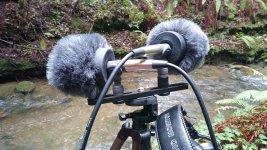
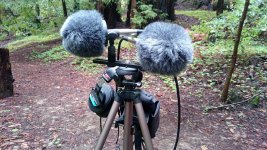
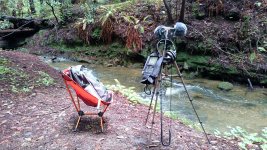
Down at the river recording stream sounds yesterday...

Page Mill mics.jpg Page Mill ORTF.jpg Page Mill set up.jpg

On a quick preview, I can't say I'm thrilled with the sound.... it just seems... harsh? Maybe I just need to get farther back, or record at a lower level, or mix in some general ambience...? Or try AB? Or MS? Or maybe it's not so bad...

Dunno. As you can tell I'm still experimenting, which is fun anyhow.

https://soundcloud.com/atticuslake/page-mile-site-in-portola-redwoods-state-park-excerpt
 
Last edited:
I probably over stated. For the concerts I was recording I didn't like OTRF as much as I liked what I ended up doing. In general for what I mostly do OTRF is not usually practical so it's not really an option.

I'm really glad this thread took the turn it did, because dispite varied opinions everyone really seems to agree on what I think is the most important thing and that is "listen". If what you are doing sounds good then your doing it right.
 
The link doesn't work so I can't comment specifically but in general water is really hard. It's SO easy to end up with white noise that just doesn't sound like what you were "hearing" at the time.

There is a trick, sort of, that we used to do for women's Foley FS (since it was a couple of guys doing it). We would use a C-1000 mic. It has a slower response time (my guess) and rounds out gritty bits and just softens the sound a bit. It's hard to describe but it wasn't the same as rolling off the highs. It really felt like the diaphragm just had a bit more inertia that our other mics so things like grit in the FS would just soften a bit with out sounding dull. Never tried it on water but it might take away a bit of the harsh splashiness?
 
Back
Top