I'm asserting that:
1. It appears we can get better than the arbitrary 80% quoted but not backed by science (math and/or empirical tests). I believe it's perhaps 94% or more from empirical tests and top modern deBayer methods.
2. If we use a high quality deBayer, we can get excellent RGB (444); when converting to YCbCr and converting to 422 and 420 there will be a (statistically) significant drop in color fidelity that cannot be recovered in post (since the original Bayer information is lost).
The Malvar, He, Cutler (Microsoft) algorithm is not the top method (dates back to 2004); ACR and others are now better.
Top, original, bottom, converted to Bayer then deBayered:
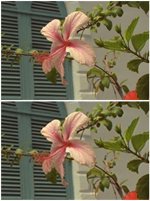
Does the bottom image look 80% of the top? Looks over 90%, right? It's not perfect, but is very good. Modern methods are even better.
1. It appears we can get better than the arbitrary 80% quoted but not backed by science (math and/or empirical tests). I believe it's perhaps 94% or more from empirical tests and top modern deBayer methods.
2. If we use a high quality deBayer, we can get excellent RGB (444); when converting to YCbCr and converting to 422 and 420 there will be a (statistically) significant drop in color fidelity that cannot be recovered in post (since the original Bayer information is lost).
The Malvar, He, Cutler (Microsoft) algorithm is not the top method (dates back to 2004); ACR and others are now better.
Top, original, bottom, converted to Bayer then deBayered:
Does the bottom image look 80% of the top? Looks over 90%, right? It's not perfect, but is very good. Modern methods are even better.
Last edited: