
blackdogdylan
Active member
forgive the long thread, guys. been collecting my thoughts and experiences for a while now.
a bit about me: I’m a professional DP & operator based in LA. a lot of my work is show opens, parody films for award shows, and promos. I was an early adopter of the FS100, picking mine up in July of 2011. I’ve been putting it to work on various jobs since then for networks like Fox, Cartoon Network, Disney and many more. what follows are some experiences, samples, and anecdotes. may they be useful to the community at large in understanding a camera that is finally getting its day in the sun (ironically, at least partially thanks to the FS700.)
okay, first off, I love the camera. it makes very pretty pictures. I dig the weird form factor. I have no problem with the placement of the LCD, nor the funny eyepiece. yes, I even use the eyepiece when I operate handheld (and I don’t want the additional weight of my DP6.) I find the swivel actually pivots it into the proper position to land it at my eye. I LOVE the versatility of the E-Mount. I’ve never had any issues with build quality or toughness.

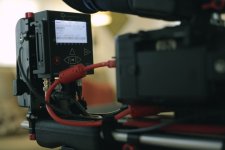
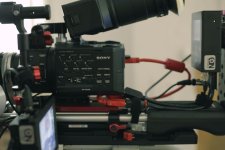
I have mine configured with the Zacuto FS100 Kit, a nanoFlash recorder, the Switronix Powerbase 70 (which I primarily use to power the nano,) a Bower ABNEX-FD adapter for my day-to-day use with a set of Canon FD primes and zooms, the 16x9 PL adapter for PL jobs, and lots of other parts and pieces to outfit it nicely.
for 90% of my jobs, I record to the nanoFlash, because my clients vary dramatically with delivery requirements, and that gives me a multitude of recording capabilities while also playing nice with both Avid & FCP. that said, I’ve been extremely impressed with the implementation of the AVCHD codec in-camera and have found it exceptional in all but the toughest of conditions (high-frequency, high-contrast detail, in fast motion, i.e. backlit water droplets spraying in the air- in those conditions, it struggles.)
I’ve used my rig on its own, in concert with an F3, and as a B-Camera and insert camera for an Alexa. I’ve run it and the F3 (with S-Log) into the 25” Trimaster OLED and a scope and done some careful image analysis. here’s what I think:
for the price, it literally can’t be beat.
okay, it’s a little schizophrenic- trapped between two worlds, not quite professional (but I can’t imagine it being a great consumer camcorder,) it must really be called prosumer. but in my experience, the image is exceptional. okay, compared to the F3, there is no question that the 10 Bit (and more expensive) image processing leads to some better color fidelity, resolution and highlight handling than the FS100. however, the F3 also suffers a bit from crispy-crunchy detail and color aliasing that can give it a more “video” look, as well as weaker in-camera recording. and S-Log? meh. I’ve frankly been a bit unimpressed with Sony’s execution of it and have not found it to magically increase the dynamic range of the F3. the DR is what it is, and all the S-Log does is strip the image processing in-camera. so yes, the FS100 is only 8 Bit, and yes it has its shortcomings… but do they warrant the price difference between the two? not in my mind.
let’s talk Picture Profiles. what I say is gonna be controversial here, so brace yourself.
I don’t use the Cinematones.
almost never. and here’s why.
the FS100 is an 8 Bit camera- the way that it tone maps the curve is fairly limited. so the Cinematones favor highlight protection. and while I DO like how they handle those highlights, they do so at a great cost to the lower end of the curve, the exact portion of the curve that the sensor seems to be tuned for.
and this brings me to an important point. if the F3 and the FS100 share the same sensor (a fact I know has been contested in other forums) then what is Sony doing to the image to differentiate them and their markets? as far as Sony was concerned, they thought the FS100 would be the ideal wedding videography camera and the F3 would be for the film and TV professionals. and sure, I suppose that’s partially true. in my mind, they dialed in the image processing on the FS100 to perform best in low-light (and it really does- the noise characteristics are unbelievable) and the F3 to be tuned for highlight handling and resolution (features favored by “pros.”)
so for my money, I think using the Cinematones is, in many circumstances, cutting off your nose to spite the face. on a scope, you can see very clearly that the upper end of the curve has a nice slope. but on the low end, a very aggressive toe lops off much of that meaty part of the curve where the camera performs so nicely. so what does everyone do? lifts their blacks to oblivion to try and eke out an exposure in the low end. yikes. now that Firmware 2.0 is up, you can even see the ISO shift in Cinematone 2 to 400 instead of 500- so clearly much more is happening in how that image is being “painted” than Sony has necessarily conveyed. while this CAN be helpful in out-of-control daylight environments, I think it’s dangerous in other conditions. AND the Cinematones also do some interesting things to color. that “red” tendency everyone complains about? that’s a trait of the Cinematones. artificial looking yellows? cinematones. don’t believe me? have a look.
clearly, shooting is subjective so my opinion is just that; my opinion. so what do I do? I shoot utilizing the 709 gamma, ProColor at 8, dial back the saturation ever-so-slightly & I CONTROL my highlights. and it looks great. most of the time. the shortcoming of this approach is that in the most extreme highlights, in these modes, the camera shorthands what it sees. I'm sure we've all seen it. kind-of-blue becomes baby blue. light-green becomes pastel lime. a-hint-of-yellow goes light canary. no, it isn’t pretty. professional cameras would have what’s called “knee sat” allowing you to dial in the color saturation of highlights. this camera unfortunately does not (please, Sony?) so in cases when it’s a problem, I tweak it in post. it is VERY simple to desaturate highlights in almost all modern NLEs. then, I get the best of both worlds: that low-end (what used to be called a “fat negative”) where it is virtually impossible to underexpose, and a more pleasing tone in the highlights.

this is an ungraded frame using my "recipe."
now, if we could just get some form of “clearscan” shutter control, knee sat & the ability to NAME our profiles, we’d really have a perfect camera ; )
I'll leave you with these.
these were some very unscientific frames I took between the firmware 1.0 to 2.0 transition, just to see whether Sony had made any changes to the imaging as some users were reporting. take this for what it is. these are each two separate frames, the inner circle is after 2.0 the outer portion is before the firmware upgrade.






lastly, here are a couple of pieces shot with the camera. many of the most recent ones (that are coolest) can’t be shown yet. maybe I’ll throw up some links when they go live. enjoy.
American Cinematheque Tribute to RDJ
On The Line - Prostate Cancer Awareness PSA
- Dylan Sanford
Director/DP
a bit about me: I’m a professional DP & operator based in LA. a lot of my work is show opens, parody films for award shows, and promos. I was an early adopter of the FS100, picking mine up in July of 2011. I’ve been putting it to work on various jobs since then for networks like Fox, Cartoon Network, Disney and many more. what follows are some experiences, samples, and anecdotes. may they be useful to the community at large in understanding a camera that is finally getting its day in the sun (ironically, at least partially thanks to the FS700.)
okay, first off, I love the camera. it makes very pretty pictures. I dig the weird form factor. I have no problem with the placement of the LCD, nor the funny eyepiece. yes, I even use the eyepiece when I operate handheld (and I don’t want the additional weight of my DP6.) I find the swivel actually pivots it into the proper position to land it at my eye. I LOVE the versatility of the E-Mount. I’ve never had any issues with build quality or toughness.
I have mine configured with the Zacuto FS100 Kit, a nanoFlash recorder, the Switronix Powerbase 70 (which I primarily use to power the nano,) a Bower ABNEX-FD adapter for my day-to-day use with a set of Canon FD primes and zooms, the 16x9 PL adapter for PL jobs, and lots of other parts and pieces to outfit it nicely.
for 90% of my jobs, I record to the nanoFlash, because my clients vary dramatically with delivery requirements, and that gives me a multitude of recording capabilities while also playing nice with both Avid & FCP. that said, I’ve been extremely impressed with the implementation of the AVCHD codec in-camera and have found it exceptional in all but the toughest of conditions (high-frequency, high-contrast detail, in fast motion, i.e. backlit water droplets spraying in the air- in those conditions, it struggles.)
I’ve used my rig on its own, in concert with an F3, and as a B-Camera and insert camera for an Alexa. I’ve run it and the F3 (with S-Log) into the 25” Trimaster OLED and a scope and done some careful image analysis. here’s what I think:
for the price, it literally can’t be beat.
okay, it’s a little schizophrenic- trapped between two worlds, not quite professional (but I can’t imagine it being a great consumer camcorder,) it must really be called prosumer. but in my experience, the image is exceptional. okay, compared to the F3, there is no question that the 10 Bit (and more expensive) image processing leads to some better color fidelity, resolution and highlight handling than the FS100. however, the F3 also suffers a bit from crispy-crunchy detail and color aliasing that can give it a more “video” look, as well as weaker in-camera recording. and S-Log? meh. I’ve frankly been a bit unimpressed with Sony’s execution of it and have not found it to magically increase the dynamic range of the F3. the DR is what it is, and all the S-Log does is strip the image processing in-camera. so yes, the FS100 is only 8 Bit, and yes it has its shortcomings… but do they warrant the price difference between the two? not in my mind.
let’s talk Picture Profiles. what I say is gonna be controversial here, so brace yourself.
I don’t use the Cinematones.
almost never. and here’s why.
the FS100 is an 8 Bit camera- the way that it tone maps the curve is fairly limited. so the Cinematones favor highlight protection. and while I DO like how they handle those highlights, they do so at a great cost to the lower end of the curve, the exact portion of the curve that the sensor seems to be tuned for.
and this brings me to an important point. if the F3 and the FS100 share the same sensor (a fact I know has been contested in other forums) then what is Sony doing to the image to differentiate them and their markets? as far as Sony was concerned, they thought the FS100 would be the ideal wedding videography camera and the F3 would be for the film and TV professionals. and sure, I suppose that’s partially true. in my mind, they dialed in the image processing on the FS100 to perform best in low-light (and it really does- the noise characteristics are unbelievable) and the F3 to be tuned for highlight handling and resolution (features favored by “pros.”)
so for my money, I think using the Cinematones is, in many circumstances, cutting off your nose to spite the face. on a scope, you can see very clearly that the upper end of the curve has a nice slope. but on the low end, a very aggressive toe lops off much of that meaty part of the curve where the camera performs so nicely. so what does everyone do? lifts their blacks to oblivion to try and eke out an exposure in the low end. yikes. now that Firmware 2.0 is up, you can even see the ISO shift in Cinematone 2 to 400 instead of 500- so clearly much more is happening in how that image is being “painted” than Sony has necessarily conveyed. while this CAN be helpful in out-of-control daylight environments, I think it’s dangerous in other conditions. AND the Cinematones also do some interesting things to color. that “red” tendency everyone complains about? that’s a trait of the Cinematones. artificial looking yellows? cinematones. don’t believe me? have a look.
clearly, shooting is subjective so my opinion is just that; my opinion. so what do I do? I shoot utilizing the 709 gamma, ProColor at 8, dial back the saturation ever-so-slightly & I CONTROL my highlights. and it looks great. most of the time. the shortcoming of this approach is that in the most extreme highlights, in these modes, the camera shorthands what it sees. I'm sure we've all seen it. kind-of-blue becomes baby blue. light-green becomes pastel lime. a-hint-of-yellow goes light canary. no, it isn’t pretty. professional cameras would have what’s called “knee sat” allowing you to dial in the color saturation of highlights. this camera unfortunately does not (please, Sony?) so in cases when it’s a problem, I tweak it in post. it is VERY simple to desaturate highlights in almost all modern NLEs. then, I get the best of both worlds: that low-end (what used to be called a “fat negative”) where it is virtually impossible to underexpose, and a more pleasing tone in the highlights.
this is an ungraded frame using my "recipe."
now, if we could just get some form of “clearscan” shutter control, knee sat & the ability to NAME our profiles, we’d really have a perfect camera ; )
I'll leave you with these.
these were some very unscientific frames I took between the firmware 1.0 to 2.0 transition, just to see whether Sony had made any changes to the imaging as some users were reporting. take this for what it is. these are each two separate frames, the inner circle is after 2.0 the outer portion is before the firmware upgrade.
lastly, here are a couple of pieces shot with the camera. many of the most recent ones (that are coolest) can’t be shown yet. maybe I’ll throw up some links when they go live. enjoy.
American Cinematheque Tribute to RDJ
On The Line - Prostate Cancer Awareness PSA
- Dylan Sanford
Director/DP


