Now It Goes Sony F3 vs C300

I did find the EX1 better than the F3. maybe that's why.

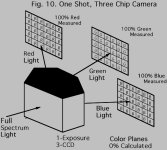
Yeah - the reason is because the three chips each have 1920x1080 pixels, and each chip is sensitive to either R, G or B. The simple explanation is that light enters the lens, and is separated by a prism and is sent to it's respective chip to measure the input and it's then processed into an image. The reason you don't get appreciable moire is because the camera doesn't have to "invent" information because each pixel gets a layered R, G, & B color information, kind of like how a Foveon sensor works:
X3_tech_hero.jpg

But actually, they work like this:

mcexr.jpg

In this way, the camera doesn't have to do much interpolation at all when creating it's image, so moire isn't really a problem. However, there is always space between each pixel, which means at least some data has to be "invented" to fill in the spaces where there is no pixel information - but that is always less on a 3-chip camcorder than it is on a single-sensor camera that has it's R, G, & B pixels aligned next to each other instead of "stacked." Hope this makes sense.
 

Attachments

  • three_chip_camera.gif
    three_chip_camera.gif
    20.5 KB · Views: 0
Very interesting. Thanks. I get it in principle but without more background on chips it actually raises more questions in my mind than it answers - ( I think to answer those would take a couple of classes though). The important thing is the conclusion that 3 chip cameras have fewer moire issues. I will do some more testing with all 3 cameras as soon as I can. I have thought about bringing my EX-1 to F3 gigs that are screen intensive. Use the F3 for wider shots where the moire is usually lower and low DOF on the background is pleasing, and then switch to the EX-1 for the more difficult closeups where there is no background anyway.
 
The XF300 has quite a lot of aliasing at 720p mode.

Any camera will exhibit increased aliasing when down-scaling from it's native resolution - proper downscaling is actually a pretty complex task. Usually, turning sharpness all the way down and applying a bit of noise reduction in-camera will mitigate the aliasing. This method works particularly well with the XF series cameras because of the custom NR settings available.
 
I have thought about bringing my EX-1 to F3 gigs that are screen intensive. Use the F3 for wider shots where the moire is usually lower and low DOF on the background is pleasing, and then switch to the EX-1 for the more difficult closeups where there is no background anyway.

This is definitely how I would go about it!
 
Back
Top