Not much of a still photographer: Need support

nyvideo

Active member
I'm not sure where to ask this question: It's really a still photo question. However, I'm in a jam and I've received so much good advice here so:

In two days I need to take some still portrait photos for my firm's web site. These need to be the sort of traditional, 1/4 angle medium close-up images of people in business attire. Unfortunately, I don't have a high quality camera. I'll be borrowing one just a few minutes before I have to take the photos.

The good news is that I'll have time to set up a black back drop and to set up lights. I'm going to use the tungsten lights I use for video. I have a small array of lights including a Mole Richardson tweenie fresnel, an Arri 300 watt fresnel, a couple of open faced 1000 watt Mickey Moles, and two 1000 watt Molequartz softlights.

I don't think of myself as a photographer, so my question: If I do a standard 3-point lighting set-up and maybe a light to give the black back drop a little depth, do you think I can make these portraits look reasonably good or is this a recipe for disaster?

Any suggestions and/or opinions would be appreciated.
What do you have for still camera? In terms of lighting, the tried and true would be 'good enough' for formal portraits. I tend to go for environmentals, and so using the lights mentioned to support an f/5.6 or f/8 at a reasonable shutter speed, like 1/125 at a reasonable ISO, like 100-200 would do fine.

Some people go for shallower DoF... but for me f/8 works...
 
Still camera will be a fairly new Pentax DSLR with a 10-year-old (4MP) Canon G3 as a back-up.

Regarding DoF, most of the final image will be the person with very little background so DoF is not terribly important. Plus, with the hair light (or is it called a back light?), there should be a nice rim of light separating the person from the black back drop.

Thank you for the feedback.
 
As always, the lighting is more important than the camera, just like in video. If you light it as you would for video so that it looks good for a video interview, it'll be just fine for a still. If it looks good, it is good.
 
DSCN0134.jpg
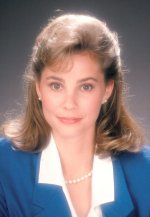
© 1988- Standard Head & Shoulders
If I do a standard 3-point lighting set-up and maybe a light to give the black back drop a little depth, do you think I can make these portraits look reasonably good or is this a recipe for disaster?

If you do the 3 point set up, properly pose your subjects, make sure they are comfortably seated, check to be sure that they are properly made up and groomed, tilt their eyewear down about 10º from your lens axis, use a 100mm+ tele for 35mm format, engage the subject to relax them... then....

You have a recipe for success !

easy on the back light spot BTW. just a hint of glow will do. Also here's what I'd do with these ...
1) Arri 300 watt fresnel- That's your hairlight. positioned well out of camera lens view at 45º behind and 45º to the left or right of the subject to create catchlight edges on the hair.
2) A couple of open faced 1000 watt Mickey Moles - Point them away from the subject into umbrellas or the facing walls for bounce (this is the fill)
3)1000 watt Molequartz softlights. -Just one 45º up and 45º left or right of the FRONT of the subject. This is your main light.
4)1000 watt Molequartz softlights. dial the output down or use ND filters to deliver 250W output for your background light
 
Last edited:
Omg... that head and shoulders looks so... 80s, in a bad bad bad way. I'm all for the traditional 3 point when doing formal portraits for business, but please refrain yourself from doing the hairlight, it's downright disgusting. I know it's a matter of taste but man... atleast just lower the hairlight and make it a side rimlight instead.

You could also place your subject a bit closer to the background and just for using one or two lights and let them spill on the background.

When it comes down to it, there are no set rules imo, only taste. Of course a severe low key photo may be rather unsuitable if you wanna know who's on the photo :D

In your case I would probably use a lense in the 70-120mm area, stop around 4.5, shutter no less than 1/60th (if you can hold the camera still enough for that), and fix the rest with the iso. I don't think you should run into problems with those lights and those settings. If you need less light through stop down on the shutter and keep the iso as low as possible.
 
atleast just lower the hairlight and make it a side rimlight instead.


I think for many corporations the following is perhaps a better example of lighting for the CEO... It's one of my all time favorites...

alfred_krupp.jpg


On the other hand perhaps this one is more appropriate... in any case Arnold Newman predominantly used the environment of the subject for his famous portraits... such as Krupp in a factory above, or Stravinsky below with a piano.

newman_arnold_312_19851.jpg
 
Last edited:
I wanted to thank you all for the helpful tips.

It was, unfortunately, one of those situations where I had no control once the shoot began. There was almost no time to make any changes to my flexible set-up once each of the people entered the room. Each one gave me 1 - 2 minutes max. I was unfamiliar with the camera so the fellow whose it was simply said "Here. These settings are good enough." I got to move a conference room full of furniture, to schlep in stands, lights, backdrop, cables, umbrellas, etc., and to use a camera I've never seen before. Then I had to pack up all the gear, load it in my car, put all the furniture back.

The images are still with the camera's owner. I expect to receive them this week. I don't even know how they turned out.

It was a recipe for disaster.

Lesson learned: Don't get involved with these kinds of projects.

Again: Thank you.
 
Back
Top