
Navigation
Install the app
How to install the app on iOS
Follow along with the video below to see how to install our site as a web app on your home screen.
Note: This feature may not be available in some browsers.
More options
You are using an out of date browser. It may not display this or other websites correctly.
You should upgrade or use an alternative browser.
You should upgrade or use an alternative browser.
HPX250: Noise and soft, Camera problem or me, expecting too much?
- Thread starter mmaller
- Start date
Barry_Green
Moderator
It's a searingly bright day, 1:50 pm in the afternoon, I just tried it. PAP 2, gain at 0dB, ND at 1/64. Auto-iris chose f/5. It's not at the perfect limit of F4, but it's not to 5.6. Even at 5.6 diffraction would provide minimal (likely barely detectable) softening, so f/5 will likely be perfectly acceptable.
lonewolf2koc@hotmail.com
Well-known member
It's a searingly bright day, 1:50 pm in the afternoon, I just tried it. PAP 2, gain at 0dB, ND at 1/64. Auto-iris chose f/5. It's not at the perfect limit of F4, but it's not to 5.6. Even at 5.6 diffraction would provide minimal (likely barely detectable) softening, so f/5 will likely be perfectly acceptable.
I can't get it down to ~f/4-f/5.6 w/ out either increasing shutter, put a ND .9 filter or CPL. This is at a 85 degree sunny (no overcast) beach and swimming pool. I'm getting f/11 to f/13. Not even close to f/5.6 range. If only there's another ND filter or one w/ a bit stronger density on the HPX-250. Can't ask for too much (like -6 dB gain) on the AG series cam.
Barry_Green
Moderator
Okay, granted I wasn't on a white beach. I was pointing it out the front door of a residence, half the frame was sky, half trees. And it was f/5.
If you're in brighter conditions than that, then you have two choices -- either add ND filtration, or change the shutter, or let diffraction destroy your image sharpness by stopping down to f/11. Your choice, I mean, you've got to deal with it one way or the other.
But if you're complaining about image sharpness at f/13, all I can do is guarantee you that it is the f-stop that's doing it to you. You cannot get sharply rendered detail at f/11 or f/13 on a 1920x1080 1/3" sensor, the laws of physics do not allow it. If you want sharp footage, you HAVE to get that iris more open. f/5.6 at the most, and f/4 would be ideal but not entirely necessary, f/5.6 would be fine.
If you've been shooting at f/11 or f/13, then, as the MythBusters would say, "There's your problem..."
http://www.xdcam-user.com/2010/05/why-is-sensor-size-important-part-2-diffraction-limiting/
I guess it's time to invest in a few 4X4 NDs.
I guess it's time to invest in a few 4X4 NDs.
lonewolf2koc@hotmail.com
Well-known member
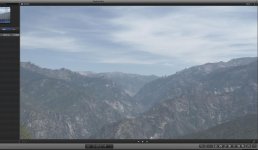
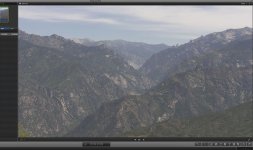
I just happen to be editing footage pertaining to the HPX-250. Here're screen grabs, as-is. Raw as it gets. No grading.
The HPX-250 was set to about f/5.6. It has a Hoya CPL. The other is a trusted 2/3" AJ-series camera w/ a premium broadcast lens is used as reference. Film Rec @600% was used.
I was shooting the HPX-250 mostly as C-roll and time lapse (real time) recording of the fast moving clouds. This is a 30 min. continuous real time time lapse recording. The zoom was around 35% (not the ideal 50%). FLAT scene file loaded. This is a true 1:1 square pixel of the 1920x1080 (as indicated by FCP 100% window) AVC-I 100. There's no scaling of the grab. As raw and true to life as it gets. Granted, this is a very challenging scene because of the uncontrollable atmospheric haze and fine details for any camera to capture. I strongly think the haze really throws the HPX-250's sensor off and somehow it looks like out of focus.
The point here is that I will have to add a considerable of artificial sharpen filters on the HPX-250 to get the detail back. This will undoubtedly increases noise.
The HPX-250 has a very hard time resolving fine details for majority of the outdoor scenic scenes. You probably asked why is you're out of focus? I'm NOT out of focus.
I verified the manual focus numerous times over and over using the RED assist. I have about 5 more similar type of mountain/cloud scenes. It's very hard for the HPX-250 to be constantly out of focus in manual for the other similar scenes shot on different day and time. The other five are a bit sharper when there's more sunlight shining on the scene.
Once contrast & color enhancements are added, it will be a very dynamic and punchy image on both cams. The haze will be cleared up once contrast is boosted. But the HPX-250 will show a lot of more noise based on the raw footage.
Attachments
Last edited:

lonewolf2koc@hotmail.com
Well-known member
Polarizing filter may help?
It was shot with a 72mm Hoya circular polarizer filter. This reduces f/11 to f/5.6. I'm obsessed w/ CPL filters and always use it on any ext. scenics. The HPX-250 is not intended use beyond its ideal shooting conditions. Ideal shooting conditions: interior 3200K, fairly well lit. Ext shot freed from fog, haze, smog. I'd NOT or ever use the HPX-250 anything beyond its ideal shooting parameter.
Last edited:
lonewolf2koc@hotmail.com
Well-known member
I tried on the Sony EX3, PMW200 and it's marginally better on challenging scenes. It is not a coincidence that these are bad units too. And of course all shot within f/4 to f/5.6 max. To me you get what you pay for. It appears that the cheaper sub $10K class of cams (1/3 to 1/2" sensors) are simply worth $10K. Trying to push the limits is definitely a waste of time. Got to stay within the shooting parameters and respect the cam's limits.
Last edited:
lonewolf2koc@hotmail.com
Well-known member
The EX3 & PMW200 use the stock Fujinon 14x series. The new PMW300 will let you have the option of the 16x next year. I'm a heavy Fujinon HA series user for many years and own several of their high end EFP lenses. Although Fujinon's OEM lens for Sony 1/2" is not even close in optical performance to their ZA or HA 2/3" series, it's still better than the KG lens on the HPX-250. Better meaning that at least there's better definition to the image throughout the focal length and not cruddy and muddy when the lighting is not favorable. You really have to use high end 2/3" lenses for a while to be able to discern between the high end and entry level. This is a Panasonic forum, I don't want to post too much Sony stuff. But I can at least say that Sony uses three CMOS sensors vs a single one. That's why it costs several grand more over te Panasonic HPX-250. Even 3 separate 1/2" ExMOR CMOS sensors, it's still not leap and bound beyond the HPX-250. It's a bit better for most scenarios, but still can't compete w/ a high end 2/3" cam. So I can only blame the optical section and DSP on the Sony 1/2" cams. I didn't bother to use the 2/3" lens adaptor on the EX3, but it should make this a pretty darn good camera once you put a broadcast 2/3" lens in front of the EX3. However, the form factor is very awkward for shoulder mount. You really need to use any of the brick style battery to counter balance the front heavy 2/3" lens. And it's an ugly looking camera once external lens are used. Remind me of a Frankenstined Canon 5DM2 dslr series w/ all of the absurd accessories to make up for the deficiencies.
Last edited:
Barry_Green
Moderator
??? The HPX250 uses three separate CMOS sensors. The only substantive difference is that the Sony is 1/2" vs. the Panasonic's 1/3", but other than that they are the same type of design.But I can at least say that Sony uses three CMOS sensors vs a single one. That's why it costs several grand more over te Panasonic HPX-250.
lonewolf2koc@hotmail.com
Well-known member
Ah, looking carefully at the spec:
I'm mistaken for the HPX-500 and HPX-600. Do those models use 3 separate CCD (HPX500), CMOS (HPX600) sensors? Last time I checked it the answer was NO. They only use a single CCD/MOS sensor. And there's a discernible quality between this and their AJ series cam with 3 CCDs. It's much cheaper to have three 1/3" MOS than three 2/3" MOS otherwise it would be incorporated into those models.
3x 1/3-type progressive 2.2 Mp CMOS
Prism color separation.
Clearly this is my fault for not looking carefully before posting.
Prism color separation.
Clearly this is my fault for not looking carefully before posting.
I'm mistaken for the HPX-500 and HPX-600. Do those models use 3 separate CCD (HPX500), CMOS (HPX600) sensors? Last time I checked it the answer was NO. They only use a single CCD/MOS sensor. And there's a discernible quality between this and their AJ series cam with 3 CCDs. It's much cheaper to have three 1/3" MOS than three 2/3" MOS otherwise it would be incorporated into those models.
Last edited:
Barry_Green
Moderator
HPX500 is three separate CCDs. HPX600 is a single 2/3" CMOS.
Hello guys,
I just came across your discussion and decided to add my comment regarding a grainy image, even though I own AC160, not 250.
But I believe that if both cameras have identical sensor and identical lens, they probably produce the same amount of grain.
(I know that the recording codec is different, but I see the grain even before pushing the record button, I see the grain on LCD)
Below is the link to "testing" clips. Shot in lower light (except in the shot 3), in a twilight, right after sun disappeared behind the horizon. There was still a lot of light left. Gain setting was 0dB. To me, the grain is considerable and very annoying, especially against the wooden green side wall of the building in shot 1 and against rocks and pebbles in shot 2).
http://icebergfilms.com/wp-content/uploads/videogallery/testing3.mov
I would love to hear your comments, tips, etc.
Cheers,
Paul
lonewolf2koc@hotmail.com
Well-known member
At first I griped and worried over this. But over time I realized that Pana' high end 2/3 " HPX-3700 at 0 dB has an ISO about 640. Noise is inevitable and is fixed. I also tried at -6 dB and still see a bit of noise but not as much at 0 dB. Their SDX900, HDX900, HPX2000 also have noise if you look carefully at -3 and 0 dB. But for the majority of the scenes, it's imperceptible unless you probe on it. Different gamma mode helps (HD, Film Rec, Film Like 2) to reduce but not completely eliminate. Yes, it's annoying but you just can't get rid of it due to whatever they do to the CCDs & DSP. I'm not at all surprised that this is on the HPX-250. In the 90s, you'l see a lot of film grain. It's magnified w/ Blu-Ray 90s era movies. But in 2010s, CCD noise is the equivalent of film grain.
Panasonic tech team recommended to reduce all v. detail, detail coring, etc.. to 0. This will soften a bit on the outline of a subject, but still retain overall sharpness thanks to the full raster 1080p image sensors. However, noise didn't disappear completely, but reduced.
Panasonic tech team recommended to reduce all v. detail, detail coring, etc.. to 0. This will soften a bit on the outline of a subject, but still retain overall sharpness thanks to the full raster 1080p image sensors. However, noise didn't disappear completely, but reduced.
Last edited:
timedmeades
New member
got any footage to illustrate this point of view?
timedmeades
New member
Could you post a link to some footage that illustrates what you are describing? Or at least a high def screen grab?

John Foundas
Well-known member
How is this cam stacking up to the Sony EX offerings?