HPX250: Noise and soft, Camera problem or me, expecting too much?

mmaller

Well-known member
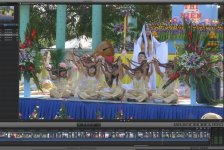
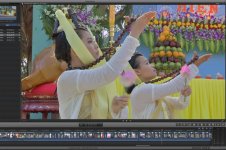
Here are a few screen grabs of a recent shoot with an HPX250 and a GH2 as a second stationary wide camera.
It was a low light situation, but not extreme.
I feel like the GH2 was sharper with less noise than the HPX250.
The GH2 was unhacked shooting maximum bitrate - 1080 30p AVCHD 24mbps.
The GH2 was wide open ISO set to 1600 using the Lumix 14mm f2.5 lens

The HPX250 was wide open with 6db of gain using AVC-Intra 100-30p / Scene file was set to Stylin.
The wide shot is noticeably softer overall than the GH2, also look at the column on the right of the frame, it is extremely soft.
Focus was set by zooming in to the person in the center of the frame and then zooming out to reframe for wide.

The screen grabs are straight from the footage with no color correction added.
Both cameras were white balanced.

Even the cu HPX250 shot looks softish and noisey.
Am I expecting too much?
Am I doing something wrong?
Is there something wrong with my camera?

Why does the GH2 look better overall?
I'm beginning to lose faith in my HPX250.

HPX250 wide.jpgGH2 wide.jpgHPX250 CU.jpg
 
The only sweet spot of the HPX250 is within 40-55% zoom range. All others you're crossing your fingers to get good results. Sharpness is pretty bad at wide (zoom @1-10%). This is very typical of HPX-250. I have shot over 400 hours of home video footage and yours is not a unique case.

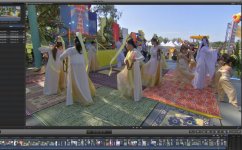
Attached is un-color corrected screen grab of the multi cam edit in FCP 10.0.8 of a typical outdoor performance w/ HPX250. It's at full 1920x1080 on a 2560x1440 LED workspace screen. HPX250 is not good at certain zoom and lighting condition. The front stage is shot with HPX250. It's somewhat fuzzy and not sharp. And yes I did check the focus but still the lens can't resolve the details. It was within f/4 and not f/8 or f/11 on the HPX-250. The side stage grab is w/ HPX3100 and broadcast super wide angle HD lens. It's a discernable difference in quality. Good thing is that the overall color and gamma are quite similar between Panasonic cams. But the sharpness and clarity is not. The final delivery is on Blu-Ray 1080p. If this was to be on YouTube, most can't discern between the two. But Blu-Ray delivery, you can't escape the flaws, especially when viewing on a 60-80" display.

You're not alone in the sharpness problem. I'm very concerned if I can use this camera as a main stage cam on any live outdoor event gig. I'm salvaging the footage and hopefully the AVC-I 100 codec and bring up the mediocre stock lens on the HPX-250. I also have another outdoor venue with similar lack of sharpness problem. So this is not unique to this particular stage. But I don't have that screen grab for reference. However, indoor with controlled 3200K lighting, the HPX250 performs quite well.

I'd bring a high quality 9" LCD monitor to evaluate the sharpness. The build in LCD on HPX-250 is just too small and you can't discern the difference. I'd also use different PAP mode for low light. 6 dB should be 0 dB with the other PAP mode. I got nailed many times for doing live outdoor events. The only time it look good is when everything is 3200K tungsten light, lighting that's within the magic hour range (early AM to sunset). Result varies with other type of lighting conditions. Will I use this camera for serious gig where your reputation is on the line? No. It's mostly for B and C roll to cut costs.

I'd use a 3-point LED light kit to increase the overall room lighting so that the overall gain will be 0 dB and probably f/4 or wider to get better results than using natural room ceiling light.
 

Attachments

  • DVXUser_HPX250_MLS-blurry.jpg
    DVXUser_HPX250_MLS-blurry.jpg
    127.7 KB · Views: 0
  • DVXUser_HPX3100_MS-sideAngle.jpg
    DVXUser_HPX3100_MS-sideAngle.jpg
    110.8 KB · Views: 0
  • DVXUser_May24-HPX3100_XLS-widest-sharper.jpg
    DVXUser_May24-HPX3100_XLS-widest-sharper.jpg
    113.7 KB · Views: 0
Last edited:
lonewolf,

Thanks for responding. Ironically I purchased the camera after reading your opinion of it on your website and seeing the footage that you had shot with it.
You certainly did get good results with the camera, as all of your footage is always superb.

How did you post those larger screen grabs. Mine were 1920 X 1080 but when I uploaded them they showed up smaller. I would like to post the larger size so you can see more
clearly what I am referencing.

How is it that the GH2 (a sub $1,000 camera with a $400 prime lens) shooting with an inferior codec, performs better than a $5,000 + video camera using one of the best
codecs available today?
or did I just answer my own question... PRIME LENS -??
 
I saved the images as .JPG in Photoshop CS6 and that's all.

Indeed you've answer your own answer. Optics play a big role in the final image. There's no other explanation because I'm getting great results w/ the HPX-250 when shooting all 3200K indoor at a big stage the following day.
Something is going on w/ the HPX250's stock KG lens not being able to faithfully resolve challenging lighting conditions.

I suspect the 22x lens on a 1/3" body with the cost of less than ~$2K/unit is too ambitious for 2012. Typically, a new 2/3" broadcast 22x HD lens is at least $30K. They must made dramatic compromises for size, price and performance to be less than $5K for the HPX250 and lens. If Panasonic limits it to 12-14x like with the previous gen cams and stick to a reputable LEICA and not newcomer like KG on the HPX-250, I'd willing to bet that the final image will be much sharper.
 
I was afraid you were going to say that. For whatever it's worth, here are the screen grabs at hopefully their original size.
What I am surprised by is that more people on this forum are not encountering the same limitations or dissatisfaction.

GH2 wide_r.jpgHPX250 CU_r.jpgHPX250 wide_r.jpg
 
These grabs are pretty much similar to my production copy of HPX250 purchased last year. I'm not at all surprised to the impairments seen on your HPX-250.

This whole situation is not thing new. I recall back in late 1998 when the Sony VX1000 was gaining traction. Mini-DV was the hottest thing for the prosumer market.
I thought all broadcasters & pros it will replace their expensive Digi Beta cams and 2/3" lenses to the VX1000 and Mini-DV. Not even close. In 2013, it's pretty much
the same thing again. Optical impairments are a norm with 1/3" class camcorders.

The unintended positive consequences w/ 1/3" cam are: It forces most shooters to light the scene better, and be more visually aware of objects in the scene & its workarounds.
 
Last edited:
What's the point of releasing a camera that has a 22X lens, but is not usable at the extreme ends of it's range and at it's maximum (open) aperture.
The BBC has approved this camera, but it seems like the approval was based on the codec (422, 10bit) rather than on actual examples of it's capabilities.
If Panasonic put a shorter focal length lens on this camera, would the problems be less severe?
I would think that improved overall performance over the cameras intended range is better than sticking on an extremely long focal length lens, and then having to act like the range just doesn't exist?

If you're in a situation where the lens is wide open and you're using a moderate amount of gain (6db) changing the focal length of the lens does not really improve
the picture quality.

I understand their are quality limitations with all cameras in low light shooting conditions.
I'm just disturbed that in moderately low light situations my GH2 can take cleaner, sharper video (with a codec not approved by the BBC) than my HPX250.

I only bring this up because I often shoot under conditions in which I have no control over the lighting.
I think this is applicable to documentary work (uncontrollable conditions) as well for which this camera was intended.

Does anyone know for example, if the Canon XF300 has the same limitations? It is also a 1/3 chip camera, but the zoom lens is not 22X, I believe it is something like 18X.
I have heard that Canon made sure this camera had an excellent lens given it's format.

Which PAP setting were you using 1 or 2. I would have thought if you were using PAP 1you would not have needed gain under those lighting conditions.

The only time my 250 shows noise when I use gain is when there is no light at all. If there is room lighting, I can usually increase to +9db with no noise.
 
I was using PAP 1, for the very reasons you just stated.
Without the 6db of gain, the picture was a little too dark when zoomed in on the main speaker, which is what I was using the HPX250 for.
6db of gain is supposedly from what I've heard really no gain at all.
I was using the GH2 for the higher wide angle shot.
The HPX250 was just completely unacceptable at it's wide angle setting. Look at how soft everything is without even comparing it to the GH2.
 
I shoot the HPX250 mainly in low light. If I had shot a similar conference setting with PAP1 and had to use 6 db of gain, I might suspect that I had accidentally left a ND filter in.
 
Terry, thanks for the suggestion, but I did not have an ND filter in place. I almost wish that were the case. I haven't used the camera since this shoot and I just checked to make sure that wasn't the case. Is it possible that my camera is acting like there is an ND filter in place even if the switch is in the off position? I don't think so, but I will run a test to see if that is a possibility.
 
mmaller,
If you are interested, I'd propose a test to see if your camera is functioning properly in terms of sensitivity. We could both light a white wall and record the camera settings to achieve 50 % on the histogram. Then we would need another means to measure the light source for comparison. I have Nikon gear and a HMC150, and AC90.
 
Terry, thank you for offering to conduct a test. What do you propose we do, besides what you stated above. How does the comparison of different cameras relate?
How will this test determine any issues with my HPX250?
 
When I do close interviews with more than 1 row, I have the same issue. I must move as far back as possible if I am unable to open the Iris more. I have learned how to deal with it, as it is a very sharp camera when used at settings will will work for your environment. I shot this all free hand as it was for a bigger promo, but if you look at the very opening look at the guys in the back, I pick the middle ground to focus and only had 4 minutes to do the shoot. I am happy with mine, but I do live shows at a distance and low light.
 
rzr219, In the example you posted, it looks like theater/stage lights are lighting the band members.
These lights are usually of high intensity, but have very narrow beams with limited fall off. I have experienced that the HPX250 performs well in this kind of lighting
as the exposure is set for the area being lit and that would explain also why the blacks are black and not muddy where the light is not falling.

WHat do you mean by...When I do close interviews with more than 1 row, I have the same issue. I must move as far back as possible if I am unable to open the Iris more.
 
mmaller,
Was just proposing a test to see if your camera is less sensitive than the normal HPX250 (i.e. broken). Would need a common way to calibrate the test light source though.
 
I am also not very happy with the HPX250 because of its mushy pictures and the noise. It is true, good light is more important with the 250. The lens is one problem, the CMOS chip is my main problem
I am watching old footage with my HVX201 and it just looks so much better, I really dont know what drove me to sell it....
 
I have been shooting some events lately with my GH2 and GH3 and I can't believe how much better the image quality is as compared to the HPX250.
I have a 32 inch monitor hooked up to my editing system and when viewing the footage from HPX250 shoots, I was always disappointed in the quality, and overall sharpness of the image. I was even beginning to think that there was something wrong with my monitor, but after viewing the GH2 and GH3 footage on the same monitor, it is clear that there is nothing wrong with the monitor. The footage from these small micro 4/3 cameras is very impressive. I am using the HPX250 less often now because of this.

This is a hit or miss camera. It appears that your iris level has to be just a bit toward 95-98% IRE to get good contrasty footage. All others will look a bit murky. Sadly, I'm dedicating this camcorder to shooting family home video, slave car mount or C-roll cam.
 
Back
Top