Nikon in Dire Straits

I really wish that Nikon would release an APS-C hybrid stills/video camera with internal 10-bit N-Log, zebras, waveform, & scopes. I begrudgingly bought an A6300 before Nikon had a viable mirrorless camera, and I might have to get another Sony or maybe Fuji if Nikon doesn't come through.
 
I was having a conversation about the current state of the industry and Nikon's troubles. I was at the store the other day and took pictures with both the Nikon d850 and the Sony A7III. I actually prefer most everything about the Nikon DSLR: the larger size, the feel in the hand, a large optical view finder, simple button layout even the lcd screen. If I didn't have to shoot video I would pick the Nikon.

My question is if these high end cameras are primarily targeted to professional photographers why are mirrorless cameras better the DSLRs? It can't be size because when you use big heavy professional glass there is no benefit to a small mirrorless body. I know that mirrorless has a quieter shutter but in most situations this isn't important. When a professional photographer is hired like for a wedding all they care about is taking photos they're not going to care about the camera's video specs. I understand there are some hybrid situations. So it would be great to have both video and photo in one camera but why does it need to be mirrorless to do this?

I don't understand in the pro market that these cameras compete in why it matters if you sell a mirrorless camera as opposed to a dslr? In regards to video Nikon should have an advantage because they don't have competing cinema cameras to protect. I understand that most people now a days want a camera to do both photos and video, and Nikon is woefully behind the video side with no hope of catching up.
 
Last edited:
A year ago, if you ever went to any professional sports game or red carpet event (etc), you/anyone would see 99% of the world's professional photographers are still using old Canons and Nikons, some Sonys.

Only forum nerds upgrade and discuss cameras so much.

Most real working pros rarely ever upgrade unless they are making a living on social media talking gear (which they should/is part of the job).

Cameras like the 1DX Mark II and D750 are still extremely popular in photography. Plus many others and even the ones that no one ever talks about (like for portraits) because they are too expensive for most.
 
A shorter flange distance benefits the mirrorless over the DSLR in terms of the optics. On top of that, the recent EVF's are better than a purely optical VF in DSLR's. (there was also a half-way solution with the Sony translucent mirror line that Sony denied abandoning ... right before they abandoned it). And, with the low light sensitivity of the modern era sensors and noise suppression/elimination, the need for large lenses is also diminished. F4 works fine under most photo scenarios.

The heat generated by the 4K/6K/8K video processing is also lower with the modern CPU's, so one can indeed make smaller bodies to go along with the smaller lenses.
 
I don't understand in the pro market that these cameras compete in why it matters if you sell a mirrorless camera as opposed to a dslr? In regards to video Nikon should have an advantage because they don't have competing cinema cameras to protect. I understand that most people now a days want a camera to do both photos and video, and Nikon is woefully behind the video side with no hope of catching up.

There's no money in the pro market. Not the level of Pro's Nikon is aiming at.

Volume. There's not enough pros to pay for the amortised R&D that drives all of this.

Just like in cinema cameras. How many Alexa Classics / Minis do you think Arri have sold world wide ? The most successful cinema camera in terms of longevity and creative appreciation (which no doubt drives sales) and still considered the Benchmark. MAYBE 10 000 - 15 000 units ? They are hugely expensive for that reason.

Nikon is going under selling 280 000 units....

JB
 
Do nikon use Sony sensors and are stuck with last years chuck outs ?
The image sensors sold to Nikon, Panasonic, etc., are made by Sony Imaging & Sensing Solutions.

Sony cameras are made by a functionally separate business, Sony Electronics Corporation (previously Sony Electronics Products & Solutions). That company buys ‘Sony’ sensors in the same way that Nikon and other customers do. Sometimes Nikon has paid a premium to have an exclusive lock on a new sensor for a while; sometimes Sony has done so. Sometimes Fujifilm has done so. Etc.

So in my basket I have z6 cage and bits.. but this thread for some reason is really making me hold back.

Is it time to go sony or canon and if so which
I’d stick with Nikon if I had already committed. In several ways the Z system is the best, most rational, and most modern of the full-frame mirrorless systems. Nikon is slightly behind on video and autofocus, which are solvable problems (and for autofocus, Nikon is not as far behind as commonly imagined, nor is this as big a problem as the reviewers make it out to be – just a few years ago, everyone was sneering at eye AF, after all. Essentially every great photo and video you have ever seen was made without this autofocus tech that has become essential overnight).

Reviewers talk about differences with little regard for the significance of those differences. Nikon thrashed Canon for dynamic range for a decade and yet no-one – except reviewers – cared.

I think the deep quality of the Z system cameras and lenses will eventually tell on the market … if Nikon survives which I accept is not certain.

My question is if these high end cameras are primarily targeted to professional photographers why are mirrorless cameras better the DSLRs?
Mirrorless with high readout speed enables many useful features and behaviours, but there is one important thing that SLRs are still clearly better at: tracking fast erratic movement in the viewfinder and timing the shot. Mirrorless cameras have appreciable lag that plays havoc with action photography: motorsports, football, wildlife, etc. – the sort of jobs that still employ a few professional photographers.

In regards to video Nikon should have an advantage because they don't have competing cinema cameras to protect. I understand that most people now a days want a camera to do both photos and video, and Nikon is woefully behind the video side with no hope of catching up.
Why no hope? It’s mostly trivial firmware and processing features, plus a few simple design features (connection locations, etc.). I’ve used a lot of stills cameras over the years and in my experience Nikon is the best of them all at firmware and processing. They got those details right in SLRs years before even Canon did. There is no reason to doubt Nikon could solve its video woes overnight if it became a priority for the company – and recent firmware updates for the Z6 suggest that Nikon management has belatedly figured out that this should be a priority.

And, as you note, Nikon does not have cine or ENG product lines to protect.

All of this makes me expect a big push for better video in the next generation of Z-system cameras. Once again, Nikon will have responded too late to this trend to exploit it for market share, but that doesn’t matter much to any individual choosing a camera after the fact.
 
I was having a conversation about the current state of the industry and Nikon's troubles. I was at the store the other day and took pictures with both the Nikon d850 and the Sony A7III. I actually prefer most everything about the Nikon DSLR: the larger size, the feel in the hand, a large optical view finder, simple button layout even the lcd screen. If I didn't have to shoot video I would pick the Nikon.

I hate the ergonomics of Sony still cameras for shooting stills. They are tiny rectangles with a few buttons. Even the Canon R5, while on a completely different plane ergonomically, is still a little on the small side(at least it looks that way, I haven't shot with one, yet). Just because you can do something(like make cameras impossibly small), doesn't mean you necessarily should. Humans are still holding these in their hands and using them(at least for now).

If all you're doing is putting an a7 on a gimbal to shoot video, that's fine. But holding it for even moderately extended periods to actually shoot stills... I bet not a one of the designers ever actually did.
 
From what I understand from the comments:

1. Nikon is not in financial trouble because professionals aren't buying their cameras especially for photography. Its because smart phones have taken the lion share of their low end consumer point and shoot cameras. There's not enough volume in the the pro level to sustain their business long term.

2. As far as mirrorless vs dslr. I think even though there are benefits they are not over whelming.

3. I do think they are lacking both in video and autofocus and are losing business because of that too. In my particular case I do very little photography for work. When I do video, I almost exclusively use a camcorder. For the odd situation that I need a small camera for gimbal work, Sony mirrorless makes the most sense because they excel at video and have the best autofocus, which I would want. So even though I like Nikon they don't do what I need. I've narrow down my gimbal camera to the A7III or A6600. I don't enjoy those cameras but there you have it.

"That ain't workin' that's the way you do it
Money for nothin' and chicks for free…
 
Last edited:
They'll probably end up doing something else, maybe make some refrigerators like Panasonic, or other smart home products.

Maybe get acquired or change their name or change their business. [RadioShack has new owners and is getting another shot online.]
 
Dateline - Rochester, NY and Minato Japan - Today, Kodak and Nikon have announced a joint venture to produce pharmaceuticals. They will get started on researching how to make an effective vaccine for ... oh, never mind.
 
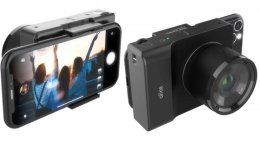
I had this idea when I was in the shower this moring. Imagine if Nikon only did what they were good at the body and lens, then on the back of the camera you insert your phone into an adapter plate, that interfaces with the camera. You use the phone's great touch screen and interface to control the camera and view your images.
 
The success of phones comes from being devices that can do dozens of tasks...no one actually wants a traditional camera anymore (outside of those working in this creative realm).
 
I get that for casual/vacation use you can't beat a phone. Who really wants to lug around an big expensive gear that can be stolen the moment it's out of your sight. But for creative professionals I find it attractive to be able to use your phone as an interface to your camera. All the good gimbals are starting to do it. Instead of buying an expensive dedicated field monitor you use your phone. Imagine being able to setup profiles on a phone app that you could easily access and customize at a moments notice instead of digging the 1980's non touch screen interface. Let alone having to view their terrible low resolution lcd.
 
Last edited:
If a company makes electronics, going from one type of product to another is easy. Nikon can easily get into the phone market. Can you imagine Nikon or ... or even Red. If either of those camera companies made a phone .... .............. ............................ oh, never mind.
 
Back
Top