Nikon D5300 video samples.

will do my best to make sensible test..
I am taking a bit of time off.. right now too much paid work on my shoulders.. sorry!
 
I know Daniel has seen these already, but for others here are a couple of very basic, quick (not technical) tests I made for myself with the D5300:

https://vimeo.com/82048322

https://vimeo.com/82099218

Please criticise fully!

My first impressions:
*I'm seeing a little moire, but no one else is so it can't be very bad!
*Low light is great (& no banding)
*A bit soft compared to my G6 but it sharpens up nicely in post
*50p looks good
*I like the aesthetic quality of the image a lot
*Great dynamic range!
I was interested in this camera for low light, but as soon as I started using it I was shocked by the level of DR. I have no idea how to test this scientifically so I'm very eager to see what results you guys get, particularly with Flaat.
I hope that one day we will understand the sensor.

I'm feeling very positive about this camera as an alternative for those not wanting to go down the RAW/ProRes route.

Please consider adding any tests/videos to the D5300 Vimeo group I created: https://vimeo.com/groups/d5300
 
What would be nice for me would be a simple side by side comparison between the D5200 and D5300 in contrasty scene like what Oleg did between 5dmark 3 and D5300 at 100 iso. The difference was so much that it did not look like the 1 stop difference between the 5D3 and the latest Nikon's. This has spark my curiosity and we will have to wait for Oleg, when it is free and it is ok.
 
I sent the instructions to Matt James and he posted this: https://vimeo.com/82195848
But I have limited internet access right now and won't be able to process them until the 30th or so.
What you see is the shutter speed becoming 1/3 stop faster every second, then 3 stops of ND filtration added (approximately), then another 3.

If any of you wants to get a usable-DR metric with this:

Highlights: look at the white target in the center. Check that the first image of all has this white target clipped. See how many stops faster the shutter is when it starts to be non-clipped.

Shadows: Look at the wrinkle just at the left of the center. Add brightness at the image, and check what's the first time that this wrinkle becomes impossible to recognize. That is, the first time when noise doesn't let you see the wrinkle.

ND: to check that it is actually 3 stops of ND that was added with the fader, compare 1/400s+ND with 1/50s with no ND. They should be just as bright. Use the waveform to be sure.

Difference: At the highlight-clipping point that you identified in the first step, check what's the waveform level for the wrinkle (use a mask to make sure it's the wrinkle you're looking at). Now, see how much faster the shutter has to be if you want the center target to have that same brightness.


All this will give you a measure of usable DR. I'm guessing 7 stops or more, which is 1+ more than the 5D2 in H.264 mode.


If you don't know how to run the math, give me the measurements and I'll compute the numbers. I can do that, what I can't do is download the video and look at all this myself.
 
OK, so I could borrow a computer with good internet and premiere for a short while, and I looked into this test. Get ready for this, you're gonna like it...

The center of the target starts to be non-100%-white at step 4 of the first batch
The first ND adds 1.66 stops of ND, the second one a total of 2.66 stops.
The left side of the chart is 3 stops darker than the centre of the target. It stops going down in step 20 of the third batch --> (20+8+9-4)/3 --> TOTAL DR IS ABOUT 11 STOPS, just about the same as in old Nikon bodies.

And now the good part...
The wrinkle is about 2.66 stops darker than the center of the target.
I lose the wrinkle at step 13 of the third batch --> (13+8+8-4)/3 --> USABLE DR IS ABOUT 8.33 STOPS

Looking at my previous numbers for usable DR, that's more than 2 stops better than a 5D2 in H.264 mode, more than one stop better than my NEX-5N, and about the same as a BMPCC in ProRes mode at its best ISO (800). Just about a stop behind the BMPCC in RAW mode.

dr.jpg


IMPRESSIVE!!

BTW: that's with Flaat_13, but I think it's working just as bad as it did in the old bodies, I guess Flaat_12 would be the same DR but with not-so-nasty deep black issues

edit: added note of caution: the target I used for my usable DR tests was a fine-textured one, this wrinkle is a lot bigger, codec compression could kill finer detail to a larger extent, and then this comparison would be flawed, favoring the D5300. But I don't think that bias is going to be more than 1 stop in any case, so I keep my conclusion: best in class, and pretty impressive!
 
Last edited:
Thanks very much Samuel, the accidental test from Oleg between the 5d3 and D5300 really aroused my curiosity. The difference was quite big, looking more than 1 stop.

Could you also give us how it would translate to Normal DR numbers. I ask because I am much more use about traditional DR numbers and even if I do understand the concept of usable DR, I think that both have there use. For me usable Dr is for people that want to know exactly how much range they have to grade/process heavily if need be like for example HDR photography while traditional Dr measurement is more for people that want more normal human eye perception. Where you will have blown highlight and crush shadows. The second thing is that if someone sees the 5300 has 8.33 stop of DR, there is a great chance that he won't understand that it is not the same measurement that will show the Canons at 11 stop etc etc.

For the codec issue it is not a problem with the Nikons because you have clean hdmi out that you can capture at high bitrate.
 
Thanks for doing this Samuel, it is very exciting.

I'm coming from a Lumix G6 and every time I see the images I've shot with the 5300 I'm immediately struck by how good the DR is, so your conclusion doesn't surprise me too much. I tried not to let myself compare it to the Pocket footage I've seen, but to be honest the thought has crossed my mind a few times. Anyway, I'm convinced this is the best h264 DSLR available at the moment. Sharpness and low light are excellent, moire is insignificant, colours are lovely for 8bit + 60p! Fanboy alert!!!
I've been using Flaat 11 and I'm pleased with the results (will post some soon). I'll try shooting some real world stuff with Flaat 12 to see how it grades (so far I don't think Flaat 13 looks too useable in the shadows and NR doesn't help). If I have time in the the new year I can redo the test (more accurately hopefully) with Neutral, Flaat 11 & 12.

It would be nice if you could get some normal contrasty scene, like some scenery you did, to see the noise level of Flaat 13. I have used Lpowel gama curve at .5/.4 with my D7100 and if you can clean the banding and add some noise reduction with neatvideo it was still ok.
 
I wrote this in another thread from a ... non factual eoshd test.

I am watching Andrew test between gh3, 5d3, 5d3 Raw and Blackmagic pocket camera. I don't know if we can correlate it to Samuel H finding on Dvxuser. His finding where that the D5300 was about the same as BM pocket but lower than 5Dmark 3 Raw. While on andrews less scientific test the 5d3 Raw is lower than BM pocket ? I am referring to this comparison https://disk.yandex.com/public/?hash=Le4Ee3Biq/a3jOphlYhqqvWPKrkIIj3Z7MAvPZbJ+ME= between 5d3 and D5300 which looks like the D5300 has about 2 stop better highlight as in the Andrew test below

http://www.eoshd.com/content/11350/depth-test-5d-mark-iii-7d-raw-vs-blackmagic-pocket-vs-gh3
 
* Results depend on the ISO, and, for the BMPCC, on whether you shoot RAW or ProRes. Also, on how you treat your RAW images in post.
* Total DR on the D5300 seems to be around 11 stops, so, not more than old Canons and Nikons. The difference is how much cleaner the shadows are, not whether there's any signal at all.
* Very mighty camera indeed. At a minimum, it's a D5200 with 60p and maybe cleaner shadows, and that's a lot already.

The way I understand what you are saying is that although the number of stops the sensor can achieve is the same as the other cameras, the 5300's ability to get detail in both the shadows and the highlights is much better - e.g. you can expose "to the left" to make sure the sky isn't blown out and then retrieve detail information from a silhouetted building. The number of stops doesn't increase, it just gets stretched.

The D5300 definitely has much cleaner shadows than the D5200 - we know that is a fact. This is Nikon's best DSLR for video (personally I think the best h264 camera). I think Flaat is going to be getting a lot of use in the near future.
 
oleg 5d3.jpgoleg d5300.jpg

I was talking about this oleg test. You can clearly see much more DR in the D5300 image. I am doing some test in Adobe lightroom because it has exposure in stops. In the highlight where clearly the D5300 has much better range I find something quite extraordinary or strange depending if my observation is valid or not. You have to expose the D5300 at about 3 stop more to get the same amount of clipping than the 5d3. I mean the image becomes quite wash out and it seems that it just does not want to clip!!!! I did not change any other setting like contrast, curve or highlight recovery so as not to change any roll-off etc. So I am a little bit unsure how to explain this. In the shadows also the D5300 has an advantage compared to the 5d3. I will have to test it and I am basing most of my reading on the histogram and red/blue cliping in lightroom from png grab.

In this case for normal DR measurement if the D5300 is 11 stop then the 5d3 would be 9 stop at least and if the 5d3 is 11 stop the D5300 would be 13 stops. The second hypothesis is that we are witnessing samuel Usable DR measuring where even if the two cameras are about the same DR value of 11 like Samuel said, you would be able to get much more out of the D5300. In this case you could expose 2.8/3 stop higher to get the same clipping level than the 5d3 with much cleaner shadows.
 
Last edited:
I read somewhere that the 5300 shoots JPEGS with very good DR. I wonder if there are any tests out there of its stills (jpegs) DR, and if that would help understand the video mode?
 
5d3clipping.jpgd5300.jpg

These are screen grabs showing what I was referring above but unfortunately the exposure tool is not 100 accurate. It seems that adobe applies some curve to a certain level to prevent clipping http://forums.adobe.com/message/4133805 That is why surely you can push it that much in lightroom nearly 3 stop more to get same level of clipping in red. so if anyone knows software with some accurate exposure tool.
 
My first D5300 Flaat 11 test shots. I'll try uploading a less compressed version later.
 
Last edited:
Thanks Daniel. I'm really loving this camera. It is a little soft but not so soft that I care. It's my first Nikon - I really like their colour science.
 
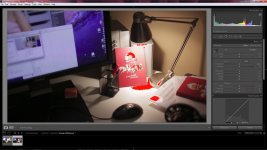
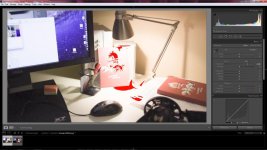
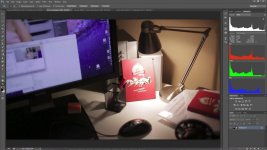
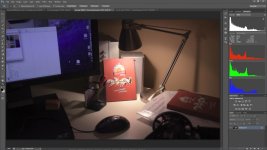
screen grab 5d3 normal.jpgscreen grab d5300 normal.jpgscreen grab d5300 1-5 ungraded.jpgscreen grab graded 1-5 stop.jpgD5300 equalise 2 stop graded.jpg

So I went back to my test. This time I got a pluggin in photoshop that will move the exposure in stops. Again I am a bit amazed.

You can see some screen grabs so that you can see the histogram to compare exposure an clipping both visually and more empically with the histogram.
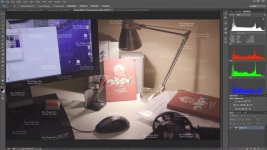
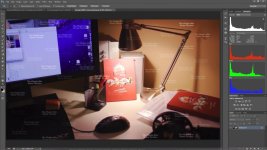
N0 1 The first one is the 5d3.
N0 2 It is the D5300 which I removed a little green so that it is closer to the 5d3 colors (better for seing clipping)
N03 It is the D5300 with 1.5 stop + exposure
N0 4 I graded it back to about the contrast ratio of the Canon (mainly black level) and put I think a little too much saturation.
N0 5 is an earlier +2 stop exposure.

My conclusion is that the D5300 has at least 1.5 to 2 stop better highlight than the 5D3. The first thing to note is that it clips less the green and blue chanel. These two don't even clip with + stop exposure in this scene !!!!!!!!!! Which makes the highlight clipping much better looking than the 5D3.
 
Nice video Matt. Just got mine, can't wait to take it out for a test. New to DSLR's, was wondering if there's anything I should know about loading Flaat? I read Samuel's quick directions, but thought I'd ask, as he seems to suggest a little caution for newbies.
 
Back
Top