
robotsound
Well-known member
I recently put together a set of Nikkor manual focus prime lenses to use for filmmaking. I did a fair amount of research on this, and wanted to share what I had learned.
If you are looking to get into Nikkor glass and have a Canon DSLR, I encourage you to do your own research, but this is a great starting point for your research.
I have a Canon T2i, so I got three lenses that would be good focal lengths for wide, medium, and telephoto shots on an APS-C or Super35mm sized sensor. If you have a different camera like a GH2 or something, you may want slightly different focal lengths. Beware that not all lenses are created equal though. I've found that Ken Rockwell is pretty trustworthy when it comes to his reviews.
These are the lenses that I ended up getting:
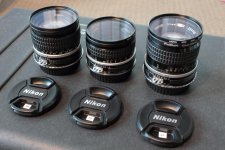
Nikkor AI-s 28mm f/2.8
http://www.kenrockwell.com/nikon/28f28ais.htm
Nikkor AI 50mm f/1.8
http://www.kenrockwell.com/nikon/50f18ai.htm
Nikkor AI-s 85mm f/2
http://www.kenrockwell.com/nikon/85f2ais.htm
Everyone's needs will be a bit different, but these lenses hit the sweet spot for my needs. I was aiming for maximum image quality and reasonable low light performance, on a budget. There are faster Nikkor primes than this, but one thing I have learned is that although the faster lenses cost more, they were optimized for wide apertures at the expense of sharpness, flare resistance, barrel distortion, etc. Thus, these lenses are the sharpest and most flare resistant of their immediate peers. They also cost less. I can get at least f/2.8 throughout the whole range, and at least f/2 at medium and telephoto distances.
These (and other brands of manual focus primes) really are universal lenses. They have absolutely no electronic components, it's just glass and metal. With the right adapters, they will work on a video camera 35mm adapter, Canon, Nikon, Panasonic, Sony, RED, Arri, or just about any other kind of camera you could think of.
Some people say that vintage lenses are fuzzy, but these are sharp!
They were designed for manual focus, so the focus ring travels between about 170 and 270 degrees, depending on the lens.
I got Fotodiox Nikon F to Canon EOS mount adapters and Canon back lens caps and they work great.
They all take 52mm filter threads. Since I already had a set of 58mm filters, I simply bought a Fotodiox 52mm to 58mm step up ring for each lens, and a Nikon 58mm lens cap to put on the front of each one.
I'm sure in a couple years or so I'll have a different camera. Maybe it will be another Canon, maybe it will be something else. However, as long as I stick with roughly the same sensor size (or buy one more prime in a different direction, like a 20mm or a 105mm), I will be able to keep using these lenses on practically any camera the future has in store.
If anyone has any questions, I'll do my best to answer them.
If you are looking to get into Nikkor glass and have a Canon DSLR, I encourage you to do your own research, but this is a great starting point for your research.
I have a Canon T2i, so I got three lenses that would be good focal lengths for wide, medium, and telephoto shots on an APS-C or Super35mm sized sensor. If you have a different camera like a GH2 or something, you may want slightly different focal lengths. Beware that not all lenses are created equal though. I've found that Ken Rockwell is pretty trustworthy when it comes to his reviews.
These are the lenses that I ended up getting:
Nikkor AI-s 28mm f/2.8
http://www.kenrockwell.com/nikon/28f28ais.htm
Nikkor AI 50mm f/1.8
http://www.kenrockwell.com/nikon/50f18ai.htm
Nikkor AI-s 85mm f/2
http://www.kenrockwell.com/nikon/85f2ais.htm
Everyone's needs will be a bit different, but these lenses hit the sweet spot for my needs. I was aiming for maximum image quality and reasonable low light performance, on a budget. There are faster Nikkor primes than this, but one thing I have learned is that although the faster lenses cost more, they were optimized for wide apertures at the expense of sharpness, flare resistance, barrel distortion, etc. Thus, these lenses are the sharpest and most flare resistant of their immediate peers. They also cost less. I can get at least f/2.8 throughout the whole range, and at least f/2 at medium and telephoto distances.
These (and other brands of manual focus primes) really are universal lenses. They have absolutely no electronic components, it's just glass and metal. With the right adapters, they will work on a video camera 35mm adapter, Canon, Nikon, Panasonic, Sony, RED, Arri, or just about any other kind of camera you could think of.
Some people say that vintage lenses are fuzzy, but these are sharp!
They were designed for manual focus, so the focus ring travels between about 170 and 270 degrees, depending on the lens.
I got Fotodiox Nikon F to Canon EOS mount adapters and Canon back lens caps and they work great.
They all take 52mm filter threads. Since I already had a set of 58mm filters, I simply bought a Fotodiox 52mm to 58mm step up ring for each lens, and a Nikon 58mm lens cap to put on the front of each one.
I'm sure in a couple years or so I'll have a different camera. Maybe it will be another Canon, maybe it will be something else. However, as long as I stick with roughly the same sensor size (or buy one more prime in a different direction, like a 20mm or a 105mm), I will be able to keep using these lenses on practically any camera the future has in store.
If anyone has any questions, I'll do my best to answer them.


