NEX FS100 and green screen

HeXman

Active member
Does anyone has experience shooting green screen with the Sony NEX FS100? I'm trying to figure out what lighting kit should I get.

I know that the FS100 is pretty good with low light conditions so I'm guessing that I might need less light than what I think I need...

This is are the conditions:

Location: 10 X 22 square feet studio
Camera: Sony NEX FS100 with teleprompter
Distance between talent and green screen: 10 feet
Distance between camera and talent: 7 feet
Green screen area that needs lighting: 6 x 6
Main purpose: Shooting green screen material
Lighting kit budget: $600 - $1500 (No need for stands)

I know Kino Flo is the top choice in a perfect world, but since I ran out of budget I been doing some research to find cheaper alternatives.

Some of these alternatives are "Cool lights" and "Flo lights" simply because they use 21" 55 watt biax tubes, which is apparently what Kino uses as well.

Another interesting thing is that apparently there are some Kino Flo (maybe others, as well) green fluorescent tubes specifically for green screen work that can pull a good key.

Any advice on this?


Thanks in advance.

- Hector
 
I actually just did a greenscreen production with the FS100.

We had Kino flos with green coating for the screen, and two whites for the key. Honestly... I think Kino flo are cardboard crap. I'd take an HMI light anytime and then diffuse my way out of it.
I know we were hindered by the way the rental studio had their lights hanging, but we really did have a hard time making the background even with the Kinos. So make sure that you have total control of light placement...
 
I don't think Kino Flos are crap for green screen, but there are so many factors to take into consideration when lighting a green screen: size of screen, distant of talent from screen, how many lights and which lights you have, etc.

Kino Flos can be great for green screen work, but you need total control over them. It sounds like, in your situation legrevedotcom, that yours were hung from a grid, which may not have been the best thing for your shoot considering Kino Flos don't have the punch or throw of a standard Fresnel. Also, there are several different configurations of flos: long 2, short 2, long 4, short 4, etc. I would have a hard time believing that you couldn't sufficiently light a screen for a clean key with a couple long 4-banks - I've done it, but there are other factors, again, to take into consideration for every green screen shoot.
 
I actually just did a greenscreen production with the FS100.

We had Kino flos with green coating for the screen...

Was the green coating worth? I'm thinking on buying a Cool lights kit and buy the Kino flos with the green coating for the green screen lights, so this just made me think about it again.... was there a big difference?
 
I don't think Kino Flos are crap for green screen, but there are so many factors to take into consideration when lighting a green screen: size of screen, distant of talent from screen, how many lights and which lights you have, etc.

Kino Flos can be great for green screen work, but you need total control over them. It sounds like, in your situation legrevedotcom, that yours were hung from a grid, which may not have been the best thing for your shoot considering Kino Flos don't have the punch or throw of a standard Fresnel. Also, there are several different configurations of flos: long 2, short 2, long 4, short 4, etc. I would have a hard time believing that you couldn't sufficiently light a screen for a clean key with a couple long 4-banks - I've done it, but there are other factors, again, to take into consideration for every green screen shoot.

hey Jordan, did you still had problems lighting the green screen even after putting some diffusing material over the lights?
 
In my experience, I haven't needed green bulbs or gels - the primary thing is that your light source is matched to your camera balance - shooting tungsten, use tungsten lights or gel; shooting daylight, use flo's, HID or HMI. Your screen should be the super-saturated roscoe green, but I have three screens from eBay that work fine. Even Savage Chromakey Green seamless works well (it's a bit less saturated than fabric screens but it's what you need if the floor figures into a shot and you're not painting a cyc).

In my experience, you want the screen to be an even line, around halfway to 60% up on your WFM. Too bright and it gets too yellow to work properly. But having an EVEN screen with no corner falloff is the most important thing. Save $60 for one of those garment steamers with the hose, all the lights in the world won't kill wrinkles. Stretch the screen tight or give the seamless paper a try (the paper needs more light in my experience).

I've found the budget biax flo's to be dynamite for greenscreen - they're soft, their rectangular shape helps, they have barn doors, they're lightweight and cheap. You can diffuse them with diffusion gels, or even the tissue paper that comes between your gels (which works just fine and it's free). Avoid the FloLights with the goosenecks - having one of these in your kit is great (they're so freaking light you can hang 'em from a ceiling grid) but the goosenecks are crap.

Search for "Cowboy Studio" on Amazon - they sell 2 and 4 bank biax flos that are really decent units - sometimes under $200 for the dual and under $300 for the quad. Cool Lights are well-liked around here as well.

I'm in the final edits of a massive greenscreen music vid, so this is all most definitely stuff that has truly worked for me.

gs.jpga31.jpg
 
Was the green coating worth? I'm thinking on buying a Cool lights kit and buy the Kino flos with the green coating for the green screen lights, so this just made me think about it again.... was there a big difference?

The green flos were worth it... We have previously found that using normals would desaturate the screen rather than help it, so that part is definitely worth looking into.

@Jordan
You are right... mostly now it's just left over bile from the day of the shoot. I know what to look for next time. I was caught in a situation where I trusted that my production manager etc had approved the stage. Turned out no one ever saw it... just booked it :S
We had to cover a pretty big screen since we were doing everything from head shots to super totals, along side with shots form down below. I would have loved to have been able to pull the flos just 30-50 cm away from the screen, but they were hanging off a metal bar suspended from a grid that wasn't immediately customizable. Add to that... the studio apparently don't care about smooth screens. The fabric was very wrinkled up :( but we saved it to a decent degree by stretching and weighting it down with sand bags and metal blocks. For just under 2000 dollars a day I would have expected more :S
@Michael... Nice advice, I wish I had that before the shoot because those were pretty much the challenges we faced.
 
Thanks guys - been a greenscreen summer for me.

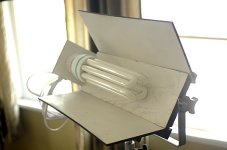
Below is the coolest thing I came up with - not a fan of DIY lights, but these big flo bulbs kick out some MAJOR lumens, and I had lots of plywood scraps and hardware lying around and had to light a 20x10 green screen. This uses a china ball holder fastened into a hole (with the china holder's socket collar). They break down flat, the "barn doors" aren't adjustable (they pop out of the sides for packing). Overall they do a fantastic job. I'll do a video tutorial on building these eventually, but the basic technique should be clear from the photo. Hardware was the china holder, two 1/4-20 knobs, two 1/4-20 threaded inserts, and a small smith-victor spud. Made the yokes with cold rolled steel from home depot. Needed a table saw, a drill, and a vise.

Very easy to clip diffusion on these as well. I shot a TV spot a while back and used one for overhead fill with a light rose gel, very very nice.

I hung two of these from the ceiling, and had a twin biax flo on each side. Worked very well. Tossed in another biax when I had to light the floor.

diy-flo.jpg
 
Back
Top