NewsShooter : Apple challenges RED over RAW patent legitimacy

Canon C200 shoots an internal Raw (6:1 compression, I believe) and the funny thing is that, for about a year until the C-Fast 2.0 prices came down, a C-Fast 2.0 "fake card" connection that recorded onto an external SSD was a topic of much conversations. Canon, in fact, made card slot somewhat more difficult to fake through by using a rather funky flap. BMD, on the other hand, allowed a pretty simple implementation of the same on its Ursa Mini Pro line. The brand new BMD Pocket6K goes beyond that and just has a USB connection out that leads directly to an external SSD, which can be easily mounted to a cage.*

*Pocket6K has a relatively minor problem with the USB speed since it doesn't allow for a sufficient data transfer in the least compressed high frame rate 6K.
 
(p4k also allows that, and needs half the datarate; I thought about going that route, but since CFast are not THAT expensive anymore, I'm shooting internally)

The storage thing is definitely an issue: since I moved from 8-bit XAVC-S to 12-bit RAW with 4:1 compression, I had change my edit SSD from 480GB to 2TB, and I'm filling 4TB backup and storage HDDs at a crazy rate. It's a big cost of moving to RAW that many people overlook. Getting half a TB of footage is average for a single day of shooting.
 
Yep, with bayer pattern sensors you need 8k to capture 4k worth of both blue and red chroma information.

6k is enough to fully compensate for the detail you lose to the bayer pattern though, so 4k supersampled from 6k will give you a full 4k in resolvable luminance detail. And (if you record the supersampled image in 4:4:4) it puts your ratio of "true" red/blue information each at 55% of your 4k luminance information (compared to just 25% each with a 4k 4:2:2 image).

My point is that you need to record in 4:4:4 (if you can't shoot raw) to really get the benefits of the additional chroma information that a 6k+ sensor can deliver to a 4k image. 55% compared to 25% gives you a LOT more chroma information to interpolate from.
Technically, to get full resolution 4K from Bayer you need 5.7K, not 6K. That's why the EVA1 was designed with a 5.7K sensor. Think about the original Alexa, where to get a full 2K image it started with a 2.8K sensor. Just double the numbers.
 
Or you need a three level sensor, like all those "ancient" three chip cameras with their archaic prism design.

What happened to Foveon?

Or we could all go back to shooting and scanning film!
 
Sigma's Foveon cameras have the most gorgeous colors but, apparently, the sensor works best at ISO 100. So, it's like shooting on film. In digital form.
 
Technically, to get full resolution 4K from Bayer you need 5.7K, not 6K. That's why the EVA1 was designed with a 5.7K sensor. Think about the original Alexa, where to get a full 2K image it started with a 2.8K sensor. Just double the numbers.

We discussed at length in 2017: http://www.dvxuser.com/V6/showthread.php?356356-Actual-Camera-Resolution-Before-Aliasing

It's a 3/2 sampling to deal with Nyquist & aliasing (along with matching OLPF):

3840*3/2 = 5760, 4096*3/2 = 6144.

We tend to say ~6K => 4K to simplify the concept and deal with DCI 4K as well. Additional resolution / oversampling can help reduce optical requirements of the OLPF.

This is for a monochrome image or luma when using a Bayer pattern (which can still have color artifacts depending on the image and deBayer quality).

With an 8K Bayer pattern, the C300 (I) trick can be used to get 4K: average G and use R, B as is (no deBayering).

Fuji states an OLPF isn't needed with X-Trans, and from the limited footage I've reviewed it looks decent, however an OLPF is still needed regardless of the marketing statements (related to Nyquist & deBayering): https://petapixel.com/2017/03/03/x-trans-vs-bayer-sensors-fantastic-claims-test/


[EDIT] This is useful and accurate information- "Did you find this post helpful" => NO (downvote)?
 
Last edited:
3/2 sampling is a simplified rounding of the actual math. DCI 4K requires 5.7K.

Here's my 2x sampling simulation (2 pixel black & white pairs) which is sampling = to the Nyquist Limit (2x), showing extreme aliasing when rotated (created in Photoshop):

Lines44_4degSmall.png.3fa44548424ef92132e574a8cf82  55cb.png


Nyquist shows us we need >2x sampling to eliminate aliasing, thus here's 3 pixels instead of 2 to represent a line:

Lines44_4degAA_.png.612d29c6869e32392a780d2a0ef9de  56.png


Here's another example from https://clarkvision.com/articles/sampling1/

sampling1.gif


Current sensors are discrete- we don't have fractional sensels/pixels, so the next whole number after 2 is 3. There's no simplified rounding going on: the images show what's happening without any math knowledge needed. To sample 4096 lines without aliasing (or 2048 black lines in above examples), we need 4096*3/2 = 6144 samples. If we sample at 4096, that's equal to the Nyquist limit (2x pixels per line), Nyquist states >2x, after 2x is 3x. The C300 II samples at 2x (4096 => 4096) and it aliases like crazy for detail near the Nyquist limit (e.g. fine fabric) just like the above examples show.

If one uses a sufficient OLPF with a 5.7K sensor for 4096 pixels, it may not be a major issue in practice, however it's not a True DCI 4K system per Nyquist Sampling Theory.
 
Think about the original Alexa, where to get a full 2K image it started with a 2.8K sensor. Just double the numbers.

2880 is precisely 1920 x 1.5 --- or as jcs likes to say, 3/2. And its raw vertical resolution is 1620, which is 1080 x 1.5. Therefore it seems that Arri is aiming at clean 1920x1080. Its internal ProRes is that resolution, as is its HD-SDI output. You could of course record RAW 2880 x 1620 and downconvert it to DCI 2K instead, 2048 x 1080, but the proportion is wrong, so you would have to trim a bit off of the height.

Therefore if we "just double the numbers," then 5.7K is precisely right for UHD, to achieve jcs's ideal immunity against moire. Again you could of course use it for DCI 4K instead, but you are trimming the height slightly and I guess slightly more prone to imaging artifacts.
 
  • Like
Reactions: jcs
Although I'm not sure about the numbers, jcs.

First of all I don't understand what you're doing with your simulation.

But Roger N. Clark's test seems to say 3 times, not 1.5 times, the resolution. So DCI 4K would need a sensor with 12,288 pixels, for perfect, alias-free capture, against even the worst pinstripes, at any angle, without an optical low-pass filter.

It's a simple solution: consider line pairs alternating black and white. That's effectively Nyquist 2x sampling. If we add another white line between the black lines, so black white white black white white etc., that's now 3x sampling (less total black lines). For my simulation, I started out with 64 black lines and ended up with 43, 64/43 ~1.5. ARRI knew what they were doing with 1920*3/2 = 2880.
 
Current sensors are discrete- we don't have fractional sensels/pixels, so the next whole number after 2 is 3.

We actually do have fractional sensels. A pixel that comes from a Bayer pattern mosaic is basically sampled from the middle of four sensels (where the two green, 1 red, and 1 blue sensel meet). So, each pixel that comes from a Bayer mosaic actually has 1/2 green, 1/4 red, and 1/4 blue data. That is why a Bayer pattern sensor has extra sensels all around it - it needs that extra fractional information to form a full pixel.

On top of that, different demosaicing will look at that fractional info differently in order to get better/faster/different results. There are some good visual examples at the bottom of the page here: https://rawpedia.rawtherapee.com/Demosaicing

My point is that you don't need to step up to another whole number to deal with aliasing.

That 5.7k number comes from the fact that to double the amount of megapixels in an image, you only need to multiply each side by a factor of the square root of 2 (AKA √2 AKA 1.414).

4096 x √2 = 5793 | 2160 x √2 = 3055

Panasonic probably rounded down from that because 5720 and 3016 are both divisible by eight which probably makes processing easier.

So, 4096x2160 = 8.847 megapixels. 5720x3016=17.252 megapixels. Just about double the megapixels. And that 2x info avoids most aliasing (luminance aliasing).

[I will say that I am unsure if Nyquist technically requires 2x in each direction, but every camera manufacturer (Red, Arri, Panasonic) appears to have come to the conclusion that 2x megapixels is enough to have true 4k luminance resolution.]

Also, that Clarkvision article is helpful but not fully accurate for a bunch of reasons. One is that he is using line pairs, so 100 line pairs per inch at bare minimum (not even getting into Nyquist) needs 200 pixels per inch to represent them. (One line pair = a black line plus the white space next to it, so you have to have at least two pixels, one for black and one for white.) So, Nyquist (2x that) would be 400 pixels per inch. What he arrived at, then, was technically 1.5x Nyquist.

However, once he rotated the lines, those lines no longer represent a pure sine wave for the purposes of his example. I believe it would be considered infinite resolution at that point. So that extra resolution is what is contributing to the aliasing he is getting. On a sensor, though, the OLPF would be blurring out that extra resolution so that you would not be seeing that aliasing.

Technically, to get full resolution 4K from Bayer you need 5.7K, not 6K

Technically that is mostly right. I would say it is probably accurate if we were talking solely about luminance (black and white) resolution.

However, color resolution is still under-sampled. At a 5.7k downsample, there is still only 1/2 worth of red pixels and 1/2 worth of blue pixels. We do have 1/1 worth of green pixels, but that is still not technically enough for Nyquist - we need at least double that (maybe even 4x?)

So, If we wanted to technically get to 2x sampling on all colors (and just in overall pixels, not in each direction) we would need about 17 million red and 17 million blue pixels. That won't happen until we hit at least 11k resolution.

However, all that being said, I think debayering has gotten good enough to where a 2x megapixel oversample is getting us almost all the way there, especially since the image is going to be seen in a compressed state by the end user and because we are not shooting pure color test charts. (And how many of us are recording uncompressed raw or 4:4:4 anyways? Color info is being thrown away at the source!)

Also, watching Steve Yedlin's Resolution Demo made me realize how unimportant resolution can be once a certain quality level is reached.
 
We actually do have fractional sensels. A pixel that comes from a Bayer pattern mosaic is basically sampled from the middle of four sensels (where the two green, 1 red, and 1 blue sensel meet). So, each pixel that comes from a Bayer mosaic actually has 1/2 green, 1/4 red, and 1/4 blue data. That is why a Bayer pattern sensor has extra sensels all around it - it needs that extra fractional information to form a full pixel.

On top of that, different demosaicing will look at that fractional info differently in order to get better/faster/different results. There are some good visual examples at the bottom of the page here: https://rawpedia.rawtherapee.com/Demosaicing

My point is that you don't need to step up to another whole number to deal with aliasing.

That 5.7k number comes from the fact that to double the amount of megapixels in an image, you only need to multiply each side by a factor of the square root of 2 (AKA √2 AKA 1.414).

4096 x √2 = 5793 | 2160 x √2 = 3055

Panasonic probably rounded down from that because 5720 and 3016 are both divisible by eight which probably makes processing easier.

So, 4096x2160 = 8.847 megapixels. 5720x3016=17.252 megapixels. Just about double the megapixels. And that 2x info avoids most aliasing (luminance aliasing).

[I will say that I am unsure if Nyquist technically requires 2x in each direction, but every camera manufacturer (Red, Arri, Panasonic) appears to have come to the conclusion that 2x megapixels is enough to have true 4k luminance resolution.]

Also, that Clarkvision article is helpful but not fully accurate for a bunch of reasons. One is that he is using line pairs, so 100 line pairs per inch at bare minimum (not even getting into Nyquist) needs 200 pixels per inch to represent them. (One line pair = a black line plus the white space next to it, so you have to have at least two pixels, one for black and one for white.) So, Nyquist (2x that) would be 400 pixels per inch. What he arrived at, then, was technically 1.5x Nyquist.

However, once he rotated the lines, those lines no longer represent a pure sine wave for the purposes of his example. I believe it would be considered infinite resolution at that point. So that extra resolution is what is contributing to the aliasing he is getting. On a sensor, though, the OLPF would be blurring out that extra resolution so that you would not be seeing that aliasing.


Technically that is mostly right. I would say it is probably accurate if we were talking solely about luminance (black and white) resolution.

However, color resolution is still under-sampled. At a 5.7k downsample, there is still only 1/2 worth of red pixels and 1/2 worth of blue pixels. We do have 1/1 worth of green pixels, but that is still not technically enough for Nyquist - we need at least double that (maybe even 4x?)

So, If we wanted to technically get to 2x sampling on all colors (and just in overall pixels, not in each direction) we would need about 17 million red and 17 million blue pixels. That won't happen until we hit at least 11k resolution.

However, all that being said, I think debayering has gotten good enough to where a 2x megapixel oversample is getting us almost all the way there, especially since the image is going to be seen in a compressed state by the end user and because we are not shooting pure color test charts. (And how many of us are recording uncompressed raw or 4:4:4 anyways? Color info is being thrown away at the source!)

Also, watching Steve Yedlin's Resolution Demo made me realize how unimportant resolution can be once a certain quality level is reached.

This is far more accurate math and thanks for taking the time to write it out (so I didn't have to!). Yes, I was referring to spatial resolution, not color resolution.

The proof is in the pudding kids, the EVA1 can clearly define 2000 line pairs on a proper test chart while "regular 4K" cameras top out at around 1650 - 1800 lp before aliasing and/or mush sets in.
 
Last edited:
Cinema RAW Light, so far, is a fixed 5:1 compression at 1Gbps. At least that's what the engineers at Canon USA told me in 2017.

Actually Canon says CRL's compression ratio varies from 1/3 to 1/5 which makes sense given that data rate is constant at 1Gbs even when the bit depth and frame rate vary. Uncompressed 12-bit 4K 30p has a data rate 25% greater than that of 12-bit 4K 24p but with CRL that data rate is apparently the held constant for both at 1Gbs, so it stands to reason that the compression ratio must vary.

https://www.canon-europe.com/pro/stories/cinema-raw-light/

The Cinema RAW Light format creates files approximately 1/3 to 1/5 the size of a Cinema RAW file
 
Last edited:
One of the most frustrating angles of all of these new 6k-ish cameras, is that a good number of them offer 4k supersampled from the full 6k sensor (C700 FF, Venice, Red) but none of them actually use that supersampling to record a full 4:4:4 RGB image. Everything tops out at Prores422 HQ.

As much as people go on about raw, I'm still struggling (in 2019) to get producers to pay for it. So most of what I'm shooting is either 12-bit 2k 4:4:4 or 10-bit 4k 4:2:2. Both of which I find are (ultimately) VERY comparable in overall image quality.

If the companies would use their higher resolution sensors to pad out the limitations of bayer sensors and give us 12-bit 4k 4:4:4. Then at least we'd be seeing a genuine leap forward in image quality that I can actually put to use.

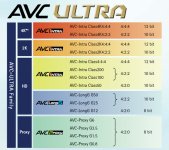
When Panasonic updates their Varicam line with a 6Kish sensor you may get your wish since the Varicam 35 already supports 12 bit AVC-Intra4K444. I don't have experience with it but it's good enough for studios to use for theatrical release.

Since the EVA1 already delivers a supersampled 4K image from it's 5.7K sensor it seems reasonable to expect an updated Varicam would be able to do the same but with 12-bit AVC-Intra4K444 files. Mitch knows what's coming but of course he won't tell.

img_avcultra.jpg
 
When Panasonic updates their Varicam line with a 6Kish sensor you may get your wish since the Varicam 35 already supports 12 bit AVC-Intra4K444. I don't have experience with it but it's good enough for studios to use for theatrical release.

Since the EVA1 already delivers a supersampled 4K image from it's 5.7K sensor it seems reasonable to expect an updated Varicam would be able to do the same but with 12-bit AVC-Intra4K444 files. Mitch knows what's coming but of course he won't tell.

Fingers firmly crossed.
 
Actually Canon says CRL's compression ratio varies from 1/3 to 1/5 which makes sense given that data rate is constant at 1Gbs even when the bit depth and frame rate vary. Uncompressed 12-bit 4K 30p has a data rate 25% greater than that of 12-bit 4K 24p but with CRL that data rate is apparently the held constant for both at 1Gbs, so it stands to reason that the compression ratio must vary.

https://www.canon-europe.com/pro/stories/cinema-raw-light/

See I wish I was as knowledgable about this stuff. But really, I don't care enough to learn the finer points. Makes sense what you say. But does "1/3 to 1/5" equate to 3:1 and 5:1? Once again, my terrible math skills can't translate fractions to ratios
 
Back
Top