FS7: New LOG for FS7

stokstad

Well-known member
Hi,

Coming from the F3 (which is still own) Ive had an FS7 and been doing various assignments with it over the past four months now.


I like S-gamut3.cine.

I don't like Slog3 on the FS7.

So I thought: Why not shoot the lovely gamut but find something better for a gamma-curve?


I like Slog on the F3.

So I thought: Why not make a gamma curve based on Slog but with a slightly bigger range to encompass the DR of the FS7 sensor?

LUTcalc ftw!
I think the result was pretty interesting and possibly something I will use quite a bit.
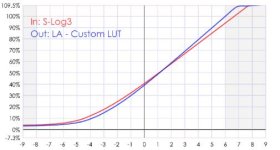
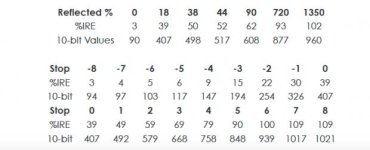
What I did was to make a EI4000 version of Slog3->Slog that does not touch the gamut (so its still untouched Sgamut3.cine) and then lower the highlights so that they reach exactly 109IRE.


The benefits of the new curve:

1. Less noise for compression with essentially the same DR
2. True EI-indications that you can actually push and pull (EI2000 in camera is actually close to ISO2000 instead of ISO1250)
3. Ability to monitor with a bit more contrast and sat while still having a wfm
4. Easier to shoot S&Q since everything looks the same and you can lower the EI to get rid of noise
5. Set the camera presets to EI500, EI1000 and EI2000 and have the full highlight DR in all three (EI1000 is the base and has same brightness as EI2000 in Slog3)
6. In theory better tonality since with added contrast you fill the wfm all the way up to 109IRE in EI2000, 100IRE in EI1000 and something like 90IRE in EI500

Downsides:

1. You don't have all the LUTs for Slog3 but I made a LC709A for the new curve which seems to work as expected.
2. Probably more
3. Im not a Color-Guru
4. I did this in 2 hours
5. I have only tested the results once
6. I dont have time to post images now but below is a link with the LUTs.

Load the LUT ending with MONITOR into your FS7 and apply to all LUT outputs incl. internal recording.
Remember that EI1000 is now your base with EI500 and EI2000 as options, the all look good to me. EI2000 has around the same amount of noise as standard EI2000 Slog3.

https://www.dropbox.com/sh/alwz0ykrkuabzsd/AAAYevThCvKGIbk7dIprm9Zua?dl=0

Please try and let me know what you think!
 
I have not tested it empirically but the new curve shown in the screen grab from LutCalc you included in the zip file folder shows loss of nearly 2 full stops of DR. Or am I missing something?
 
What's wrong with slog3?
Funny that it's specifically you who replied, because weren't the extended range gammas you were a big advocate of at some point pretty much the same thing? I guess big difference being that the other method manipulated the LC709c LUT.
 
1. Slog3 has alot of noise for compression to handle, giving macroblocking and other artefacts esp. in S&Q mode.

2. Slog3 is hard to expose without a LUT (which takes away the wfm) on fast paced jobs.

3. Slog3 use a smaller range of tonality from the 10bit container because its not designed for the sensor but a future, better one.
 
The DR is the same but the stops in the shadows are recorded as darker shades. In my test you lift them for an image just like slog3.

It might be better to record a lut with slog2 and keep the sgamut3.cine I will have to try it out a bit more :)
 
1. Yeah, don't get any black areas in your S&Q! I always over expose (if I can) by at least 1 or 2 stops equivalent to shooting at 500 iso.

2. I have waveform and LUT in all modes I shoot in (except S&Q). I've never had an issue shooting SLog3 and find it very easy to expose, in fact, it makes you lazy.

3. Slog is designed to capture the full DR from the current sensors. If you're having issues with posterisation you're probably shooting a scene with minimal DR like a white cat in the mist. Under these circumstances a LUT or even HG curve is preferable to fill up your 10 bit bucket.

I'd love there to be LUTs in CUSTOM Mode along with SGamut3.cine and to be able to load a LUT and modify it with the PAINT menu controls and WB etc. You can't have it all at this price though...
 
1. Yesterday I shot some backlit midshot portraits with ppl wearing black shirts, try exposing that without getting noise that ruins compression. The problem is not crushing the blacks in post its the XAVC-I not being able to handle very much in 100fps-mode. So I rather have a clean image that compress what I actually want to use.

2. I guess I meant user3D LUTs, the 709(800%) seems to work fine with wfm, which is great!

3. Or shoot with a curve that has all the range but with enough tonality (using the wfm all the way up to 100IRE) so that you dont have to worry about switching curves ever.

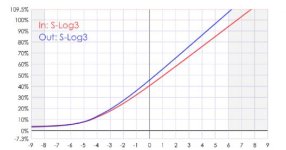
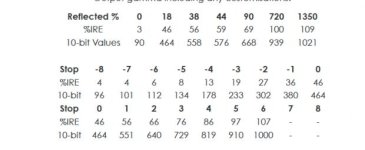
I have made another version that is more close to slog3 but with a curve that has a sweetspot at EI1250 and a pushed alternative at EI2000.

https://www.dropbox.com/sh/alwz0ykrk...dIprm9Zua?dl=0

Skärmavbild 2016-06-22 kl. 12.14.05.jpgSkärmavbild 2016-06-22 kl. 12.14.25.jpg
 
And in EI2000 you get a better lowlight option, pushing the "none-noisy" parts of the image up (without clipping more highlights than in EI1250) but leaving the noisy parts in the the same area as regular slog3:

Skärmavbild 2016-06-22 kl. 12.17.47.jpgSkärmavbild 2016-06-22 kl. 12.17.56.jpg
 
I like the go-getting Edvard, but as someone who spent 12-18 months of my life chasing ways to combine SGamut3.cine and SLOG2 (in order to get the very best I believed the sensor had to offer), my honest recommendation would be to move on and simply accept SLOG3 as your new overlord.

Is it a little frustrating? (Existentially) I'd say yes. But working in SLOG3/SGamut3.cine, gives you the best colours the camera has to offer, and the smoothest workflow for grading that there is. And that little bit of bit depth you lose? It's the single most compressed part of the curve, so you really are giving up very little.

SLOG3 might not be technically ideal, but it provides the most consistently appealing results, in the broadest range of situations (particularly when you're handing over footage for someone else to grade).
 
2. Slog3 is hard to expose without a LUT (which takes away the wfm) on fast paced jobs.

Since FW 3.0 it is possible to display WFM while LUT is displayed but not burned in. When it's set this way it shows levels of the LUT'ed signal - exactly how Cine EI was designed.
 
2. Slog3 is hard to expose without a LUT (which takes away the wfm) on fast paced jobs.
.

I sure don't understand that statement. In my opinion, both S-LOG2 and S-LOG3 are easier to expose without a LUT. Been shooting with S-LOG and RAW for well over three years now and never used an MLUT once.
 
I sure don't understand that statement. In my opinion, both S-LOG2 and S-LOG3 are easier to expose without a LUT. Been shooting with S-LOG and RAW for well over three years now and never used an MLUT once.

That's odd that you don't understand. By its nature LOG means you are just looking at a storage format with low contrast which means changes in exposure are naturally minimized in appearance and color is extremely difficult to judge. It's always easier to expose something correctly for a final look if you can see an image on set that is closer to your final look...

You can very easily be under/over by a stop or have your white balance be off without noticing it on monitor if you are only looking at SLOG3. Yes you can just ETTR and use histogram/scope but that doesn't really tell you if you're going to need to fix exposure in post to match the actual look if you aren't actually looking at it with the look you eventually intend to apply.
 
Well, you clearly don't understand how S-LOG can be used quite effectively without a MLUT. And since I'm not exposing just by how I think a shot looks on my monitor or viewfinder, and I have no reason to make color judgments on set, then viewing a "look" that is closer to final has no value to me. None at all. You could give me a B&W viewfinder and monitor and it would not slow me down one second or change how I used the camera. In fact, the bad habit of exposing just by eye can often lead to misjudgments and needless second-guessing because of variable ambient light conditions, poor monitor calibration, and so forth. So you can have your way of using MLUTs if that works for you, but I'll continue to use my own menthod, which I know without any doubt works better for me. Look, I didn't post to start a argument about who's way of exposing is better than the other guy's (there are many ways to skin a cat), but I don't understand how anyone who claims to know how to expose properly would say that not using an MLUT makes it harder. That is patently false. So, yeah, you may think it is odd, but I don't understand why someone would say that.
 
That's odd that you don't understand. By its nature LOG means you are just looking at a storage format with low contrast which means changes in exposure are naturally minimized in appearance and color is extremely difficult to judge. It's always easier to expose something correctly for a final look if you can see an image on set that is closer to your final look...

You can very easily be under/over by a stop or have your white balance be off without noticing it on monitor if you are only looking at SLOG3. Yes you can just ETTR and use histogram/scope but that doesn't really tell you if you're going to need to fix exposure in post to match the actual look if you aren't actually looking at it with the look you eventually intend to apply.

So in order to expose film (35mm, 16mm) you'd need a visual reference on a monitor to judge exposure?
 
1. Slog3 has alot of noise for compression to handle, giving macroblocking and other artefacts esp. in S&Q mode.

2. Slog3 is hard to expose without a LUT (which takes away the wfm) on fast paced jobs.

3. Slog3 use a smaller range of tonality from the 10bit container because its not designed for the sensor but a future, better one.

Hi Edvard

Point 1. Yes if you under expose (as I experienced in my first attempts with S&Q when I first got the FS7 last Feb). But can't say I've seen noise and microblocking bringing this back with a standard LUT under the conditions I describe below and I really do love contrast for effect.

Point 2: Zebras? I shoot almost exclusively Slog3 CineEI with a MLUT using Zebras and have always got excellent results - even in S&Q. WFM is handy but in the eyepiece viewfinder is almost impossible (for my old eyes) to get an accurate quick exposure. I was shooting Spitfire fly bys last week. Set desired exposure using Zebra for background sky and everything else followed (except the Spitfire moving at 300 Knots at 300 feet AGL). Have you tried Zebras? Did I miss this in the thread?

Point 3. I really do need to get myself a pair of pixel peeping googles as I just don't see these micro variations. But everyone has their opinion and I'm happy to be educated in ther finer magical arts.
 
The only times I have had an issue with macro blocking is shooting raw 240fps.

You should never be judging exposure by eye.
 
Thank you all for the feedback!
Im def. not seeing this as something to replace slog3 with altogheter since many workflows move around that curve and its a great way to keep consistency. I have a few tweaks left on the low part of the curve trying to get the lum.levels to be similar to slog3. Then I have another option to experiment with atleast :)

hehe this forum always seems to get to the "how to expose" argument. Im not very inclined to get into it more than that I do use zebras and wfm and luts in various configurations depending on the shoot. The issue for me is rather one of general approach coming from the f3 where you are imo more creatively free to expose over/under. So basicly my curve is all about underexposure looking better and without as much noise for compression to handle.
 
S-gamut3.cine is not the best for colors because the gamut is not as large as s-gamut or s-gamut3, or bt2020. S-gamut and S-gamut3 are about the same so that makes S-log2 viable as well; the gamma with its full 10 bit recording depth you get the most shades. It has to be adjusted to bring the primaries inline with 709.

As long as you expose with middle gray at its rightful place for the gamma or lut, you are covered for the most latitude in post but exposing by eye is folly.
 
Back
Top