New Blackmagic Camera July 16th?

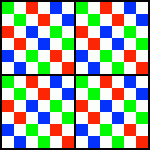
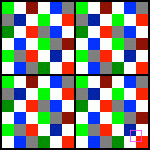
But the photosites are half the size ? So you get 36 photosites where you used to only get 4 ? Josh’s great diagram above helps you visualise that...

So in the same AREA you get equal colour channels made by more pixels and you get white ones too.

JB

At the state fair, for 12 tickets you can toss a ping pong ball at an array of goldfish bowls, but not every toss wins a fish. Some of the photons don't land inside the buckets.
 
At the state fair, for 12 tickets you can toss a ping pong ball at an array of goldfish bowls, but not every toss wins a fish. Some of the photons don't land inside the buckets.

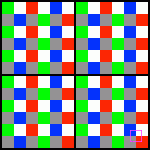
Yes, but at the fair they don't have big funnels (microlenses) attached to each goldfish bowl. :)

Gapless microlenses (with no gaps even between the microlenses) have been available in consumer sensors for about 12 years now: https://www.ephotozine.com/article/digital-camera-image-sensor-technology-guide-16808

This will only really be a problem when there is less light. When there is less light, there are less photons and some are not going to get through the colored filters on the sensor. The filters are literally going to absorb a lot of the photons.

However, this is mostly negated by the use of clear (white) sensor elements that will not absorb any photons.

If you had missed it earlier, look at the low light difference between Bayer and RGBW: http://image-sensors-world.blogspot.com/2020/07/image-algorithmics-on-rgbw-color-filter.html
 
Now, I would still ask for a further improvement in future sensors: a 6x6 RGBWK pattern with 6R, 6G, 6B, 12W, and 12K photosites, where the K ones have no color but instead are covered by a neutral density filter absorbing, say, 5 stops of light. Could this allow us to get A LOT more DR out of the highlights of the image? (the current RGB tints allow something similar to this, but for just 1-2 stops of highlight recovery through clever debayering algorithms) (the K thing with 5 stops of ND makes the last 3 stops of recovered highlights totally monochrome, or at least very desaturated, unless even more clever algorithms are used to infer some color information)

It seems like a good idea in theory. I think the issue might be that as you saturate the sensor, only 1/4 of the sensor elements are going to be getting a signal that is not blown out and that sensor element is only capturing grayscale, so you might only be left with a black and white image or one with really inaccurate color. So, if you did this, you might want to do just a small amount of ND (blocking double or 1.5x of what the colored filters are naturally blocking.)

And you would want half of the white pixels to have ND on them like this:

RGBW6by6LargeGray.gif
 
You are both right that I was totally wrong, but I think we can still do better than the comparison you suggest...

Let's try again:

If we compare this 12k sensor with a 6k Bayer sensor, for every old pixel you now get four smaller pixels covering the same area
a new 12x12 area with 24R, 24G, 24B, 72W, corresponds to an old 6x6 area with 9R, 18G, 9B ---> the much higher resolution definitely shows!

Comparing the new 12k sensor with an 8k Bayer sensor:
a new 6x6 area with 6R, 6G, 6B, 18W, corresponds to an old 4x4 area with 4R, 8G, 4B --> similar color resolution to an 8k sensor, but better distribution across R,G,B

Very nice sensor pattern, working thanks to the insane sensor resolution!

Now, I would still ask for a further improvement in future sensors: a 6x6 RGBWK pattern with 6R, 6G, 6B, 12W, and 12K photosites, where the K ones have no color but instead are covered by a neutral density filter absorbing, say, 5 stops of light. Could this allow us to get A LOT more DR out of the highlights of the image? (the current RGB tints allow something similar to this, but for just 1-2 stops of highlight recovery through clever debayering algorithms) (the K thing with 5 stops of ND makes the last 3 stops of recovered highlights totally monochrome, or at least very desaturated, unless even more clever algorithms are used to infer some color information)

edit: something like this:
View attachment 139771

I believe they already do your k pixels by summing the combined RGB :-)

So there’s two “exposures” for a HDR like image and there’s extra sensitivity based on the W pixels.

JB
 
Yes, but at the fair they don't have big funnels (microlenses) attached to each goldfish bowl. :)

Gapless microlenses (with no gaps even between the microlenses) have been available in consumer sensors for about 12 years now: https://www.ephotozine.com/article/digital-camera-image-sensor-technology-guide-16808

This will only really be a problem when there is less light. When there is less light, there are less photons and some are not going to get through the colored filters on the sensor. The filters are literally going to absorb a lot of the photons.

However, this is mostly negated by the use of clear (white) sensor elements that will not absorb any photons.

If you had missed it earlier, look at the low light difference between Bayer and RGBW: http://image-sensors-world.blogspot.com/2020/07/image-algorithmics-on-rgbw-color-filter.html


Yep.

In the state fair fable, some of those buckets have coloured masks that make it harder for a photon to fit into that bucket.

The W pixels are more than twice as wide as those.

JB
 
John - what was the make-up like on the models in your test? And just to confirm - you used no diffusion, correct?
 
John - what was the make-up like on the models in your test? And just to confirm - you used no diffusion, correct?

No diffusion used, though I have a diffusion test I’ll show later.

Make up was self applied by the models and I asked for “minimal”. I know that neither of the guys had anything on.

JB
 
Christ this is cool. You must have to pick a specific set of DNAs. I don't understand how there's any standardization here:

"DNA is a completely new concept in lens development, pioneered by ARRI Rental in collaboration with visually ambitious cinematographers. Sourcing vintage optics from different historical periods, we embrace unusual image attributes that arouse an emotional response.

Selected optics are rehoused into modern lens casings, with the manufacturing carried out in-house at ARRI Rental. Each lens has its own personality, often customized for individual filmmakers, allowing stories to be told with a new visual boldness."

This is a hark back to the boutique nature of high end production. Panavision New York used to keep a 300mm on the shelf with Gordon Willis' name engraved on the case. Because he was the only one who got to use it.
 
Botched that explantion a bit. Here's how Arri words it:


Example:

You change ISO from 800 to 400. The picture becomes darker. You open the iris 1 stop. The brightness returns, but because you are now putting 1 more stop of actual brightness onto the sensor, you lose one stop of actual highlight latitude. That's what the over/under charts inform you about.

Yes but different manufacturers handle this in different ways. ARRI is a simple slide up and down the exposure range, but with Canon camera the range is actually shifted using different gains. Not all RAW are created equal.
 
This is a hark back to the boutique nature of high end production. Panavision New York used to keep a 300mm on the shelf with Gordon Willis' name engraved on the case. Because he was the only one who got to use it.

Panavision has a 50mm T1 that is “Mandys”

JB
 
This is a hark back to the boutique nature of high end production. Panavision New York used to keep a 300mm on the shelf with Gordon Willis' name engraved on the case. Because he was the only one who got to use it.
Panavision still does this kind of custom lens development. Here's an article about the lenses they did for The Force Awakens:
https://www.panavision.com/panavision-designs-lenses-mindel-star-wars-force-awakens

Apparently J.J. Abrams was originally interested in finding some of the vintage lenses used on the original Star Wars films, but they eventually decided that even if they could track them down, they probably wouldn't hold up well to modern digital production. So Panavision created a new set of lenses to try and capture a similar look.
 
I believe they already do your k pixels by summing the combined RGB :-)

So there’s two “exposures” for a HDR like image and there’s extra sensitivity based on the W pixels.

JB

That provides a boost of 1-2 stops of DR, what I'm suggesting is adding a few darker k pixels that allow for an even bigger boost... but I say this knowing that the RGB pixels will saturate before the k ones, so there's no color information in the areas recovered solely from the k pixels, which means clever algorithms must be needed in order to make this work in practice, and making it work well enough may not be possible at all. Dividing those six k pixels into 2r, 2g, 2b, with color filters but much darker than the regular RGB pixels, would solve this, providing 3-4 stops of extra highlight recovery with lessened resolution, but then you have 7 channels to debayer from and I don't know how much of a nightmare that may be (perhaps it's a pain but still less pain than the guesswork with k pixels). The good thing about this is that it's only a change in the CFA and the algorithms, the silicon doesn't need to change, since the 12k sensor has such insane resolution to begin with.
 
Setup a Hackintosh drive specifically to try the BETA and sample footage out - well worth the time to experience the out of this world footage - and 12k works well on a 2014 machine! (i7 4790, Z97, 1TB M2 SSD, 32Gb RAM, AMD Radeon 8Gb) - Blackmagic lept on the cutting edge with their innovations, outdoing Sony, Canon and other behemoth corporations! They are the new RED in my eyes, minus the BS! I'm no pro let alone an expert in this, looks like useable Dynamic Range is comparable to the original pocket (which I own) - I stand to be corrected of course.

Thanks JB for this thread!
 
Last edited:
It seems like a good idea in theory. I think the issue might be that as you saturate the sensor, only 1/4 of the sensor elements are going to be getting a signal that is not blown out and that sensor element is only capturing grayscale, so you might only be left with a black and white image or one with really inaccurate color. So, if you did this, you might want to do just a small amount of ND (blocking double or 1.5x of what the colored filters are naturally blocking.)

And you would want half of the white pixels to have ND on them like this:

that's way too many k photosites, I don't think I need such vast resolution in the recovered highlights - plus I'm thinking more about this and the lack of color information reduces the usefulness of the extra DR

but the insane resolution of this sensor can allow a color version of this as well, with an RrGgBbWk color filter array, if BRAW and the enconding and debayering algorithm set allows for an 8-channel sensor

but the gains could be great: make the rgbk shades six stops darker than the RGBW shades and you're adding another 4+ stops of highlight recovery over what the RGBW model is doing

such a new world of options when you can make a big 12k sensor that is read in 15ms and is paired with a codec designed for this kind of stuff!!!


Comparison of the resolutions from this RrGgBbWk array compared with a 6k Bayer RGB sensor:
a new 12x12 area with (16R, 16G, 16B, 48W, 8r, 8g, 8b, 24k) corresponds to an old 6x6 area with 9R, 18G, 9B ---> still much higher resolution in the normal range, and comparable to 6k in the recovered highlights!!
The downside is that you're devoting a third of the sensor area to the highlight recovery part, so you'll get more noise in the standard range, which means you probably want to rate the sensor to ISO 600 or so, instead of 800 (so you throw more light into the sensor, which is not going to be a problem because you have the new highlight recovery part)

RGBW6by6Large.gif
 
Last edited:
John - did you notice a need for an IR Cut in front of the sensor or was it good enough for you? I know you are rocking Rawlite filters in front of your G2s.
 
Back
Top